
You're home the same afternoon, your leg feels sore and a little tight, and you're staring at a discharge sheet wondering what's normal tonight, tomorrow, and next week. That's the point where good radiofrequency ablation after care matters most. It's not just looking after a tiny dressing. It's a structured surveillance period where you walk, watch how symptoms change, and confirm the treated vein has closed.
One source of confusion helps to clear up first. Radiofrequency ablation can mean different procedures in different parts of the body, and their instructions aren't interchangeable. The guidance here is for endovenous treatment of a leg vein, so match every rule to the procedure you had and to what your physician wrote down for you.
Table of Contents
- Recovery Timeline From Day One to Week Four
- How Long to Wear Compression and When to Stop
- Activity Limits for Walking, Work and Travel
- How to Care for Puncture Sites and Manage Pain
- Expected Symptoms Versus Warning Signs
- When Follow-Up Ultrasound Is Needed
- Confirm Your Follow-Up Plan Before You Leave
Recovery Timeline From Day One to Week Four
After an endovenous vein procedure, your first days are a period of observation as well as recovery. You are usually encouraged to walk the same day, using short, frequent walks to support circulation while the treated vein closes. Prolonged sitting does not provide the same movement.
The timeline depends on the specific procedure and your physician's instructions. Many patients return to normal daily activities within a short period after minimally invasive treatment, while changes in vein symptoms may take several weeks to become noticeable. For example, less leg heaviness alongside lingering bruising can fit a gradual recovery.
How the Four Weeks Usually Unfold
| When | Care Focus | Expected Milestone |
|---|---|---|
| Day of procedure | Walk short distances; follow your instructions for dressings and compression | Walking tolerated without sharp leg pain |
| Days 1-2 | Take several short walks; use pain relief as directed | Soreness easing day by day |
| Days 3-7 | Continue walking; follow your procedure-specific care instructions | Bruising beginning to fade; tenderness may remain |
| Days 8-14 | Resume daily tasks as tolerated; limit strenuous exercise if instructed | Tenderness along the treated vein gradually easing |
| Weeks 2-4 | Build activity back according to your physician's guidance; attend planned follow-up | Symptoms improving; closure may be checked by ultrasound |
On the day of treatment and during the first couple of days, soreness and bruising may be most noticeable. Keep puncture sites and dressings in line with your written directions, and take several short walks around the house or outside. A steady reduction in soreness is generally more reassuring than expecting it to disappear at once.
During the first week, bruises can look darker before they fade, and the treated vein may feel tender or firm to the touch. These changes can be part of healing, but the schedule varies with the procedure. Radiofrequency ablation refers to treatment using heat inside an unhealthy vein, yet the exact approach and aftercare rules may differ. Follow the instructions for the treatment you received rather than borrowing another patient's routine.
By days 8 to 14, many everyday tasks may feel manageable, although tenderness can linger. Over weeks two to four, activity is generally increased gradually, with any restrictions guided by your physician. A follow-up ultrasound may be used to confirm that the vein has closed. Improvement is usually gradual: symptoms should be moving in the right direction, and new or worsening symptoms merit a call to your care team. Use this timeline as a general guide, not a substitute for your individual instructions.
How Long to Wear Compression and When to Stop
After radiofrequency ablation, compression is one part of follow-up, alongside checking how your leg responds and following any procedure-specific instructions. “Radiofrequency ablation” can refer to different procedures, so the right schedule depends on what was treated and your symptoms. Swelling or a wound may also affect whether ongoing support is recommended.
The NICE guidance on varicose veins says compression bandaging or hosiery, when prescribed after an intervention, should generally not continue beyond the period described in the recovery timeline. Your provider can explain whether compression is appropriate for your procedure, which level to use, and how long to wear it. The same care plan may include follow-up checks, such as ultrasound, to assess the treated vein. Avoid changing to a stronger or weaker stocking on your own.
A Practical Daytime Routine
- Put stockings on in the morning: Wear them during the day if your instructions call for it.
- Remove them for sleep if advised: Ask your provider whether to wear them overnight.
- Choose the right fit and level: The guide to compression stockings for chronic venous insufficiency explains why fit and compression level matter.
Pay attention to how your leg and foot feel while wearing a stocking. Call the same day if you notice numbness, tingling, a change in foot colour, or new calf pain. The stocking may be too tight, bunched, or unsuitable for your leg.
A leg that feels better does not automatically mean you should stop early. Continuing longer than instructed can also irritate the skin. If the stockings feel itchy or difficult to tolerate in the heat, do not fold down the top or substitute a weaker pair. Contact your provider to review the fit or fabric.
Practical rule: Follow the schedule on your discharge paperwork. If you are unsure when to stop, ask your provider rather than guessing.
Activity Limits for Walking, Work and Travel
Walking is the activity you shouldn't restrict. Most patients are encouraged to walk soon after treatment, and short, regular walks are part of recovery, not a risk to it. What may need a pause is different. Patients may be asked to temporarily limit strenuous exercise or certain activities after treatment, and we set that timeline for you.
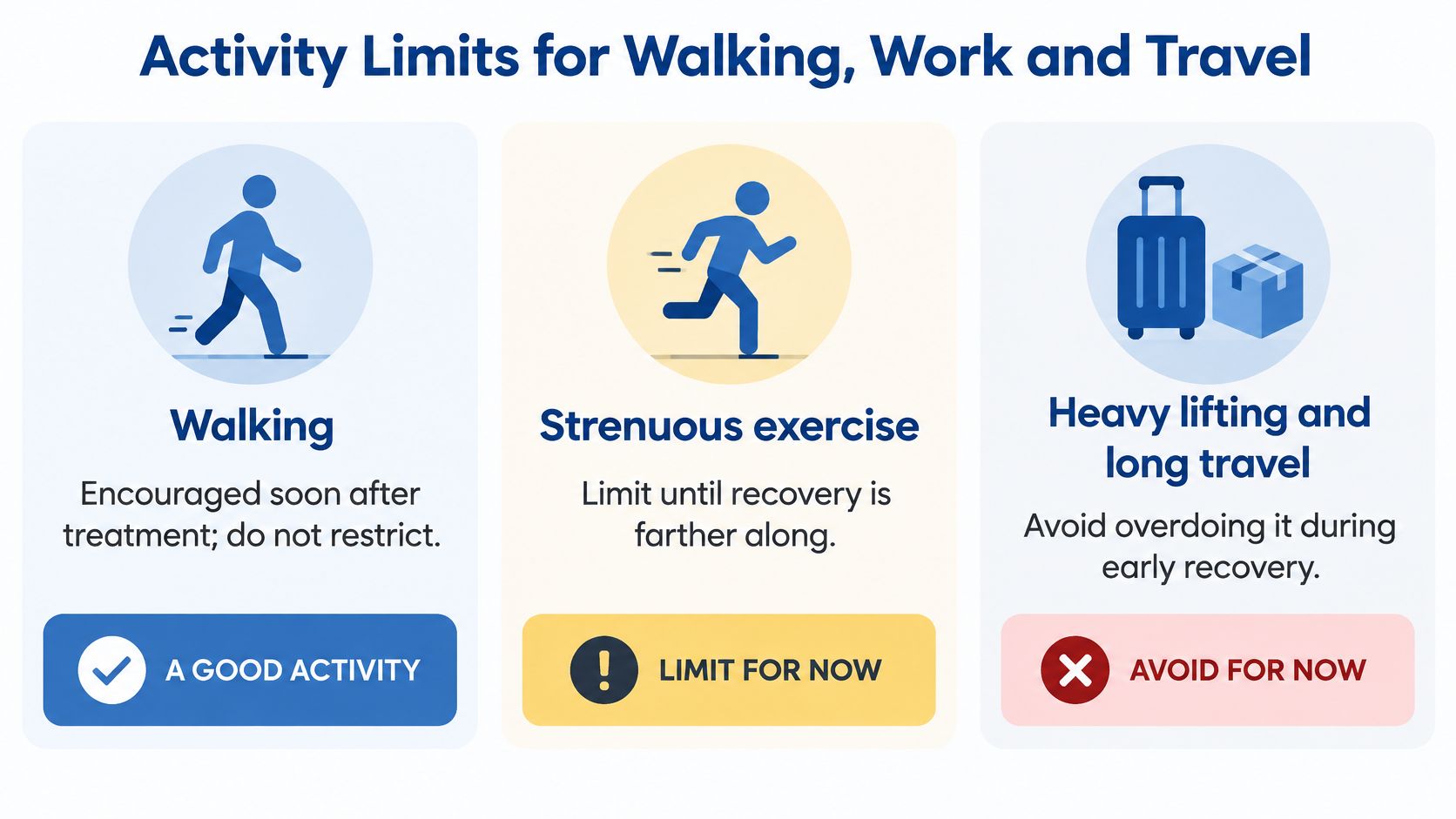
A clinical reference on radiofrequency ablation describes expected soreness for 3 to 14 days and commonly cited activity restrictions of 24 to 48 hours. An NHS patient protocol for a different radiofrequency ablation context advises avoiding strenuous exercise and driving for a week. That contrast shows why you can't borrow a timeline from another type of ablation.
| Activity | Usually allowed | Wait for clearance |
|---|---|---|
| Walking | Yes, encouraged soon after treatment | Not restricted |
| Desk work | Yes, with a position change every hour | Not restricted |
| Driving | Only if no sedation was used and movement is comfortable | Ask provider first; arrange transport if sedated |
| Strenuous exercise | Light activity as tolerated | Hold until the provider clears you |
| Heavy lifting | Light lifting only | Hold until cleared |
| Air travel | Possible after review | Ask provider; move around on long flights |
| Prolonged standing or sitting | Break it up every hour | Limit long shifts until cleared |
Driving after a procedure depends on the procedure and on whether a sedating medication is used. If a sedating medication is used, you must arrange transportation home. For desk work, long drives, flights, or jobs on your feet, change position every hour, walk a short loop, and flex your ankles while seated.
Longer restriction isn't automatically safer. Staying inactive can undermine mobility and circulation, while paced walking supports both. If you have chronic venous insufficiency, obesity, limited mobility, or wound care needs, ask for an individualized activity and compression plan rather than following a generic calendar. Resume each activity when we clear it, not because a set number of days has passed.
How to Care for Puncture Sites and Manage Pain
Minimally invasive procedures generally use very small access points. Temporary bruising, tenderness, or swelling can occur, while significant scarring is uncommon. After a vein procedure, you may be asked to wear compression, avoid strenuous exercise for a period of time, and follow specific bathing or wound care directions, and instructions vary by procedure.
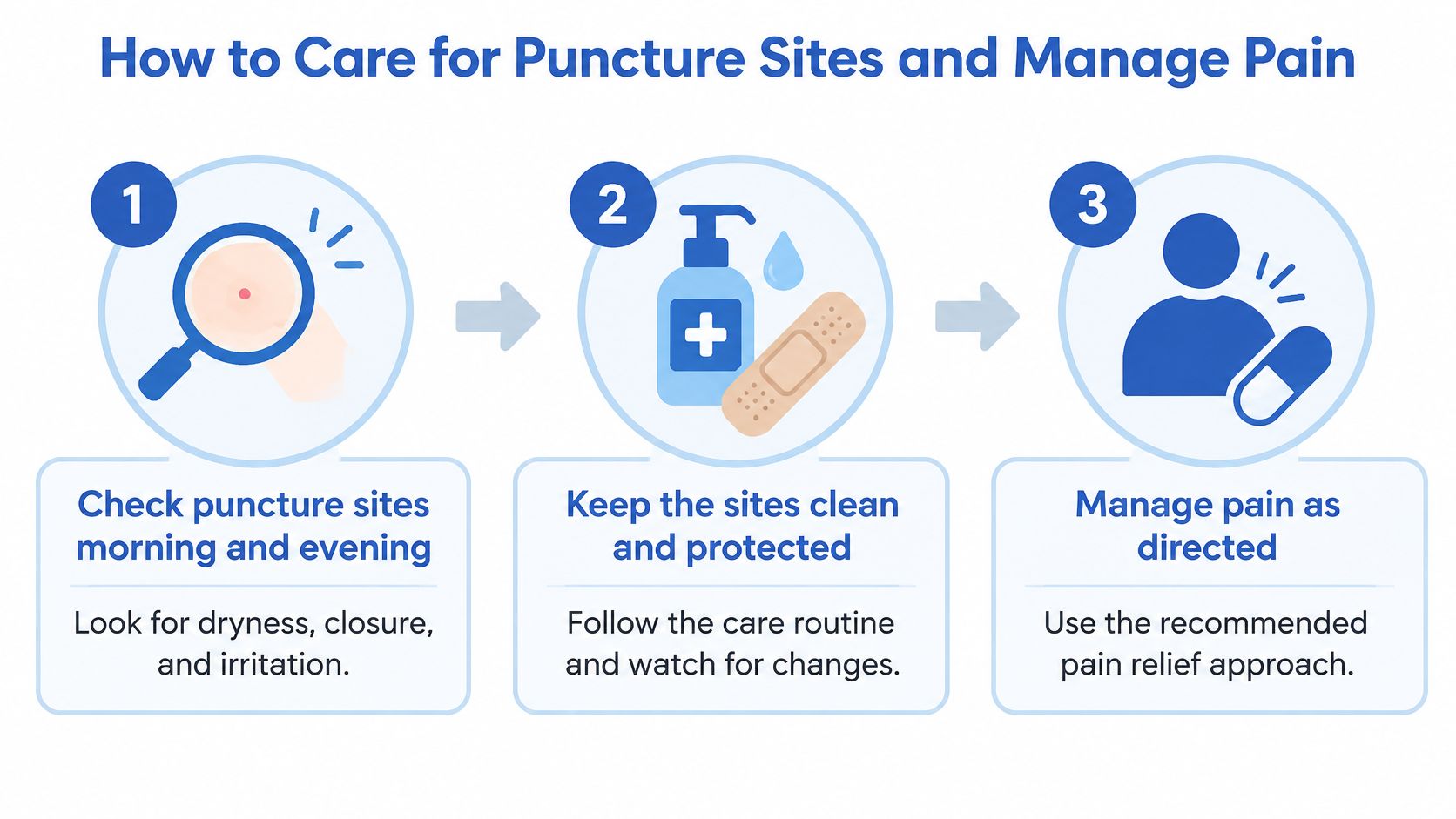
Your Daily Routine in Six Steps
- Check each access point morning and evening. Look for dryness, closure, and irritation. A calm, dry site each day tells you healing is moving in the right direction.
- Keep the dressing clean and dry. Change it only as instructed, with clean hands. A damp or dirty dressing raises infection risk, so call us if it gets soaked.
- Follow your bathing directions exactly. Showering is usually allowed once sites are closed and we say so. Soaking in a bath, pool, or hot tub waits until the sites have healed, because prolonged soaking softens closing skin.
- Expect bruising along the treated vein. It can spread or darken for several days before fading, and the vein may feel like a tender cord. A cool cloth wrapped in fabric can ease discomfort if we approve it. Don't apply heat unless told to.
- Use only the pain relief we recommend. Take the analgesic and dose on your paperwork, and don't combine medications without asking. Some products interact or duplicate the same ingredient under a different brand name.
- Keep a simple daily note. Write down pain, swelling, and how each site looks. That log shows whether you're following the expected pattern and gives us real detail at follow-up instead of a guess from memory.
Healthy bruising is tender but gradually fades and doesn't feel hot. A site that's increasingly red, hot, swollen, leaking pus, or spreading doesn't fit that pattern and needs a call. Say your bruise is large on day three but pain is lower than day two and the skin isn't hot. That's usually reassuring. If pain climbs while redness spreads outward, treat that change as the signal.
You're doing well when pain falls over days and the sites look calmer at each check, even if bruising is still visible.
Expected Symptoms Versus Warning Signs
A leg may feel tender, bruised, or mildly swollen after radiofrequency ablation, but the direction of change matters. The NICE evidence review on radiofrequency ablation of varicose veins found that fewer than 5% of patients still reported symptoms such as leg pain, fatigue, edema, or visible varicose veins after treatment. The review's complication rates varied by study and technique, so these figures provide context rather than a prediction for an individual.
In the same NICE evidence review on radiofrequency ablation of varicose veins, skin burns were reported in approximately 2% to 7% of patients, abnormal sensations or paraesthesia in 0% to 15%, and clinical phlebitis in roughly 2% to 3%. Deep-vein thrombosis was reported at about 1%, while pulmonary embolism was reported at below 1%. These uncommon complications are reasons to watch for changes, not signs that they will happen to you.
| Symptom | Usually Expected | Contact Clinic Same Day | Seek Emergency Care |
|---|---|---|---|
| Bruising and tenderness along the vein | Yes | If spreading or darkening rapidly | No |
| Mild swelling that eases day by day | Yes | If it stops improving after several days | No |
| Numbness or tingling in the leg | Sometimes, often temporary | If it persists or spreads | No |
| Skin burn, blistering or hot red streak | Uncommon | Yes | No |
| One leg swelling rapidly with severe calf pain | No | Urgent assessment | If severe or with breathing symptoms |
| Chest pain, shortness of breath or fainting | No | No | Yes, call emergency services now |
A hot, tender cord along the treated vein can reflect phlebitis and warrants clinical assessment, even if walking is still possible. Rapid swelling in one leg with severe calf pain also needs urgent attention. Do not try to manage suspected clotting with extra compression, heat, or medication you already have. The guide to possible side effects after endovenous laser ablation describes warning patterns associated with another heat-based vein procedure; aftercare instructions can differ because “radiofrequency ablation” may refer to procedures with different details.
Use the pattern of change to guide your response. Symptoms that gradually ease are more reassuring than symptoms that are new or rapidly worsening. Contact your clinic the same day if a symptom worsens; for chest pain, shortness of breath, or fainting, call emergency services immediately.
When Follow-Up Ultrasound Is Needed
A week after treatment, the puncture can look quiet while the vein underneath is still changing. This stretch of aftercare is a surveillance period: the goal is to confirm that the treated vein stayed closed and to look for clot extension when risk or symptoms justify it, not only to check a dressing. Radiofrequency ablation is one of several vein procedures, and follow-up rules differ by the treatment you had. Your physician sets the timing from that specific procedure.
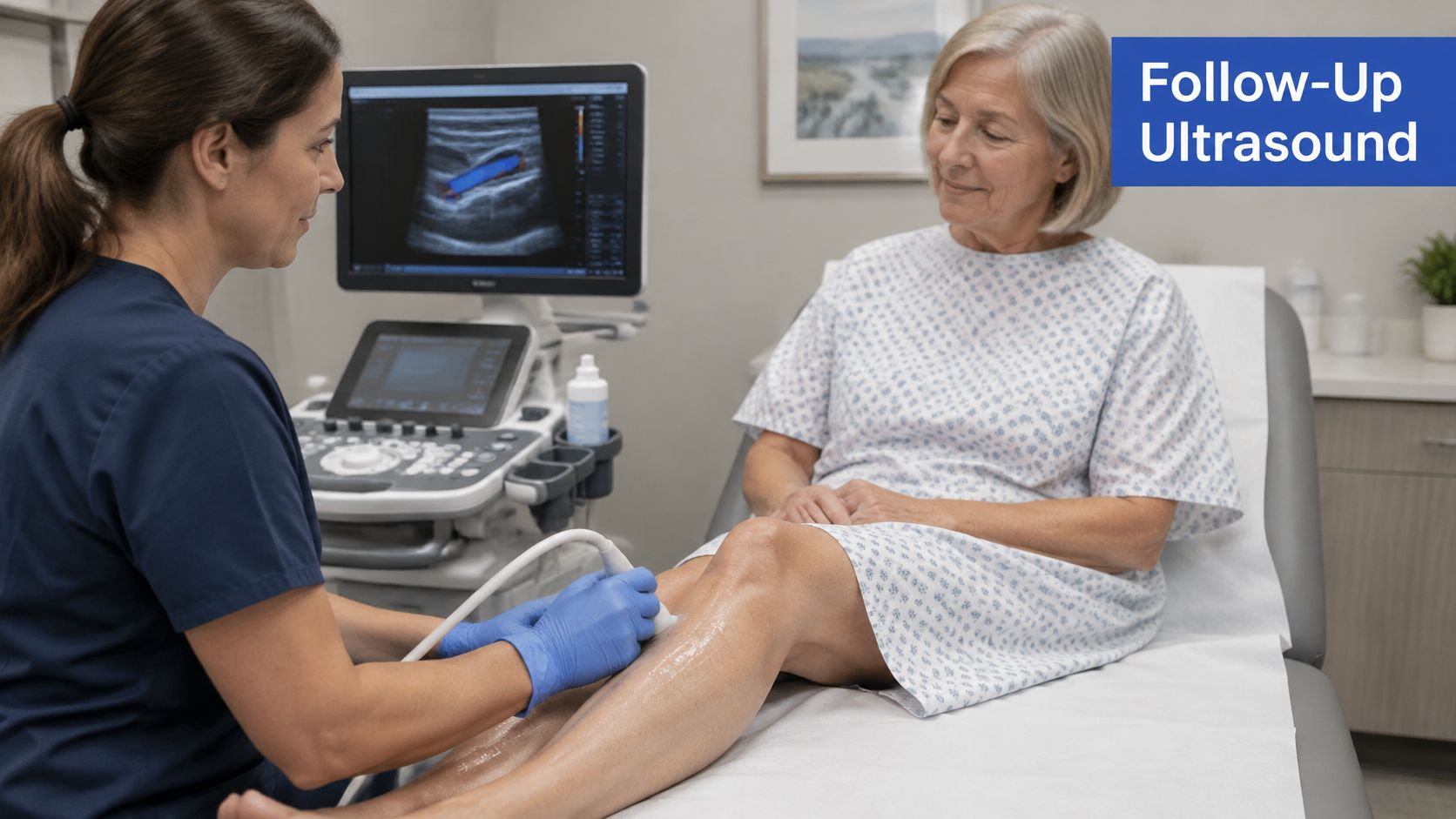
A follow-up ultrasound may be used to confirm that the vein has closed. It can also check for thrombus extending into a deeper vein. Routine ultrasound to exclude deep-vein thrombosis may be unnecessary in low-risk patients after thermal ablation because DVT rates are low, according to the 2025 SCAI guideline summary, which reports thrombus extension into a deep vein in 2.6% of limbs, neuropathy in 6.3% of cases, and EHIT above grade 2 in 5.9%. EHIT means clot related to the heat treatment. Those figures are why the scan decision still depends on your history and exam, not on one schedule for every leg.
A prior clot, limited walking, an active wound, or a large treatment area raises the value of looking sooner. So does a new problem: marked swelling, pain that keeps climbing, or numbness that spreads. Higher-risk patients, and anyone with new symptoms, are often imaged earlier. Lower-risk patients may be scanned later or followed by exam alone. Ultrasound for chronic venous insufficiency shows what duplex imaging can display, including whether the treated segment is closed and how blood moves through neighboring veins.
A closed segment on that scan documents the vein that was treated. If you still have ulcers or edema, keep wearing compression as directed, continue wound checks, and stay alert for recurrence in other veins. The result covers this procedure. It does not clear every vein in the leg for life.
Confirm Your Follow-Up Plan Before You Leave
You are at the desk, bandage on, details already blurring. Leaving with the plan written down turns the next weeks into a structured surveillance period. The name radiofrequency ablation covers procedures with different aftercare rules. Radiofrequency ablation uses radiofrequency energy to heat the inside of an unhealthy vein so it closes and blood redirects through healthier veins. Compression time, activity limits, bathing, and scan timing still follow the procedure you had today.
The same team provides care from evaluation through treatment and follow-up, so the answers you record now should match later visits. Write them on your discharge paperwork before you go. Five questions cover that window:
- Compression: How long should it be worn, and at what level?
- Activities: Which are cleared now, and which wait, including lifting, running, or long flights?
- Duplex scan: Is one planned, and on what date?
- Bathing and wound care: Which directions apply to this specific procedure?
- Escalation: Which symptoms need same-day contact, and what number do you call after hours?
Book the follow-up visit and the scan date before you leave. If you already started the daily note while caring for the puncture sites, bring that note with the discharge sheet. Dr. Shah develops personalized treatment plans focused on improving circulation, promoting healing, relieving symptoms, and helping prevent recurrence, and the note gives that plan something specific to adjust.
When in doubt, call early rather than waiting for the next appointment.
If you're recovering from vein ablation and aren't sure whether bruising, swelling, numbness, or a non-healing wound fits the expected pattern, we can review your symptoms, confirm vein closure, and build a follow-up plan around your circulation. Visit Vein and Wound Institute to request an evaluation and get clear next steps for your recovery.