
Compression can do more than ease heavy legs. For people with venous ulcers, the right pressure can help a wound close, and after healing it can cut the chance of the ulcer returning. That benefit only holds if two conditions are met first. Your arterial circulation has to tolerate the pressure, and you have to be able to put the stocking on and keep wearing it. Treat chronic venous insufficiency compression stockings as a medical prescription, not as tight socks chosen by color or comfort alone.
Table of Contents
- Compression Classes Matched to Venous Severity
- When Compression Stockings Are Not Safe
- Class 2 Versus Class 3 for Preventing Recurrence
- Stocking Types and Venous Ulcer Options
- How to Measure and Fit Compression Stockings
- Wearing Tips and Fixes for Daily Use
- Confirm When to Escalate to Medical Treatment
Compression Classes Matched to Venous Severity
In chronic venous insufficiency, faulty vein valves let blood pool in the lower leg. Pressure inside the veins stays high when you stand, fluid leaks into nearby tissue, and swelling, skin damage, and ulcers can follow. A graduated stocking squeezes hardest at the ankle and gradually less up the calf. That gradient narrows surface veins, helps valves close better, supports the calf muscle pump, and pushes blood upward toward the heart.
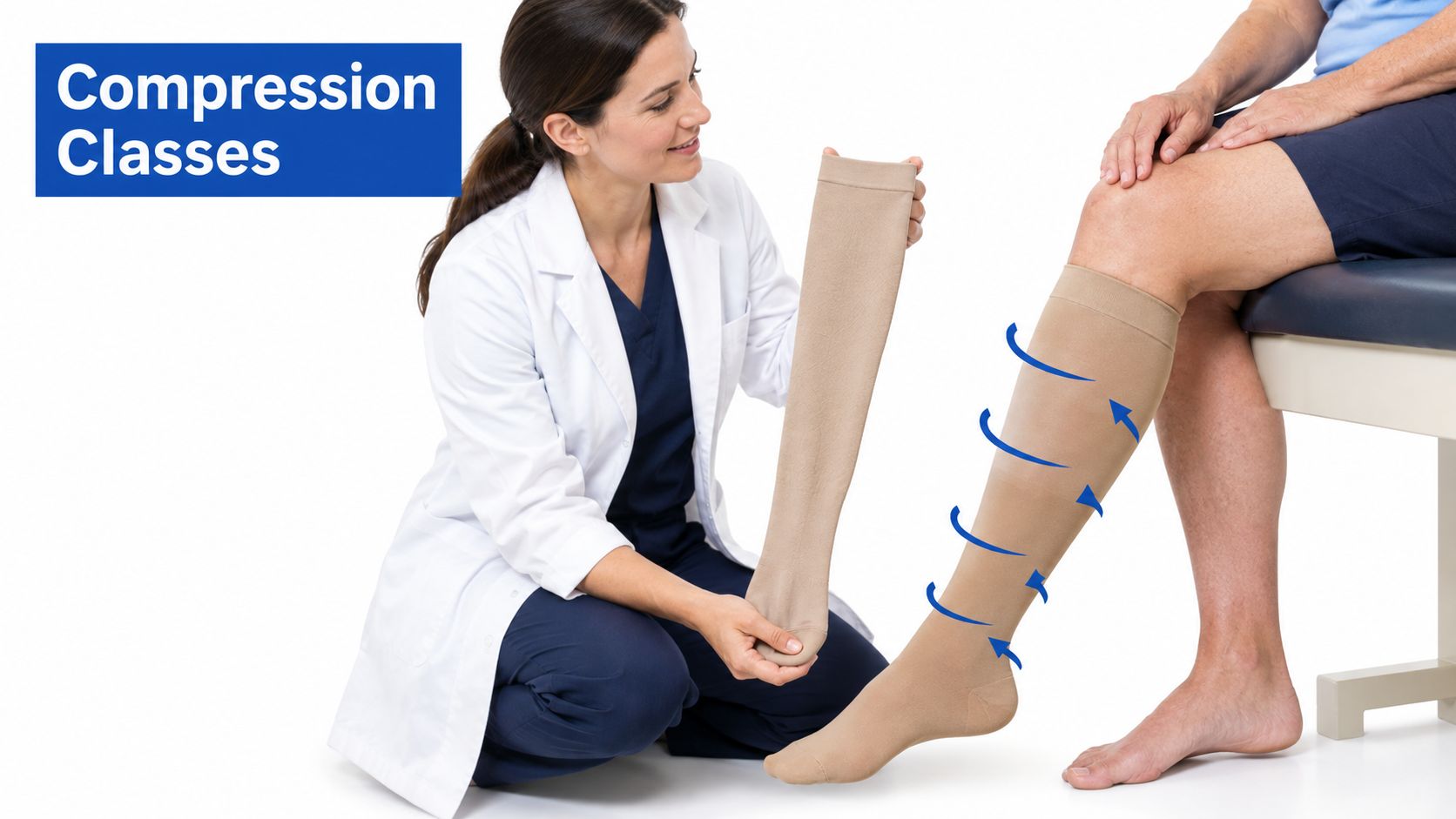
Compression Classes and Typical Use
| RAL Class | Ankle Pressure (mmHg) | Typical Use |
|---|---|---|
| Class I | 18-21 | Mild CVI, small varicosities, symptom relief |
| Class II | 23-32 | Larger varicosities, moderate CVI, venous ulcer prevention in many cases |
| Class III | 34-46 | Severe CVI, venous leg ulcers, recurrence prevention |
| Class IV | Above 49 | Selected severe cases under specialist care |
Those European RAL ranges come from the chronic venous insufficiency chapter in EBM guidelines, which also gives the everyday benchmarks clinicians use beside the classes. About 20-30 mmHg commonly fits mild disease and smaller varicosities. About 30-40 mmHg is used for larger varicosities or moderate to severe disease. For an active venous leg ulcer, strong compression generally means an elastic system delivering at least 40 mmHg at the ankle, once significant arterial disease has been excluded.
If you're unsure how symptoms, vein reflux, and skin changes fit together, our explanation of what chronic venous insufficiency is and how it's treated walks through the underlying problem before you choose a class.
Why the Number Matters for Healing
Compression isn't only for comfort. In the Cochrane review of compression bandages or stockings for venous leg ulcers, compression probably shortened time to complete healing compared with no compression during follow-up of up to 12 months, based on 5 studies involving 733 participants. The same review found compression probably increased the proportion of ulcers completely healed, drawing on 10 studies involving 1,215 participants.
Practical rule: Pick pressure by diagnosis, arterial safety, and daily wearability together. A class you can't apply correctly delivers no reliable pressure at all.
Don't assume two brands with the same label feel or perform identically. Limb shape, fabric stiffness, size, and leg swelling change the pressure delivered at your ankle. Check the manufacturer's pressure data and size chart for the exact garment, then reassess after swelling falls. Pressures above the usual ulcer range are used selectively because long-term tolerance drops, and sore pressure points can undo the benefit.
Say you have small varicose veins, mild evening swelling, and no skin breakdown. You'd usually start in the lower benchmark range rather than jumping to the strongest stocking. Say instead you have a healed ulcer and firm swelling that returns daily. Your clinician may aim higher, but only after confirming arterial flow and checking whether you can don that garment every morning.
When Compression Stockings Are Not Safe
A stocking can support venous blood flow, but pressure must be chosen only after checking that arterial circulation can tolerate it. When arteries are narrowed, firm compression may further limit blood reaching the foot.
Test Arterial Flow Before You Choose a Class
A pulse check alone can miss arterial disease. The Journal der Deutschen Dermatologischen Gesellschaft article on compression safety recommends measuring arterial perfusion with ankle-brachial or toe-brachial pressure testing. An ABI below 0.5 is generally a contraindication to compression. With higher readings, some patients may still need lower pressure and specialist supervision.
Mixed arterial and venous disease calls for an individualized pressure, garment, and monitoring plan. A wound's appearance alone cannot show whether firm compression is safe.
- New or worsening pain: Remove the stocking and seek advice. Increasing pain needs attention.
- Cold, pale, or blue toes: Take the stocking off and get medical guidance, since these changes can signal poor arterial flow.
- Numbness or tingling: Check for folds or a rolled edge. Remove the garment and report symptoms that persist.
- Tightness that does not ease: A stocking should feel firm. A tourniquet-like band above the ankle or below the knee may indicate a fit problem.
Red Flags That Need Assessment First
Sudden one-sided leg swelling, suspected deep vein thrombosis, spreading redness or heat, and breathlessness with fluid overload from heart failure need medical assessment before compression is started. These symptoms may point to problems that require diagnosis and timely treatment.
Ulcers can have venous, arterial, mixed, diabetic, or other causes, and the cause affects whether compression is appropriate. A clinician can assess the wound and decide whether vascular testing is needed before recommending a garment.
If arterial testing indicates that compression should be avoided, follow that guidance rather than choosing a class by pressure target alone.
Class 2 Versus Class 3 for Preventing Recurrence
After a venous ulcer heals, venous pressure can still leave the skin vulnerable to another ulcer. Stronger compression may lower recurrence risk, but the benefit depends on whether the stocking can be worn consistently.
What Stronger Compression Achieves
In the Cochrane review of compression for preventing recurrent venous ulcers, European class 3 stockings reduced six-month reulceration compared with no compression. Recurrence was approximately 210 of 1,000 people using class 3 versus 457 of 1,000 without compression. The relative risk was 0.46 in 1 study of 153 participants.
The review also compared class 3 with class 2. Over follow-up ranging from 18 months to 10 years, recurrence was about 342 per 1,000 with United Kingdom class 3 hosiery versus 530 per 1,000 with class 2, across 5 studies involving 1,314 participants.
The Adherence Cost You Can't Ignore
Higher pressure can be harder to tolerate. In the same Cochrane review, withdrawal was approximately 6.7 percentage points higher in the class 3 group across 5 studies involving 1,372 participants. A stocking left in a drawer cannot prevent recurrence, regardless of its listed ankle pressure.
- Choose class 3 when recurrence risk is high, arterial flow allows it, and you can apply the stocking reliably, with or without help.
- Consider class 2 when it is the strongest option you can wear all day without skin damage or repeated failed attempts.
- Use an interim plan when you are awaiting vascular assessment or cannot yet tolerate high pressure. Your clinician may use reduced compression of 20 mmHg or less, an option described in the PubMed record on barriers to compression use, while determining a safe longer-term approach.
Decision rule: Choose the strongest clinically appropriate pressure you can keep wearing.
If class 3 is difficult to use, address the barrier before stepping down when possible. Better sizing, a donning aid, caregiver training, or a different fabric or length may help. If class 2 makes daily use possible, document that choice and review swelling, skin, and ulcer history at follow-up.
Stocking Types and Venous Ulcer Options
Length and construction matter because they change coverage, grip strength, and toe access. The longest garment available is often unnecessary. Coverage of the affected calf and ankle matters, where venous pressure and ulcer risk are usually greatest.
Stocking Types and Venous Ulcer Options
| Type | Typical Use | Key Note |
|---|---|---|
| Knee-high stocking | Most mild to moderate CVI | Standard fit, covers ankle and calf pump area |
| Thigh-high stocking | Disease extending above the knee | Harder to don, needs more hand strength |
| Open-toe design | Patients needing toe inspection or wider foot fit | Leaves toes visible for color and circulation checks |
| Two-layer hosiery | Appropriately selected venous leg ulcers | Healing 70.9%, median 99 days in VenUS IV |
| Multilayer bandage | Venous leg ulcers under clinic supervision | Healing 70.4%, median 98 days in VenUS IV |
Knee-high is the default starting point for most mild to moderate disease because it's simpler to fit and apply. Choose thigh-high when varicosities, swelling, or the treated vein segment extends above the knee and your clinician wants coverage there. Open-toe styles help if toe shape, nail problems, diabetes foot checks, or a wider forefoot make a closed toe irritating.
The near-identical ulcer results in the table come from the VenUS IV trial report on compression hosiery versus bandaging. Median healing time was 99 days with two-layer hosiery versus 98 days with multilayer bandages. For an appropriately selected patient, hosiery can therefore be a practical alternative, with easier bathing, fewer clinic-applied dressing changes, and more independence.
That independence cuts both ways. Bandaging suits patients who need clinic supervision, frequent wound inspection, rapidly changing leg size, or help they don't have at home. Hosiery suits patients who can apply both layers smoothly and keep the wound dressing undisturbed. If you're comparing wound appearances, our guide to the key differences between venous and arterial leg ulcers explains why cause matters before either option is used.
How to Measure and Fit Compression Stockings
Measure the leg you'll treat, not your usual sock size. Shoe size tells you almost nothing about ankle pressure, and a generic small, medium, or large can miss the narrow ankle and wide calf combination that's common in venous disease.
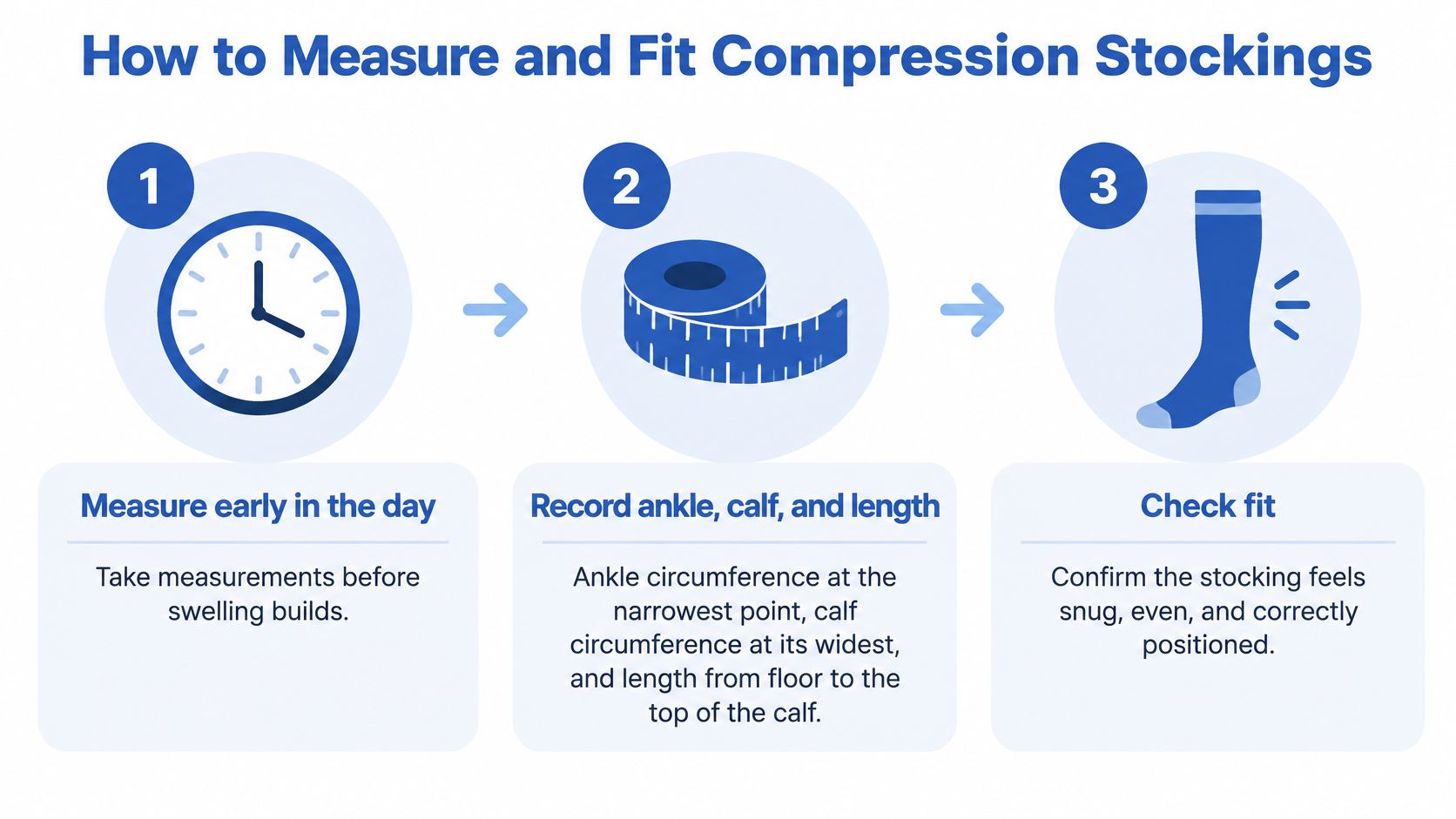
Seven Fitting Steps
- Measure early in the day: Do it before dependent swelling builds, ideally soon after getting up, so the size reflects your least swollen leg.
- Record ankle circumference: Wrap the tape at the narrowest point just above the ankle bones. This measurement anchors the stated pressure class.
- Record calf circumference and length: Measure the calf at its widest point, then measure from the floor to just below the knee crease for a knee-high style.
- Add thigh measurements if needed: For thigh-high stockings, record thigh circumference and leg length exactly where that brand's chart requests them.
- Match the brand chart: Use every measurement, not just calf size. If you fall between sizes or the ankle and calf point to different sizes, ask for professional fitting or a different style.
- Confirm the gradient and position: The heel pocket should sit on your heel, fabric should lie smooth, and the top band shouldn't fold into the knee crease.
- Reassess after edema reduction: A stocking fitted to a very swollen leg may become loose within weeks. Remeasure when swelling, weight, or wound dressings change.
Measure both legs if both will wear stockings. They often differ, especially after an ulcer, injury, or previous clot on one side. Write the date beside the numbers because a later fitter needs to know whether they came from a swollen afternoon leg or a morning leg.
A correct fit feels snug and even. It shouldn't pinch at the toes, dig below the knee, roll down, or bunch behind the knee.
If arthritis, weak grip, back pain, or limited hip movement stops you reaching your foot, solve that during fitting, not after purchase. Try the garment with the donning aid, gloves, or caregiver technique you'll use at home. Open-toe designs and alternative compression systems may be reasonable when a standard closed-toe stocking repeatedly fails despite the right size.
Wearing Tips and Fixes for Daily Use
Most daily problems have a mechanical cause. The stocking was put on after swelling built up, the heel sits in the wrong place, fabric twists at the ankle, or the top band rolls and creates a narrow tight ring. Fix the mechanics before you conclude that compression itself has failed.
Put stockings on first thing, before standing for long or showering in hot water. Sit with your foot supported, turn the stocking inside out to the heel, place your foot in, seat the heel pocket, then unroll the fabric up the calf without yanking only on the top band. Smooth each section as you go. Rubber donning gloves improve grip and protect the knit from nails.
- Rolling top band: Don't fold it over to keep it up. That doubles pressure in one ring. Recheck calf length and circumference, and consider a wider cuff or different length.
- Bunching behind the knee: Remove and reapply with the heel seated correctly. Extra fabric usually means the stocking is too long or was pulled too high.
- Skin irritation: Wash new garments as directed, dry skin fully before donning, and moisturize after removal. Persistent rash under a silicone band needs a style change.
- Worsening pain: Remove the stocking, inspect toes and skin, and contact your clinician if pain, numbness, or color change doesn't settle promptly.
Remove stockings at bedtime unless your clinician gives a different instruction for an ulcer system or after a procedure. Use removal as your daily skin check, looking at toes, heel, ankle bones, and any previous ulcer site. Compression stockings may be recommended after treatment, and your provider tells you the appropriate compression level and how long to wear them, so follow that procedure-specific plan rather than copying another patient's schedule.
Extra body weight, arthritis, neuropathy, and limited hip mobility call for extra support, not blame. A rigid donning frame, a caregiver who has practiced with you, or a lower-friction liner can make the difference between daily use and abandonment. If you have reduced sensation, ask someone to help check pressure points because you may not feel early skin injury.
Replace the garment when elastic feels slack, the stocking slides despite correct application, holes or runs appear, or your measurements no longer match its size. New redness that doesn't fade after removal, blistering, or a break in the skin is a reason to reassess fit and pressure promptly.
Confirm When to Escalate to Medical Treatment
Persistent symptoms despite consistent compression, leg elevation, walking, and activity changes warrant a closer look, especially when the stockings fit and you wear them as directed. Compression applies external pressure, while a vascular procedure can address a faulty valve or refluxing vein.
Seek medical assessment for visible or bulging veins with ongoing aching, heaviness, or fatigue; swelling that keeps progressing; brown discoloration or eczema-like skin changes; or a sore that returns or stops healing. These signs can help guide what to check, including the wound, venous circulation, and other possible causes of swelling.
A clinician may review your symptoms, examine your legs and any wounds, and use duplex ultrasound findings to identify the source and extent of venous disease. A minimally invasive procedure may be considered if symptoms persist or compression, elevation, and activity changes do not provide enough relief. Endovenous treatments close the problem vein from within, allowing blood to reroute through healthier veins. The choice depends on vein size and location, ultrasound findings, symptoms, and overall vascular health. Read about signs of venous insufficiency and when to visit a vein treatment center to prepare for an appointment.
Bring your stocking class and size, notes about fit or wearability problems, and a brief history of symptoms or wounds. This helps the clinician distinguish a fit issue from untreated reflux and decide whether further testing, wound care, or treatment should come next.
Vein and Wound Institute provides vein evaluation, diagnostic testing, and treatment for chronic venous insufficiency and related conditions. If symptoms persist or worsen, an evaluation can help determine an appropriate next step.