The usual advice about endovenous laser ablation side effects is to expect some bruising and call if anything feels wrong. That's reassuring, but it's not specific enough. A tender patch that's fading and a calf that's becoming more swollen need different responses, even if both begin with discomfort.
The pattern matters more than the presence of a symptom alone. Most effects are temporary, but worsening pain, spreading swelling, progressive numbness, or breathing symptoms shouldn't be dismissed as ordinary healing. Understanding the difference lets you recover without treating every bruise as an emergency or overlooking a complication.
Table of Contents
- How Common Each Side Effect Is
- Why Heat Inside a Vein Causes Side Effects
- Normal Recovery Timeline After Treatment
- Numbness and Nerve Injury in the Lower Leg
- Blood Clots After Heat Treatment Explained
- Risk Factors and How to Lower Them
- Decide Between Urgent Care and Routine Follow-Up
How Common Each Side Effect Is
A percentage can describe a study group, but it cannot predict exactly what one person will experience. Reported rates vary with the laser system, the veins treated, follow-up methods, and how each study defines a side effect.
| Side effect | Reported rate and context | Clinical category |
|---|---|---|
| Bruising or ecchymosis | 24–75%, reported range in the laser-systems systematic review | Minor |
| Endothermal heat-induced thrombosis (EHIT) | 9% in the complications summary; pooled class I 0.4% and class II 1.0% in the laser-systems systematic review | Potentially serious, classification-dependent |
| Swelling | 7.2%, complications summary | Usually minor |
| Hematoma | 6.4%, complications summary | Usually minor |
| Neurologic symptoms, any | 4.33%, pooled 1,470-nm procedures in the 2024 meta-analysis | Moderate, severity-dependent |
| Infection | 4%, complications summary | Potentially serious |
| Burns | 2.64%, pooled 1,470-nm procedures in the 2024 meta-analysis; under 0.2%, laser-systems systematic review | Potentially serious |
| Deep-vein thrombosis (DVT) | 1.42%, pooled 1,470-nm procedures in the 2024 meta-analysis; under 0.5%, laser-systems systematic review | Serious |
| Permanent neurologic injury | 1.70%, pooled 1,470-nm procedures in the 2024 meta-analysis | Serious |
| Thrombophlebitis | 0.6%, pooled third-generation procedures in the meta-analysis of third-generation ablation; about 5% in other reports | Moderate |
| Hyperpigmentation | 1.0%, pooled third-generation procedures in the meta-analysis of third-generation ablation | Usually minor |
| Pulmonary embolism | Under 0.1%, laser-systems systematic review | Life-threatening |
The 2010 systematic review included 10,883 treated patients and recorded 69 major adverse events, or 0.63%. That figure describes the review's patient group, not an individual's personal risk. Estimates from different studies should be read in context because the methods and definitions vary.
A study that counts any change in sensation, for example, measures a broader outcome than one that counts only lasting nerve injury. Minor effects still matter: bruising may not threaten health, but it can affect comfort during recovery.
Use complication rates to guide informed consent. Use a symptom's severity and direction of change to decide whether it needs attention.
Why Heat Inside a Vein Causes Side Effects
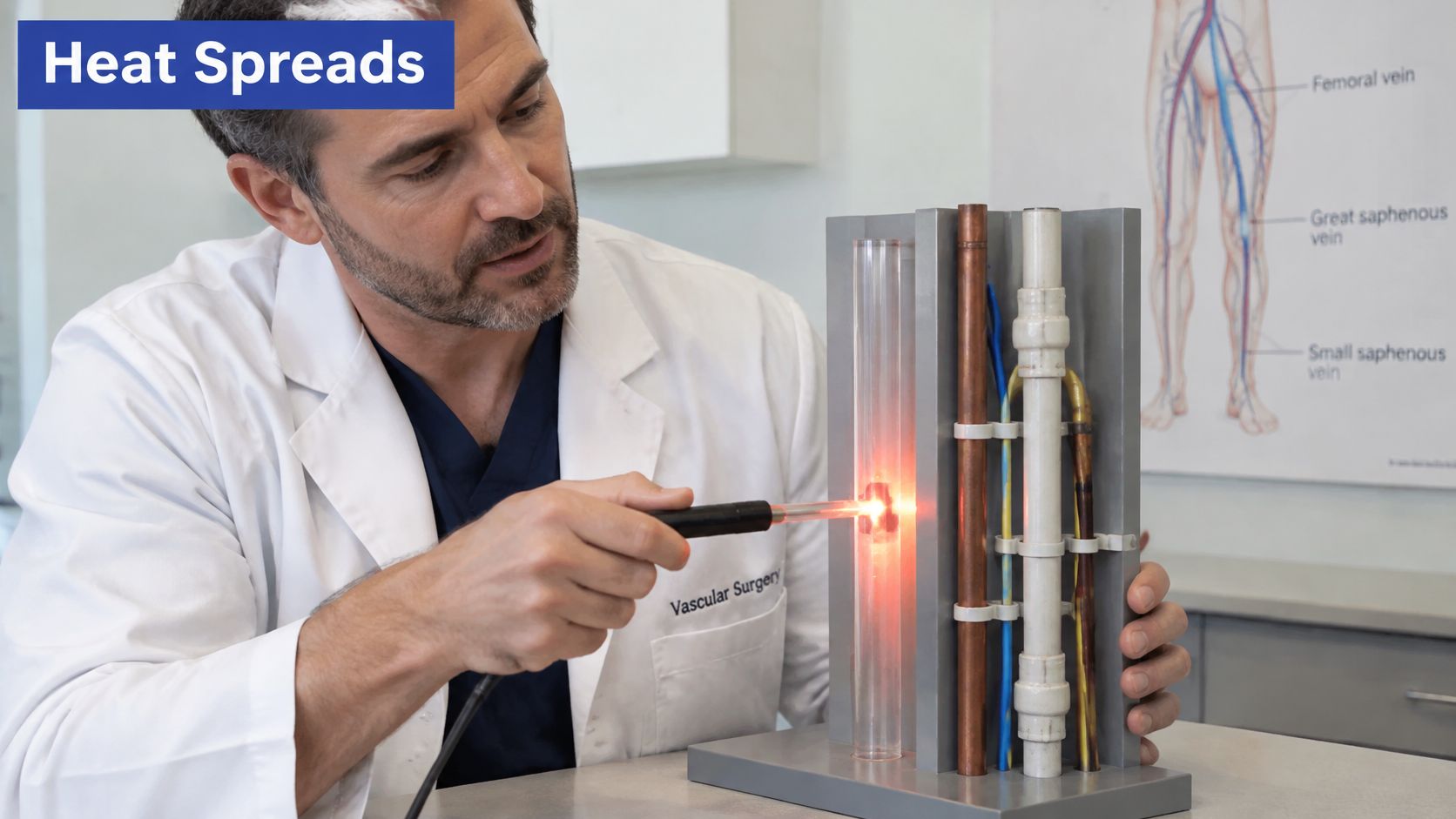
Think of sealing a leaking pipe by heating it from inside. The intended effect is inside the pipe, but nearby wiring and other pipes still need protection. During endovenous laser ablation, the laser fiber delivers controlled energy inside an abnormal superficial vein to seal it from within.
The treatment uses a small catheter access point rather than removing the vessel through surgical incisions. Blood naturally redirects through healthier veins, which can reduce venous pressure and improve symptoms.
Where unwanted effects can develop
The same controlled heat that closes the vessel can affect structures around it. It helps to separate the treatment area into distinct locations:
- Inside the vein: Closure involves a heat-related response within the treated vessel. Unwanted thrombus extension toward the deep circulation is different from the intended closure.
- Around the vein: Skin and small sensory nerves can be irritated by heat or by instruments used during treatment. This helps explain burns, altered sensation, and some localized discomfort.
- Across the recovering leg: Tissue inflammation and adjustments after treatment can contribute to temporary swelling and tightness. These symptoms don't automatically mean blood can't leave the leg.
For example, a pulling sensation along the treatment path may reflect local healing. A progressively swollen calf involves a different pattern and requires assessment rather than an assumption that it's the same process.
Small access points don't eliminate thermal risk
Traditional vein stripping removes the abnormal vein through incisions. An endovenous approach avoids those larger wounds, but the energy still acts inside living tissue.
That distinction explains why a minimally invasive procedure can have little visible skin injury while still causing tenderness or sensory symptoms underneath. Small access doesn't mean no internal healing is needed.
The amount and distribution of heat depend on the system, energy delivery, vein location, and surrounding anatomy. Protecting adjacent tissue is therefore part of treatment planning, not just a matter of choosing the newest device.
Normal Recovery Timeline After Treatment
Bruises do not need to disappear by a set date for recovery to be on track. Judge progress by steady improvement, while watching for symptoms that worsen or fall outside the expected pattern.
Most minimally invasive endovenous procedures use local anesthesia. You usually remain awake and may feel pressure or brief discomfort, but significant pain during treatment is not typically expected. The small access points also make significant scarring uncommon.
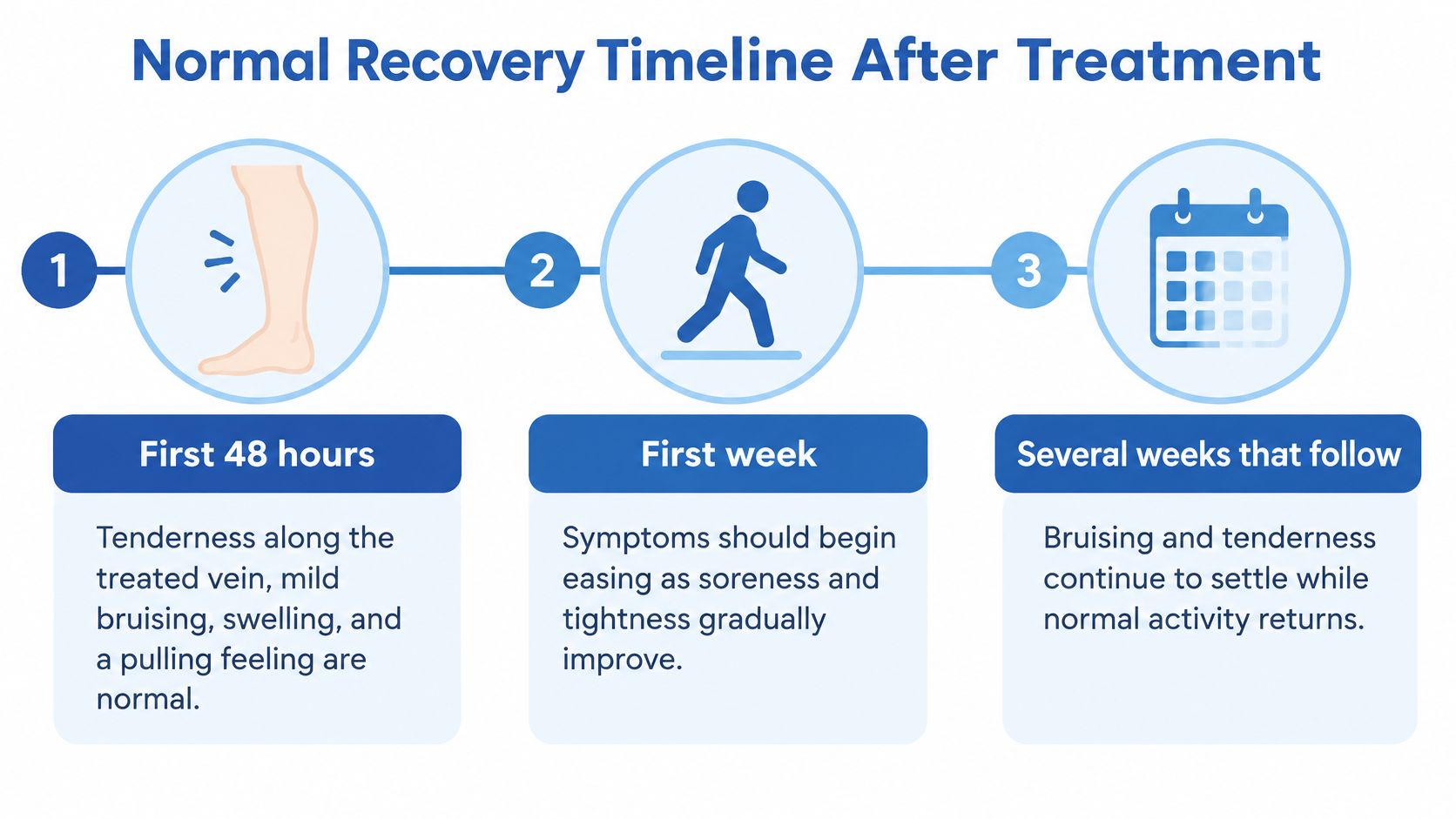
Expected recovery by time window
| Window | What is normal | What to do |
|---|---|---|
| First 48 hours | Tenderness along the treated vein, early bruising, mild swelling | Wear compression as directed and keep walking gently |
| First week | Bruising may become more noticeable and change colour; tightness or pulling can occur | Keep the scheduled follow-up and watch the trend |
| Several weeks | Symptoms ease, although a firm cord may still be felt; changes in underlying symptoms typically appear during this period | Confirm progress at follow-up |
Early recovery
Follow your written instructions for compression, walking, bathing, and care of the access site. Compression should fit as prescribed and feel supportive. If it feels painfully constricting, contact your care team rather than adding tighter layers.
Gentle movement supports circulation, but strenuous exercise may need to wait. Use your procedure-specific instructions to guide when you return to lifting, running, or demanding work.
The following weeks
Bruises can change colour as they settle. A localized firm area may remain noticeable after the initial soreness improves, while changes in underlying vein symptoms typically appear during the first several weeks.
For related recovery information, read this guide to greater saphenous vein radiofrequency ablation recovery. The instructions for your laser treatment remain the priority.
If you need help with meals, mobility, or daily routines during recovery, A Better Solution in Home Care services may help you arrange that support. Home assistance does not replace clinical follow-up.
Keep your appointments and contact your care team if discomfort increases or symptoms move outside the expected pattern. An early recovery window does not make worsening symptoms routine.
Numbness and Nerve Injury in the Lower Leg
A patch of numbness after endovenous laser ablation can have several causes, including temporary irritation of a nearby sensory nerve. The location and progression of the symptom help clarify what may be happening.
Small sensory nerves run close to superficial veins. In the lower leg, the great saphenous vein and saphenous nerve are near one another, so heat or mechanical irritation during treatment in that area can affect sensation.
Why treatment location matters
A clinical review of EVLA-related nerve injury cites neuropathy in 0.8% of cases when the treated length was under 40 cm from the saphenofemoral junction, compared with 4.6% when it was at least 40 cm. The review also cites one comparison reporting short-term paresthesia in 3.33% with a 1,470-nm system versus 30% with a 980-nm system.
These figures come from specific comparisons, so they do not establish a rate for every procedure using those wavelengths. Anatomy, treatment length, energy delivery, and protective technique can all affect the risk.
Tingling, burning, reduced sensation, or sensitivity to clothing are possible sensory changes. Paresthesia is the medical term for an unusual sensation, such as pins and needles. It describes what you feel, not the cause or duration.
Improvement versus progression
A small area that gradually becomes less noticeable is more reassuring than numbness that spreads or becomes painful. Persistent symptoms should be documented and discussed with the treating team.
When describing a change, note its location, whether it affects movement as well as sensation, and whether the area is shrinking, unchanged, or spreading. New weakness, severe pain, or extensive sensory loss needs prompt medical assessment.
Some people have sensory symptoms before treatment. This explanation of whether varicose veins can cause numbness can help you consider whether a symptom was already present. Tell your treating team what you noticed beforehand and what changed afterward. That timeline helps them assess the affected nerve area, check for swelling, or consider another cause.
Blood Clots After Heat Treatment Explained
A treated vein can look bruised or feel tender while a clot remains limited to the surface. The key distinction is where the clot is: in or near the treated vein, or extending into the deep-vein system.
Understanding the terminology
Endothermal heat-induced thrombosis (EHIT) describes clot formation associated with the treated vein near its connection to the deep veins. Clinicians classify EHIT according to whether, and how far, it extends into the deep-vein system. Deep-vein thrombosis (DVT) is a clot in a deep vein. A pulmonary embolism occurs when clot material reaches the lungs and interferes with circulation.
Bruising is blood beneath the skin, while superficial phlebitis is inflammation in a surface vein. These findings differ from a clot extending into a deep vein, and their appearance alone cannot establish where a clot is located.
The systematic review of laser systems reports the bruising, thrombophlebitis, and pooled EHIT estimates listed earlier. Reported clot rates vary with surveillance, patient selection, and diagnostic definitions, so a rate from one group should not be treated as a personal prediction.
Why ultrasound matters
Duplex ultrasound shows blood flow and the relationship between the treated vein and nearby deep veins. It can help confirm that the treated vein has closed and assess whether clot has extended beyond it.
The treating clinician uses the ultrasound findings, EHIT classification, symptoms, and individual risk profile to decide whether observation, repeat imaging, or anticoagulation is appropriate. A scheduled scan remains useful even when bruising improves or the leg feels comfortable.
For more information about deep-vein thrombosis and its effects, see our DVT guide. Do not try to diagnose a clot from symptoms or appearance alone, and do not start, stop, or change blood-thinning medication without instructions from your treating team.
Risk Factors and How to Lower Them
Risk depends on the treated vein, catheter position, nearby nerves, energy settings, and your medical history. Planning starts with identifying where abnormal reflux occurs. A vein consultation and duplex ultrasound help determine which treatment suits your condition and goals.
The review of EVLA patient education discusses how anatomy, technique, and individual health factors shape treatment planning.
Risk factors, possible effects and ways to reduce risk
| Risk factor | Side effect or planning concern | What lowers the risk |
|---|---|---|
| Longer treated segment | Post-ablation nerve symptoms | Limit the treated length when clinically appropriate |
| Lower-leg treatment near the saphenous nerve | Tingling or numbness | Map the anatomy and use adequate tumescent anesthesia |
| Laser wavelength and delivery system | Short-term sensory symptoms | Match the system and technique to the treatment target |
| Excessive energy delivery | Burns or nerve injury | Use appropriate energy settings and careful technique |
| Diabetes | Delayed healing or infection concerns | Address glucose management and arrange wound review |
| Prior thrombosis or anticoagulant use | Clot history and bleeding-management concerns | Review medications and plan surveillance based on individual risk |
| Lymphedema or active venous ulcers | Swelling, skin integrity, or infection concerns | Coordinate wound care and assess compression tolerance |
| Darker skin tone or existing pigmentation | Pigment changes may be more visible or persist | Protect the skin and review new discoloration |
Blood-thinning medication can affect bleeding and treatment planning. The reason for taking it also matters, so review all medications with the treating clinician rather than changing them yourself.
What you can prepare
- Bring a medication list: Include prescribed blood thinners, nonprescription medicines, and supplements. Follow the clinician's instructions before making any changes.
- Describe your usual symptoms: Note existing numbness, swelling, pigmentation, and open wounds.
- Ask about thermal protection: Tumescent anesthesia places fluid around the vein. It numbs the area and helps protect nearby tissue during treatment.
- Plan skin and wound care: Follow dressing instructions and protect healing skin from sun exposure.
- Arrange follow-up: Attend the ultrasound visits recommended for your treatment and risk profile.
If a wound is not progressing, a wound healing assessment for clinical teams can help structure discussion of contributing problems. It does not replace an examination or a coordinated wound-care plan.
Is a newer laser or another method safer?
The best-fitting method depends on the vein's size and location, ultrasound findings, symptoms, and overall vascular health. Radiofrequency ablation uses radiofrequency energy to heat and close an unhealthy vein. Laser ablation delivers laser energy inside the vein to seal it with controlled heat. These methods differ in how they deliver heat, and treatment recommendations are personalized.
Ask how close the target vein is to nerves or skin, which procedure fits your anatomy, and how your medical history or wound may affect the plan. Closure of the vein and comfort during recovery are separate outcomes to discuss.
Decide Between Urgent Care and Routine Follow-Up
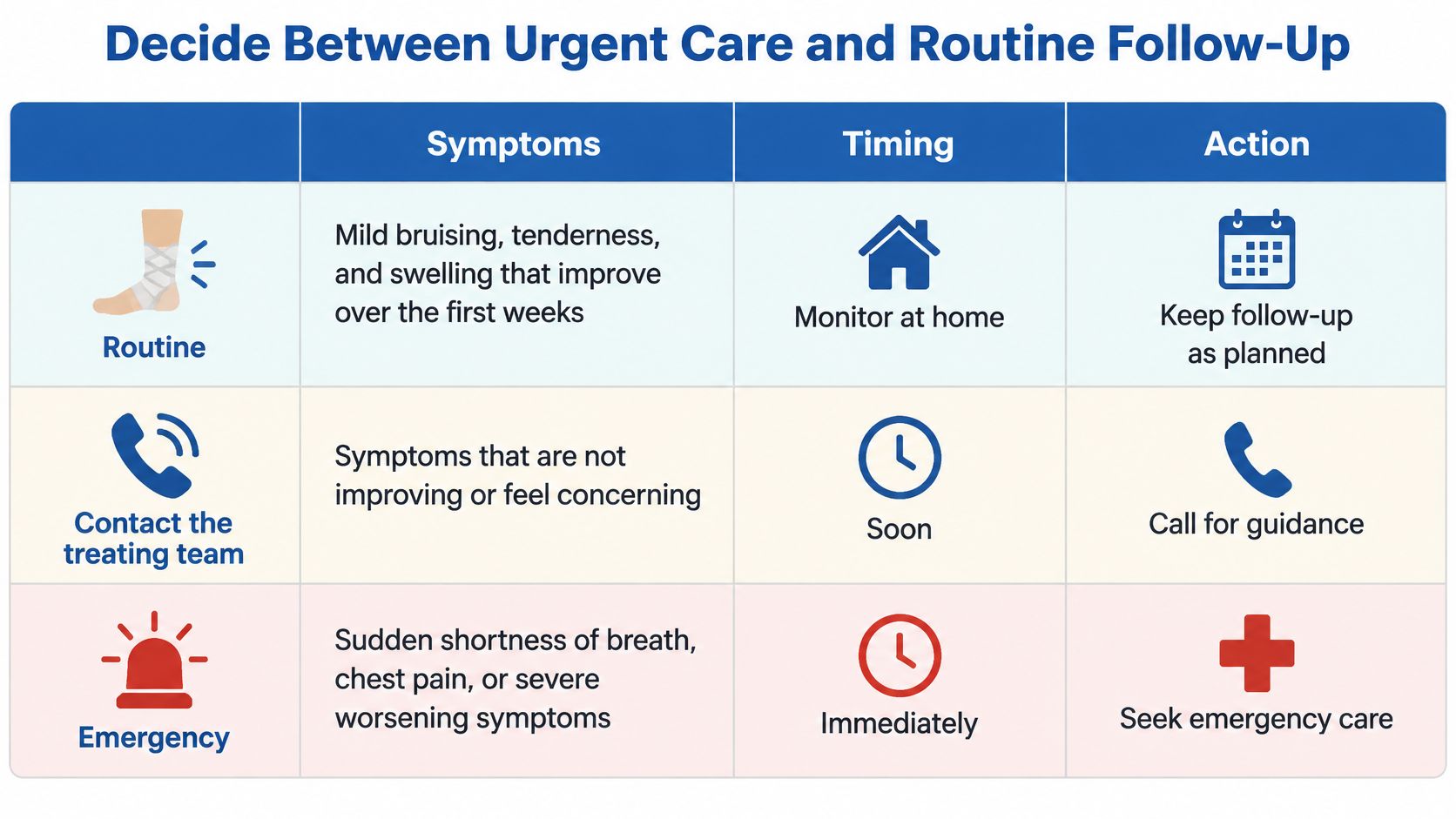
The pace and direction of a symptom help determine how quickly to seek care. Use this table to guide your next step; it cannot diagnose the cause. If symptoms are severe or worsening rapidly, seek urgent assessment.
Symptoms, timing and the action to take
| Symptom | Timing | Action |
|---|---|---|
| Mild bruising, tenderness, or swelling that is improving | First weeks | Monitor and discuss at follow-up |
| Swelling or pain in one leg that is worsening | Any time | Contact the treating team the same day |
| Hard cord that spreads or grows | Any time | Contact the treating team the same day |
| Fever, increasing redness, or heat | Any time | Contact the treating team promptly |
| Growing numbness or new weakness | Any time | Obtain prompt examination |
| Chest pain, sudden shortness of breath, or coughing blood | Any time | Seek emergency care now |
Make the change easy to describe
When you call, say where the symptom is, when it began, and whether it is getting worse. Mention fever, difficulty walking, new weakness, or breathing symptoms right away.
A photo may help show spreading redness or swelling, but it cannot rule out a clot. Don't delay an examination to take or send a better picture.
Know when not to wait
Call emergency services for fainting or sudden weakness involving the face or arm, difficulty speaking, or other emergency symptoms. Families preparing to help at home may find a caregiver's guide to stroke recognition useful for recognizing possible stroke signs.
Monitor symptoms that improve, report changes that progress, and act immediately on emergency warning signs. For concerns that do not require emergency care, contact the treating team using the action guide above.
Vein and Wound Institute provides clinical evaluation, duplex ultrasound, and coordinated vein and wound care. Visit Vein and Wound Institute to book a consultation and discuss a treatment and follow-up plan designed for your symptoms, circulation, and healing needs.