You're arranging a ride home, looking at your compression stocking, and wondering whether a sore, tight leg afterward will mean something's wrong. Knowing what to expect after vein ablation means understanding two different timelines: when you can resume everyday activities and when your leg finishes settling down.
Those timelines don't always match. You may feel ready for normal routines while bruising or a firm area remains. The most useful distinction is whether symptoms stay local and improve, or become new, more painful, or more widespread.
Table of Contents
- Recovery Timeline From Procedure Day to Week Six
- Normal Sensations Versus Warning Signs
- How to Walk, Move and Wear Compression Safely
- Follow-Up Ultrasound and How Long the Vein Stays Closed
- When Recovery Runs Slower or Needs More Treatment
- Confirm Your Recovery Plan With Your Clinician
Recovery Timeline From Procedure Day to Week Six
| Phase | What You May Feel | What to Do |
|---|---|---|
| Procedure day | Pressure, numbness or brief discomfort from local anesthesia | Rest briefly and go home wearing compression as instructed |
| Days 1 to 3 | Tenderness, bruising and tightness along the treated vein | Walk regularly and avoid strenuous exercise as instructed |
| Days 4 to 7 | Soreness often eases; many patients have resumed usual activities, sometimes sooner | Increase activity gradually and use compression as directed |
| Weeks 2 to 4 | Lumpiness or a firm cord may remain as the area settles | Keep walking and follow the clinician's activity limits |
| Weeks 4 to 6 and beyond | Bruising may still be fading; residual veins may remain visible | Attend follow-up and imaging if scheduled |
These phases are a practical guide, not deadlines your leg must meet. The procedure used, the vein treated, your starting symptoms, and any additional treatment all affect how recovery feels.
Returning to activity can happen sooner than the table's later phases suggest. In a randomized trial of 117 patients reviewed by the National Institute for Health and Care Excellence, the mean time to resume usual activities was 3.5 days after mechanochemical ablation and 4.8 days after radiofrequency ablation, with no statistically significant difference.
Getting through the early days
Before leaving, make sure you can distinguish the dressing over the access point from any compression garment you've been prescribed. Ask what should stay in place, what can be removed, and what to do if either becomes uncomfortable.
At home, think in terms of gentle movement mixed with rest, rather than staying in bed or testing your leg with a demanding workout. Put everyday items within easy reach and leave heavy household tasks for someone else until you're cleared.
A useful example is returning to computer work. You may feel capable of answering emails while still needing movement breaks, whereas a job involving lifting or prolonged standing may require modified duties.
Recovery milestone: Being able to do your usual activities doesn't mean every bruise, tender spot, or visible vein should have disappeared.
Watching the overall direction
During later recovery, compare how your leg feels with how it felt previously, not with someone else's results. A remaining mark or firm area deserves a different response from a new, rapidly worsening symptom.
You don't need to push through pain to stay on schedule. If activity repeatedly increases discomfort, reduce the load and contact your treating team for guidance rather than assuming you're behind.
The activity figures describe return to usual activities, not complete cosmetic or symptom resolution. Your physician's instructions override this general timeline, particularly if you've had several veins treated, additional procedures, or ongoing wound care.
Normal Sensations Versus Warning Signs
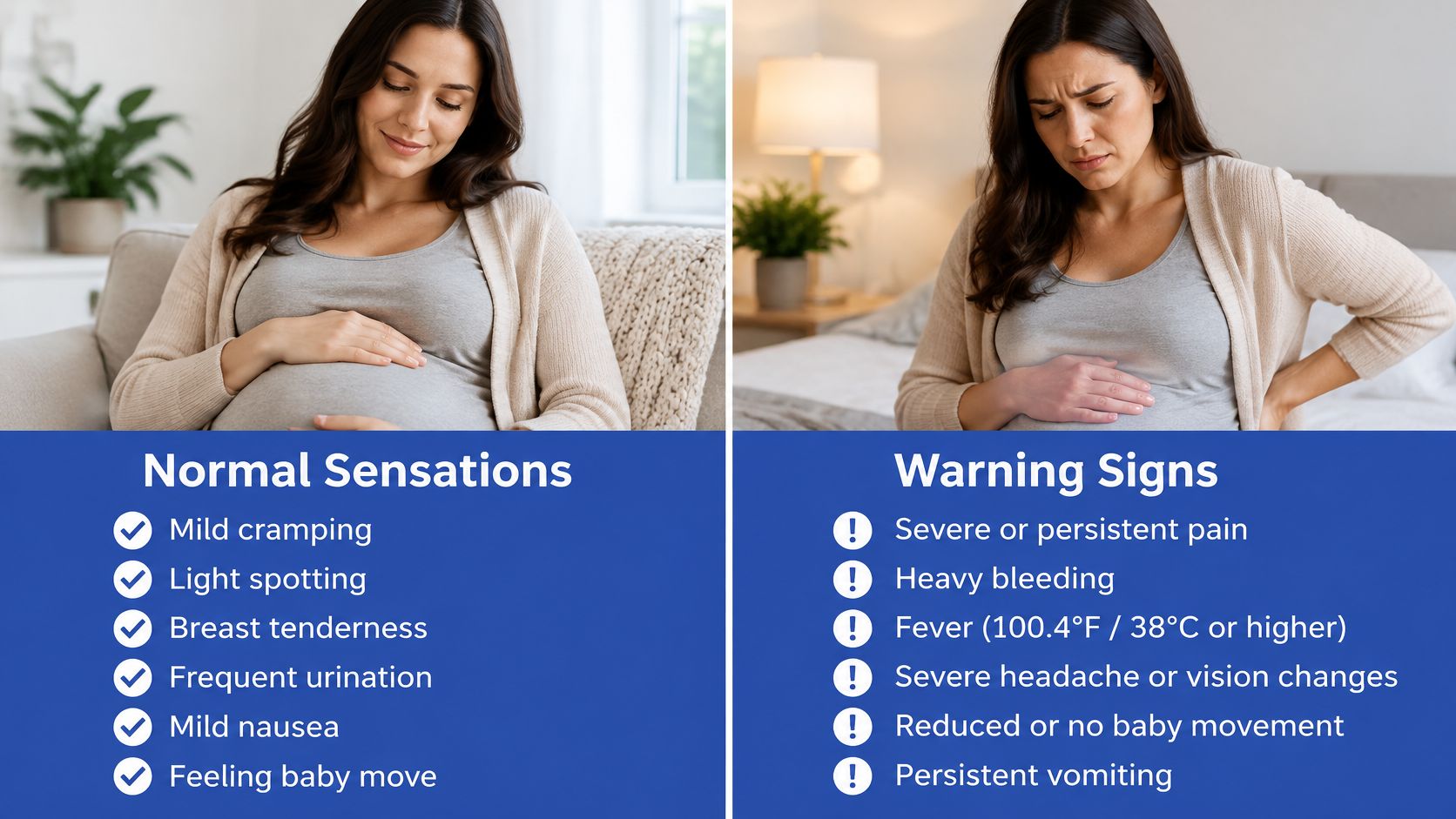
By the second evening, a tender line along the treated vein is common. That local ache can be healing. A calf that swells for the first time, or pain that keeps climbing, is a different problem. Sort them by the day you are in, not by how brave the sensation feels.
| Symptom | Usually Expected? | What to Do |
|---|---|---|
| Bruising, tenderness or mild tightness along the vein | Usually, if local and gradually improving | Monitor; contact the clinic if it worsens rather than waiting for the next visit |
| Firm, lumpy cord along the treated vein | Often, during local healing | Contact the clinic if it grows or becomes very painful |
| Phlebitis, an inflamed vein | A recognized post-procedure reaction | Arrange clinician review rather than diagnosing it yourself |
| New or worsening one-sided leg swelling or calf pain | Not routine | Contact the clinician promptly for assessment; marked or rapidly increasing swelling needs urgent assessment |
| Sudden shortness of breath, chest pain or coughing blood | Not routine | Seek emergency care immediately |
Bruising, mild tightness, and a firm cord often appear in the first days and should ease rather than spread. An inflamed vein can stay lumpy longer. The Guy's and St Thomas' NHS patient guide reports that about 1 in 10 patients develop phlebitis, or vein inflammation, after a nonsurgical varicose-vein procedure, and discomfort and lumpiness can persist for 3 to 4 weeks.
A tender ridge that slowly softens fits local healing. A newly swollen or increasingly painful calf needs assessment, even with an expected bruise nearby. You cannot reliably tell superficial inflammation from a deep-vein clot by touch alone.
Closing an unhealthy vein works like closing a road that has been snarling traffic. Blood takes the open side streets, the healthier veins. Pressure in the bad route can fall, and symptoms can ease, because that closed vein does not have to carry blood again.
After thermal ablation, the treated vein gradually becomes scar-like tissue. Local inflammation helps explain tenderness, bruising, tightness, and a cord you can feel beneath the skin. That cord works like a healing seam under fabric: firm for a while, then softer. It should not suddenly thicken and throb.
Most minimally invasive endovenous procedures use local anesthesia, so you usually remain awake. Pressure or brief discomfort can happen. Significant pain is not typically expected. Pain that jumps from mild soreness to something that stops comfortable walking is a change in the map, and it deserves a call.
Reactions also vary by method. The page on endovenous laser ablation side effects covers reactions linked to that treatment.
The 2023 vascular society guideline recommends against routine early duplex screening after thermal ablation in asymptomatic, average-risk patients, while supporting prompt imaging when symptoms suggest a clot and surveillance for selected higher-risk patients.
Tell your clinician about prior clots, limited mobility, cancer, pregnancy, or estrogen use. Those details help the team decide whether recovery needs closer monitoring.
If a symptom is new, spreading, or frightening, contact the clinic the same day. For chest symptoms, sudden breathlessness, or coughing blood, seek emergency care instead of waiting for a callback.
How to Walk, Move and Wear Compression Safely
Your aftercare instructions should name the procedure you had and explain its specific restrictions. At our practice, the physician gives guidance based on the treatment performed, because compression, bathing, wound care, and exercise instructions aren't identical for every procedure.
Make movement and compression manageable
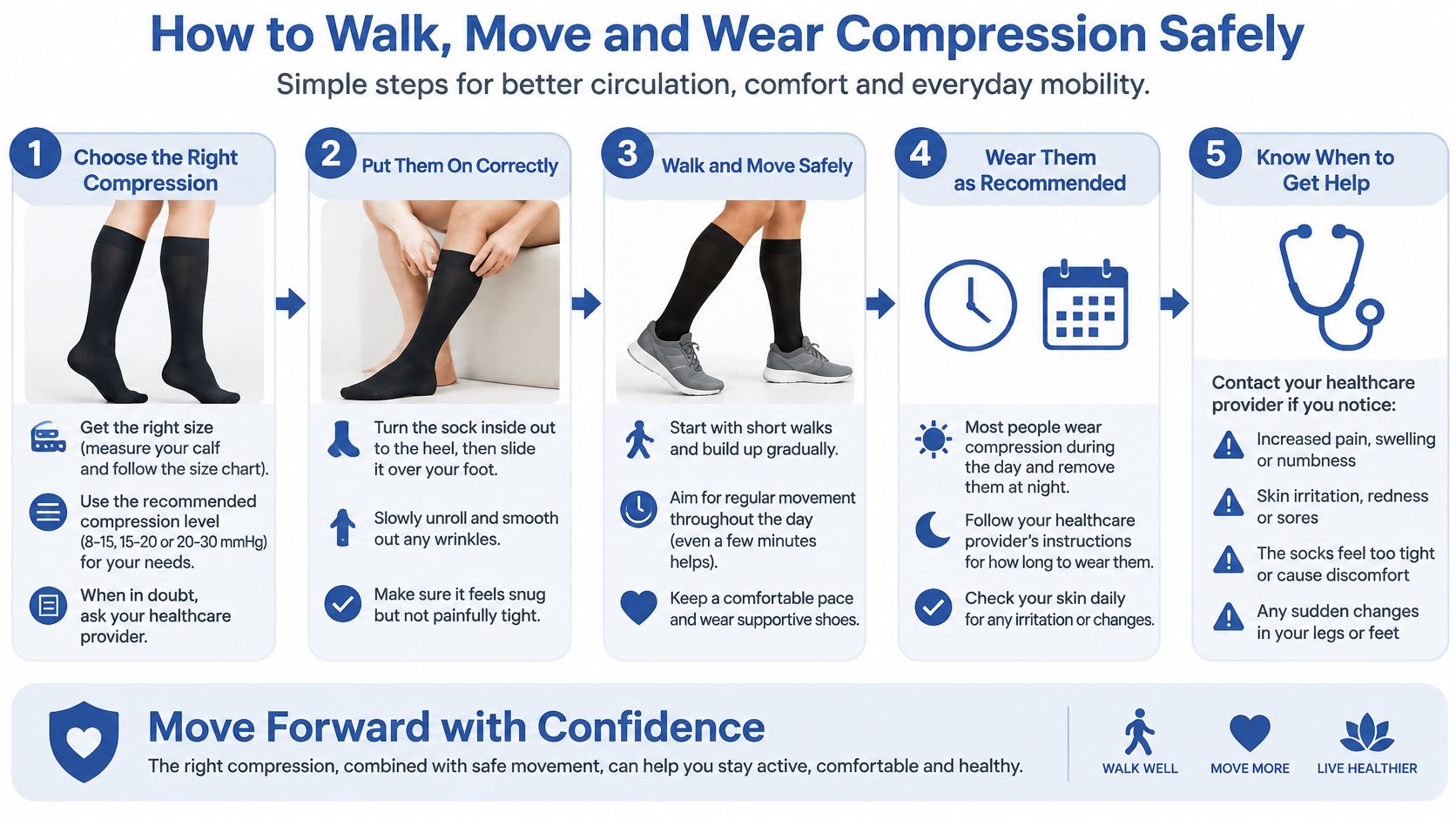
Confirm the compression schedule before leaving. If compression is prescribed, have the team show you how the garment should fit and whether it stays on during sleep or rest. Don't substitute a tighter garment or change the schedule yourself, because fit and pressure matter.
Start with short, comfortable walks. Early walking helps maintain circulation without asking your leg to tolerate a workout. Choose a level route near home, increase gradually, and stop to seek advice if you develop new pain or swelling rather than ordinary mild soreness.
Separate walking from strenuous exercise. Gentle movement isn't the same as running, heavy lifting, or demanding leg exercises. Keep those activities on hold until your clinician clears them, and interrupt long stretches of sitting with comfortable movement.
Use rest deliberately. If swelling occurs, resting with your legs raised may help, but don't treat elevation as a substitute for assessing new one-sided swelling. Follow your prescribed compression schedule during rest rather than assuming you should always remove or always retain the stocking.
For practical help getting a prescribed garment into position, use our instructions on how to put on compression stockings. Smooth out wrinkles and avoid rolling the top into a tight band.
Protect the access site and track changes
Follow the written bathing directions. Confirm when you may shower, remove dressings, and soak the treated area. A small access point still needs appropriate care, and instructions for another person's procedure may not apply to yours.
Check the access points each day. Notice bleeding, increasing redness, drainage, or a dressing that becomes wet or loose. Contact the clinic about concerning changes so the team can decide whether you need a dressing adjustment or examination.
Match work duties to your restrictions. Many patients resume normal daily activities within a short period, but returning to work isn't automatic clearance for every task. Describe your actual duties, including lifting, driving, standing, or sitting, so your instructions are useful.
Keep a brief recovery log. Record walking, compression use, discomfort, and new symptoms in a notebook or phone. A description such as “more swollen after work than yesterday” gives your clinician something concrete to assess.
Practical habit: Set out your prescribed stocking and plan movement breaks before the day gets busy. Don't let a packed schedule turn into skipped compression or hours without moving.
Follow-Up Ultrasound and How Long the Vein Stays Closed
| Time Point | Randomized Trial (117 patients) | Case Series (63 patients) | Systematic Review (Laser Ablation) |
|---|---|---|---|
| 1 month | 83% mechanochemical; 92% radiofrequency | Not reported | 99.2% |
| 3 months | 89% great saphenous; 81% small saphenous | Not reported | Not reported |
| 6 months | Not reported | 94% | Not reported |
| 12 months | Not reported | 95% | 96.3% |
| 24 months | Not reported | 95% | 96.0% |
These complete-occlusion figures come from the studies summarized in the NICE interventional procedure consultation document, including a randomized trial of 117 patients, a case series of 63 patients involving 73 treated legs, and a systematic review of longer-wavelength laser ablation.
Occlusion means the treated vein is closed. It's a technical outcome, not a measurement of how quickly your bruises disappear or whether every visible branch vein has gone.
How to read the closure figures
Keep each study in its own column. The participants, techniques, and follow-up assessments weren't necessarily alike, so the table isn't a fair head-to-head ranking of treatments.
The case series doesn't identify its technique in this summary. Its results therefore shouldn't be labeled as mechanochemical outcomes. Likewise, an unreported cell doesn't mean the vein reopened; it means that measurement isn't available in the summarized evidence.
The findings support a reassuring but qualified message: closure is highly likely, but it isn't guaranteed to remain permanent. Reopening, called recanalization, and later venous problems remain possible.
What an ultrasound adds
A follow-up duplex ultrasound may be used to confirm closure and evaluate blood flow. Our explanation of ultrasound for chronic venous insufficiency describes why imaging answers questions that a skin examination alone can't.
If imaging is recommended, attend even when your leg feels better. Conversely, if you develop concerning symptoms, don't wait for an already-booked scan.
- Closure assessment: The clinician checks whether the intended vein remains closed.
- Safety assessment: Imaging can investigate suspected thrombus extension or a deep-vein clot.
- Further planning: Persistent symptoms may require reassessment of other veins or another cause of swelling.
Your clinician should explain what the scan found and whether it changes your care. A successful closure result and ongoing discomfort can coexist, so neither the image nor your symptoms should be interpreted in isolation.
When Recovery Runs Slower or Needs More Treatment
Most changes you notice will appear within the first several weeks. Relief often arrives in steps, not all at once. Closing the target vein works like shutting one leaky pipe so blood uses the sounder lines beside it. That reroute can lower pressure in the leg, yet surface branches can still show.
Those leftover branches may need staged phlebectomy, which removes selected superficial veins through small access points, or sclerotherapy, which treats selected veins with an injected agent. Additional treatment doesn't automatically mean the original ablation failed. A second, smaller vein is sometimes left for a later visit on purpose.
Different recovery pathways
Uncomplicated varicose-vein recovery. Suppose aching and bulging veins were the main problem, and there is no open wound. A typical early course is heaviness that eases across those first several weeks, with tenderness that shrinks rather than spreads. Stalled recovery looks different: aching or bulging that is unchanged by about week six, or a new firm tender patch along the treated path that keeps enlarging.
Swelling or lymphedema alongside venous disease. Closing a refluxing vein may fix one source of backup without clearing every reason the limb holds fluid. The leg can still feel full by evening. Limb care often continues after the treated vein has closed, because the fluid problem and the vein problem are not the same job.
An open venous ulcer or diabetic wound. The procedure sits inside a larger plan. Dressings, compression chosen for that wound, debridement when needed, watching for infection, and checking circulation can all remain after the vein is sealed.
For venous ulceration specifically, a randomized trial cited in the venous-ulcer evidence review found median healing time of 56 days with early ablation versus 82 days with deferred ablation. That finding concerns venous ulcers, not every diabetic or non-healing wound.
A closed vein and a closed wound are different milestones. Drainage that continues past the expected healing window still needs a proper wound check. By itself, it is not proof the ablation failed.
When slower progress deserves review
Call the treating team if improvement stalls, swelling stays hard to live with, or the wound changes. Increasing redness, pain, drainage, or a new worry about blood flow in the foot is not "just a slow week."
Keep wound visits even when the vein procedure itself went smoothly. Compression may still belong in the plan. Its strength should follow your vascular and wound assessment.
Confirm Your Recovery Plan With Your Clinician
Your recovery instructions should reflect your condition and goals, not just the name of the procedure. At our practice, treatment recommendations are personalized, so use a general timeline to prepare questions rather than replace your written plan.
Before going home, confirm these details:
- Compression: How long should you wear it each day, and should it stay on overnight?
- Activity: Which tasks are restricted, and what determines when you can restart them?
- Bathing and dressings: When can you shower, change the dressing, or soak the access site?
- Follow-up: Is duplex ultrasound recommended, and if so, when?
- After-hours help: Which number should you call, and where should you go if the clinic is closed?
Questions worth bringing to the visit
Ask which procedure was performed and what recovery pattern fits it. Clarify whether residual veins might need staged treatment after the initial healing period.
Tell the clinician about prior clots, immobility, cancer, pregnancy, or estrogen use, and ask whether those factors change your instructions. Finally, ask which symptoms should trigger an urgent call in your particular case.
Vein and Wound Institute offers vein evaluation, duplex ultrasound follow-up, and coordinated wound care across Los Angeles, Santa Barbara, and Ventura Counties.
Keep the warning-sign table available, save the after-hours contact number, and bring your questions to every visit. If an instruction is unclear, ask the team to write it down before you leave.
Vein and Wound Institute provides minimally invasive vein treatment, diagnostic ultrasound, and coordinated care for non-healing wounds. Visit Vein and Wound Institute to arrange an evaluation and discuss a recovery plan that fits your symptoms, circulation, and wound-care needs.