Your legs feel heavy by late afternoon, your ankles swell, and the bulging veins have become more than a cosmetic concern. You've been told surgery is an option, but you'd rather avoid an operation if another treatment can address the problem. The important question isn't whether a treatment is nonsurgical. It's what that treatment fixes.
Some options relieve pressure and discomfort without closing a vein. Others close a diseased vein from inside, while targeted injections treat smaller visible branches. For confirmed varicose veins with truncal reflux, NICE's varicose vein guideline recommends endothermal ablation before ultrasound-guided foam when thermal treatment is unsuitable, rather than treating stockings as the default definitive treatment.
Start with the source: A duplex ultrasound distinguishes a leaking main vein from smaller surface veins, helping prevent a cosmetic treatment from being mistaken for treatment of the underlying reflux.
If you're searching for varicose veins treatment, non-surgical options belong in different categories, not a single best-to-worst ranking. General reading, such as the NexiHerb guide to vein support, can help you prepare questions, but vein-support products shouldn't replace diagnosis. These eight options start with symptom management, then move through surface-vein treatment and procedures that close refluxing veins.
Table of Contents
- 1. Graduated Compression Therapy
- 2. Micronized Purified Flavonoid Fraction (Diosmin-Based Venoactive Medication)
- 3. Liquid Sclerotherapy
- 4. Ultrasound-Guided Foam Sclerotherapy
- 5. Varithena (Polidocanol Endovenous Microfoam)
- 6. VenaSeal Closure System (Cyanoacrylate Closure)
- 7. ClariVein Mechanochemical Ablation
- 8. Endovenous Thermal Ablation (Laser and Radiofrequency)
- Non-surgical varicose vein treatments at a glance
- Choosing the Right Non-Surgical Path for Your Legs
1. Graduated Compression Therapy
Category: Symptom control without closing the diseased vein.
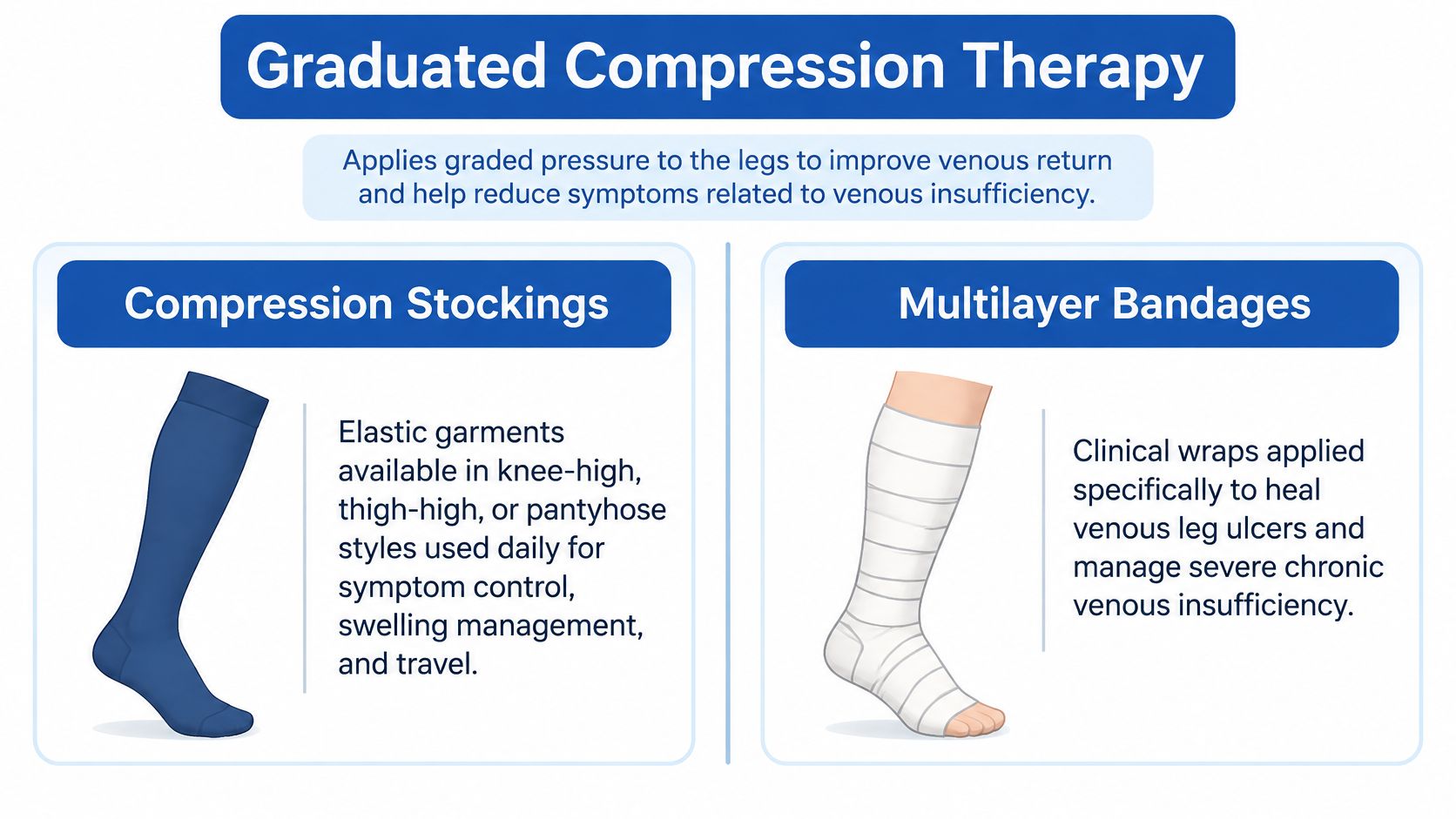
Graduated compression stockings apply firmer pressure around the ankle and progressively less pressure higher up the leg. They support venous return and can ease swelling, aching, and heaviness, particularly during prolonged standing. They don't repair failed valves or eliminate a refluxing saphenous vein.
For example, someone whose ankles swell during a standing shift may feel more comfortable wearing properly fitted stockings. A patient with a venous leg ulcer may instead need clinician-applied compression bandaging alongside wound care, after circulation has been assessed.
Fit and circulation matter more than strength
A Cochrane review of compression stockings found insufficient high-certainty evidence to determine their effectiveness as the sole initial treatment for varicose veins in people without active or healed venous ulcers. That doesn't make compression useless. It means symptom support shouldn't be presented as equivalent to closing the source of reflux.
- Measure before swelling builds: Use ankle circumference, calf circumference, and leg length rather than shoe size alone.
- Choose pressure deliberately: Stronger compression isn't automatically better, particularly with possible arterial disease, diabetes-related sensory loss, or fragile skin.
- Apply smoothly: Put stockings on when swelling is lowest, and avoid folds or rolled tops that create concentrated pressure.
Our explanation of compression stockings for chronic venous insufficiency distinguishes ongoing support from definitive vein treatment. Persistent pain or swelling despite a good fit calls for reassessment, not tighter stockings.
2. Micronized Purified Flavonoid Fraction (Diosmin-Based Venoactive Medication)
Category: Symptom-focused medication, not vein closure.
Micronized purified flavonoid fraction, usually called MPFF, is a diosmin-based venoactive preparation commonly combined with hesperidin. It's used for symptoms associated with chronic venous disease, such as heaviness, aching, and swelling. It doesn't remove varicose veins, restore damaged valves, or shut down a refluxing vein.
Consider someone who wants relief while deciding whether to proceed with ablation. An oral preparation may be discussed as an adjunct, but feeling better while taking it doesn't establish that the underlying circulation problem has resolved. Persistent skin changes or a wound still require assessment.
Judge it by a defined symptom, not a circulation promise
The practical question is whether a particular preparation produces a worthwhile change in your symptoms without unacceptable side effects or interactions. Product names and formulations vary, so a diosmin-containing supplement shouldn't automatically be treated as interchangeable with a standardized MPFF medication.
- Identify the exact preparation: Bring the packaging and ingredient list to your appointment.
- Review your medication list: Include prescriptions, supplements, and any history of medication reactions.
- Track a meaningful outcome: Record heaviness after work, ankle swelling, or discomfort during walking rather than relying on a vague sense of improved circulation.
Symptom relief can be useful without being corrective. A tablet that makes your legs feel better still doesn't close a leaking vein.
I wouldn't use MPFF as a reason to postpone duplex assessment when symptoms persist. Walking, elevation, and appropriately selected compression remain practical supportive measures, but none should obscure worsening disease. If the main objective is eliminating bulging veins, medication alone won't meet it.
3. Liquid Sclerotherapy
Category: Targeted treatment of small visible veins.
If your main concern is a cluster of spider veins or small blue reticular veins, liquid sclerotherapy may fit better than a catheter procedure. The clinician injects a sclerosant, commonly polidocanol or sodium tetradecyl sulfate, into the target vessel. The agent irritates its lining so the vein closes and gradually becomes less visible.
A typical use is treating residual small veins after the main refluxing vein has been addressed. It can also suit isolated surface veins when examination doesn't suggest a larger underlying problem. It isn't a substitute for treating significant saphenous reflux just because the visible veins are easier to reach.
Treat the feeder problem when one exists
The Cochrane review of injection sclerotherapy emphasizes the importance of differences in sclerosants, techniques, vein sizes, and comparison treatments. The practical implication is straightforward: the outcome depends on selecting the right vein and technique, not merely choosing an injection.
Possible trade-offs include bruising, tenderness, pigmentation, fine new vessels, and the need for additional treatment. Sclerotherapy also carries risks such as skin injury, allergy, and clotting, so careful injection technique and patient selection matter.
- Confirm the treatment target: Aching, swelling, recurrent veins, or skin changes may warrant duplex assessment before cosmetic injections.
- Plan for gradual change: Closure and visible fading aren't the same event, and appearance won't necessarily improve immediately.
- Use procedure-specific aftercare: Compression, exercise restrictions, and heat exposure advice should match your treatment.
Our sclerotherapy aftercare guidance explains practical recovery considerations. Don't assume an injected surface vein means all sources of reflux have been treated.
4. Ultrasound-Guided Foam Sclerotherapy
Category: Closure of selected refluxing veins and larger branches.
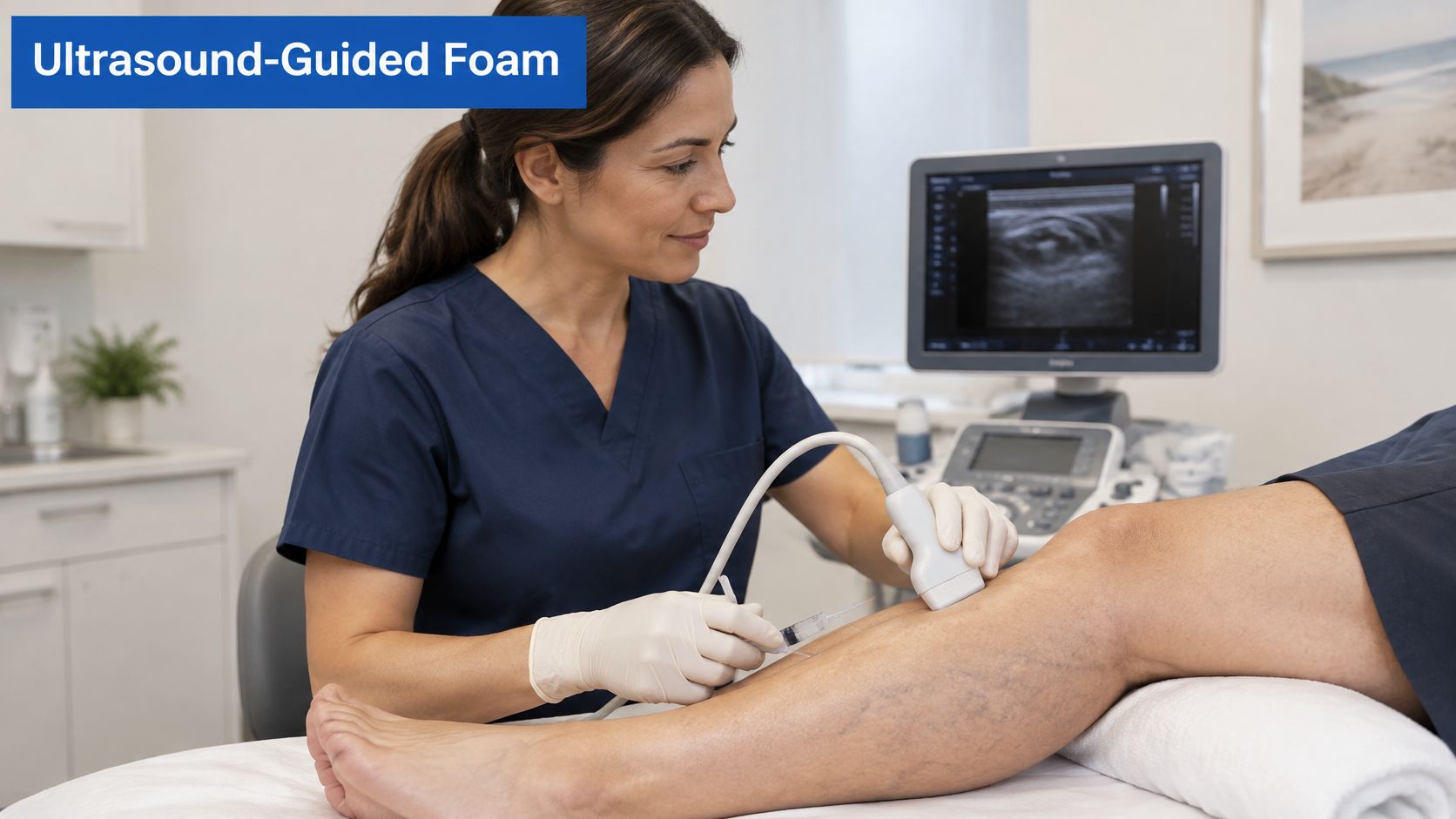
A twisted varicose branch may be difficult to treat with a straight catheter. Ultrasound-guided foam sclerotherapy allows the clinician to place a needle in the target vein, watch the injection, and follow the foam's distribution. The sclerosant is prepared as foam so it displaces blood and contacts the vein lining.
This can suit recurrent varicose veins, tortuous tributaries, or selected refluxing trunks when thermal treatment isn't appropriate. Unlike a cosmetic surface injection, the target may sit beneath the skin and be identifiable only with ultrasound. The ultrasound map determines whether foam is treating the source or a branch.
Useful flexibility, with possible retreatment
Foam can complement another procedure rather than replace it. A randomized study published in SAGE Journals reported residual or recurrent tributary reflux in 3 of 74 legs, or 4.1%, after transluminal foam combined with laser ablation, compared with 12 of 77 legs, or 15.6%, after laser ablation alone.
That finding concerns a specific combination technique, not a universal foam success rate. For an individual patient, the relevant questions are whether the target closes, symptoms improve, and additional branches need treatment.
Foam avoids heat but still involves an active medication and procedural risks. Tender lumps, pigmentation, superficial inflammation, clotting, and transient visual symptoms should be discussed beforehand. Report any previous reaction to sclerosants and relevant clotting history.
Walk according to your recovery plan, use prescribed compression, and attend the recommended reassessment. A less visible vein alone doesn't confirm that reflux has resolved.
5. Varithena (Polidocanol Endovenous Microfoam)
Category: Branded microfoam treatment for selected refluxing veins.
Varithena is a polidocanol endovenous microfoam, not an unrelated alternative to sclerotherapy. It belongs to the same broad chemical-closure category, but uses a standardized manufactured preparation rather than foam mixed by the treating clinician. It's delivered under ultrasound guidance to treat selected incompetent saphenous veins and associated varicosities.
For example, a patient with symptomatic great saphenous reflux and connected winding branches may be considered for microfoam. The advantage is the ability to distribute treatment through suitable vein segments without using thermal energy. The limitation is that chemical closure still depends on vein anatomy, flow, and an appropriate treatment plan.
Measure closure and symptoms separately
The European Society for Vascular Surgery evidence tables summarize a pooled randomized analysis in which polidocanol endovenous microfoam produced a duplex response of 74.5% at eight weeks, compared with 5.4% with placebo. That response meant elimination of saphenofemoral-junction reflux and/or complete target-vein occlusion, not guaranteed disappearance of every visible vein.
- Before treatment: Review previous clots, sclerosant reactions, medications, and the ultrasound-defined targets.
- After treatment: Follow the individualized walking and compression plan rather than borrowing instructions from another procedure.
- At reassessment: Discuss both symptom change and whether remaining visible branches need separate treatment.
Calling Varithena noninvasive would be misleading. It requires needle or catheter access and can cause inflammation, pigmentation, and venous thrombosis. Minimally invasive is the more accurate description.
The brand name doesn't decide suitability. A carefully mapped reflux pattern does, along with your medical history and treatment priorities.
6. VenaSeal Closure System (Cyanoacrylate Closure)
Category: Internal closure of a refluxing vein without heat.
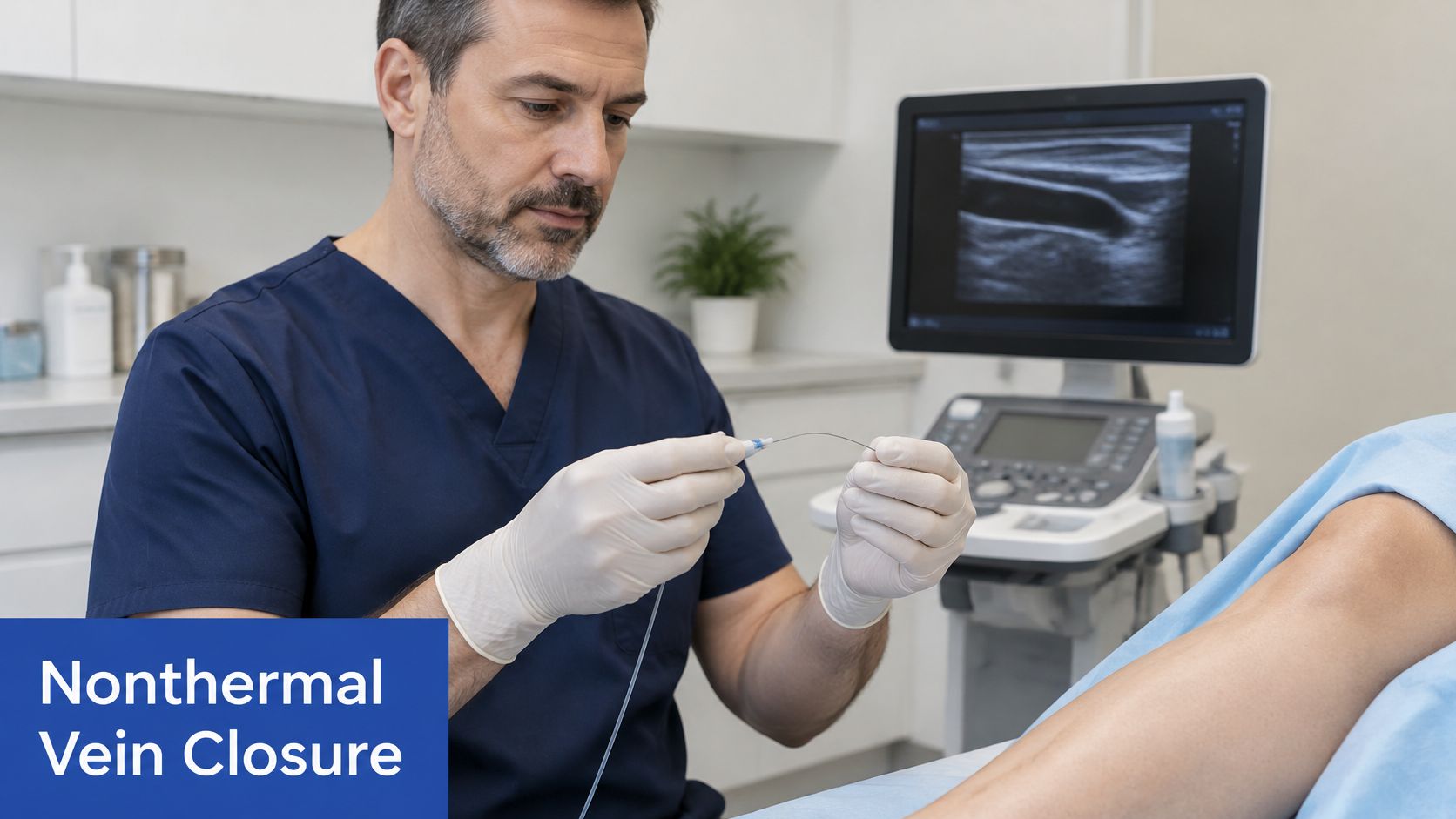
Avoiding heat doesn't have to mean choosing foam. The VenaSeal Closure System delivers a medical-grade cyanoacrylate adhesive through a catheter to seal a selected incompetent vein. Ultrasound guides positioning, while controlled adhesive delivery and external pressure bring the vein walls together.
This approach may suit a patient with a catheter-accessible refluxing saphenous vein who wants to avoid thermal treatment and its surrounding numbing injections. It still requires local preparation and vascular access. It isn't needle-free, and it doesn't directly erase every visible branch.
The trade-off is adhesive rather than heat
Thermal ablation uses heat and tumescent anesthesia around the vein. Cyanoacrylate closure avoids that thermal mechanism, but introduces an adhesive that remains in the treated vein. That distinction matters if you have a history suggesting adhesive or acrylate sensitivity.
A useful distinction: Avoiding heat removes heat-related concerns. It doesn't remove the possibility of inflammation, hypersensitivity, or thrombosis.
Redness and tenderness after adhesive closure can require assessment to distinguish an expected inflammatory response from a problem needing treatment. Significant swelling, worsening pain, or symptoms extending beyond the treated area shouldn't be dismissed as routine.
Compression requirements may differ from those after thermal ablation or foam. Follow the plan for your actual procedure, especially if it includes additional branch treatment or you have ongoing swelling.
For a patient with both truncal reflux and spider veins, VenaSeal addresses the leaking trunk. Cosmetic injections may remain a separate decision after the response to closure becomes clear.
7. ClariVein Mechanochemical Ablation
Category: Internal vein closure using mechanical irritation plus sclerosant.
ClariVein combines a rotating wire with a liquid sclerosant. The wire mechanically irritates the vein lining while the medication adds a chemical effect. The clinician guides the catheter with ultrasound and treats a suitable incompetent vein without thermal energy.
A typical candidate is someone with an accessible refluxing saphenous segment who prefers a nonthermal approach without adhesive implantation. The attraction is avoiding the heat-based mechanism and the accompanying tumescent injections along the treated segment. Local anesthesia at the access site may still be needed.
Two mechanisms don't mean every vein is suitable
ClariVein depends on both catheter access and appropriate sclerosant use. A severely winding vein may not offer a suitable catheter path, and medication-related contraindications still apply. Selecting mechanochemical ablation therefore involves more than a preference to avoid laser treatment.
- Map the route: Ultrasound establishes the vein's course, size, reflux pattern, and relationship to surrounding structures.
- Review the agent: The exact sclerosant and your history of reactions or thrombosis belong in the treatment discussion.
- Define the remaining work: Bulging tributaries or spider veins may need separate treatment even when the main vein closes.
Suppose duplex imaging shows a leaking main vein feeding a visible calf cluster. Mechanochemical ablation may address the main source, while targeted sclerotherapy addresses persistent branches. Treating only the cluster would leave the upstream reflux untreated.
The main practical limitation is that avoiding heat doesn't guarantee lasting closure or eliminate follow-up. Reopening, residual reflux, inflammation, and clotting remain relevant considerations. Judge the result by symptom improvement and the treated vein's status, not by the absence of thermal energy.
8. Endovenous Thermal Ablation (Laser and Radiofrequency)
Category: Heat-based closure of a refluxing main vein.
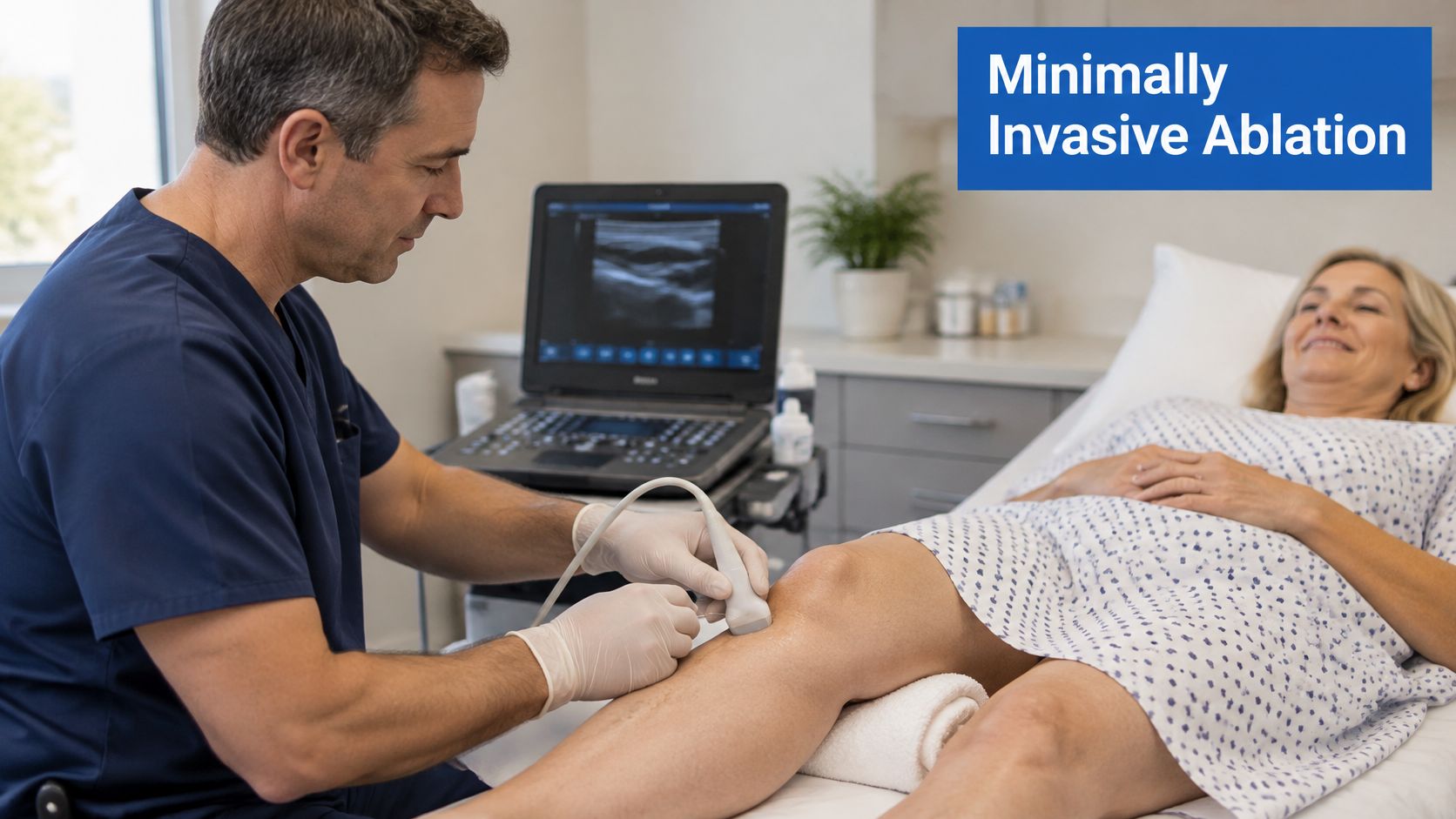
Endovenous laser ablation, or EVLA, uses a laser fiber, while radiofrequency ablation, or RFA, uses a heating catheter such as ClosureFast. Both close a selected diseased vein from inside rather than removing it through conventional stripping. Small access points are still required, so nonsurgical doesn't mean no puncture or no recovery.
These methods commonly suit a relatively straight, refluxing saphenous vein responsible for aching, heaviness, or connected varicosities. Blood then redirects through healthier pathways. The deep and superficial circulation must be assessed before deciding which vein to close.
Established treatment, not a lifetime guarantee
A randomized-trial evidence synthesis in BMC Surgery reported five-year clinical recurrence of 18.7% after RFA and 38.6% after EVLA. Those figures describe the evidence included in that synthesis, not a prediction for every device, anatomy, or patient.
Thermal procedures require tumescent anesthesia, fluid placed around the vein to numb the area and protect surrounding tissues. That adds injections, but it's an important safety step. Bruising, tenderness, nerve irritation, skin injury, and thrombosis belong in the risk discussion.
Our guide to recovery after greater saphenous radiofrequency ablation explains practical recovery considerations. Walking is generally encouraged, while compression and restrictions on strenuous activity should follow your individualized instructions.
For someone with a refluxing main vein and large surface branches, thermal ablation treats the source first or as part of a combined plan. It doesn't guarantee that every branch will disappear without additional treatment.
Non-surgical varicose vein treatments at a glance
| Item | Best For | Setting | Recovery Pattern | Key Limitation |
|---|---|---|---|---|
| Graduated Compression Therapy | Mild to moderate symptoms, swelling, and support alongside other treatments | Home use; clinical bandaging for ulcers | Ongoing use; symptom relief lasts while compression is worn | Does not correct reflux or eliminate varicose veins |
| Micronized Purified Flavonoid Fraction (Diosmin-Based Venoactive Medication) | Symptom relief in mild disease or as an adjunct | Oral medication; physician-guided | Taken for weeks to months; benefit is primarily symptomatic | Does not treat underlying reflux or remove veins |
| Liquid Sclerotherapy | Spider veins, reticular veins, and small varicose veins | Office-based | Little downtime; veins fade over weeks to months, often after multiple sessions | Not suited to large veins or significant reflux on its own |
| Ultrasound-Guided Foam Sclerotherapy | Larger varicose veins and saphenous reflux | Office or outpatient setting | Short recovery; return to daily activities soon, with compression afterward | Repeat treatment may be needed; requires ultrasound expertise |
| Varithena (Polidocanol Endovenous Microfoam) | Symptomatic incompetent great saphenous veins and varicose veins | Office or outpatient setting | Quick return to normal activities; walking and compression afterward | Not suitable for every patient; recurrence can occur |
| VenaSeal Closure System (Cyanoacrylate Closure) | Nonthermal closure of incompetent saphenous veins | Office or outpatient setting | Light activity and walking soon after treatment | Adhesive may cause inflammation or discomfort; long-term data are more limited |
| ClariVein Mechanochemical Ablation | Nonthermal treatment of saphenous reflux and selected tributaries | Ultrasound-guided outpatient setting | Quick procedure; rapid return to normal activities | Requires specialized equipment and training |
| Endovenous Thermal Ablation (Laser and Radiofrequency) | Symptomatic saphenous reflux and varicose veins requiring closure | Ultrasound-guided outpatient procedure | Most return to usual activities within days | Requires tumescent local anesthesia; recurrence can occur |
Choosing the Right Non-Surgical Path for Your Legs
Start with symptom control, but don't confuse the starting point with the final treatment. Compression, walking, and elevation can support comfort while the cause is evaluated. They aren't prerequisites that everyone must exhaust indefinitely before considering a closure procedure, particularly when significant reflux or skin complications are present.
Our consultation process uses clinical examination and duplex ultrasound to identify where abnormal reflux occurs and match the plan to your symptoms, vascular health, and goals. The decision should account for vein size, location, depth, tortuosity, and whether the problem involves a main trunk, tributaries, or small surface vessels. A preferred brand comes after that assessment, not before it.
Match the treatment to the job
- For symptom support: Consider properly selected compression and conservative measures, with medication as an individualized adjunct rather than a cure.
- For a refluxing main vein: Compare thermal ablation, adhesive closure, mechanochemical treatment, or foam according to anatomy and medical history.
- For remaining visible veins: Use targeted treatment after accounting for any larger reflux source.
Wounds and skin changes deserve more urgency than a cosmetic concern. The NICE baseline assessment tool identifies symptomatic or recurrent varicose veins, venous skin changes, and venous ulcers as reasons for vascular referral, and bleeding varicose veins require immediate referral. Wound care and vein evaluation may need to proceed together rather than waiting for one problem to resolve first.
Postpartum concerns also need the right anatomical assessment. Information about managing vulvar varicosities postpartum addresses a different location and clinical context from ordinary leg-vein treatment. Persistent pelvic or vulvar symptoms shouldn't automatically be assigned the same plan as an isolated calf vein.
Before deciding, make sure you understand which vein is being treated, whether that treatment addresses the reflux source, and what may remain afterward. Discuss the anesthesia, medication or adhesive involved, recovery instructions, and follow-up plan. A clear explanation of those trade-offs is more useful than a promise of effortless or permanent results.
Book a vein consultation and bring your medication list, previous vein-treatment records, and a description of when symptoms interfere with daily life. The next step is a personalized plan based on the source of the problem, not just the veins you can see.
Vein and Wound Institute offers duplex-based evaluation, minimally invasive vein treatments, compression therapy, and coordinated wound care for patients with symptomatic veins or non-healing wounds. Visit Vein and Wound Institute to arrange a consultation and discuss which nonsurgical approach fits your circulation, symptoms, and goals.