You got home the same day, stocking snug, with a small bandage and a list of instructions that felt shorter than the questions in your head. That gap is what radiofrequency ablation greater saphenous vein recovery looks like. There isn't one back-to-normal date. Your job, how long you stand, and whether the treated vein stays closed on a later scan matter more than a generic calendar. Early comfort is encouraging. It isn't the same thing as a finished result.
Table of Contents
- Recovery Timeline at a Glance
- Caring for the Treatment Site in Week One
- Activity Limits and When You Can Return to Work
- Managing Pain, Bruising and Tenderness
- Warning Signs That Need a Call to Your Provider
- Book Your Follow-Up Scan to Confirm Closure
Recovery Timeline at a Glance
Say you left the office this afternoon after radiofrequency ablation of the greater saphenous vein. Most minimally invasive endovenous procedures are performed under local anesthesia to numb the treatment area, and you usually remain awake. You may feel pressure or brief discomfort, but significant pain isn't typically expected. Many minimally invasive vein procedures take approximately 15 to 45 minutes, depending on the procedure and the number of veins treated. You walk before you leave. Then you rest at home with the stocking or bandage in place.
The vein was heated from the inside through a small access point so it closes, and blood redirects through healthier veins. That is different from traditional stripping, which removes the vein through larger incisions. Office treatment avoids general anesthesia. The leg can still feel odd for days, because the closed vein and the nearby tissue need time to settle.
| Phase | What you can usually do | What to watch for |
|---|---|---|
| Procedure day | Walk around before leaving and rest at home | Numbness, pressure or mild tenderness at the access site |
| Days 1 to 3 | Short walks several times a day and compression as directed | Tenderness and mild swelling along the treated vein |
| Week 1 | Desk or light activity if your job allows; no strenuous exercise | Bruising along the vein, fading over the following days |
| Weeks 2 to 4 | Gradually increase walking and daily activity | Symptoms usually improve; call if they worsen |
| One month | Attend the follow-up duplex ultrasound | Confirmation of closure and any residual reflux |
| Month 3 onward | Return to full exercise once your provider clears you | New bulging veins, heaviness or swelling that returns |
How to read the phases
Procedure day is about moving a little, then sitting with the leg up. Days 1 to 3 are for short walks, not a long hike. Week 1 is often fine for desk work if compression is tolerable and the leg isn't throbbing. Weeks 2 to 4 are when many people notice the heavy, achy vein symptoms starting to ease, while bruising fades from purple toward yellow-green. The one-month visit is when ultrasound checks closure. It isn't a ribbon-cutting for a permanent cure. From month 3 onward, new bulging, returning heaviness, or swelling that comes back still needs a look.
Practical rule: Treat this table as your baseline. A change that moves the wrong way, more pain, more swelling, or a new firm cord, is the thing to flag, not the bruise that slowly lightens.
Numbness near the access site can linger and then fade. Tenderness along the treated path is common. Use the row you're in today, then compare tomorrow with that row rather than with someone else's recovery story.
Caring for the Treatment Site in Week One
The first week is a short routine, repeated. After a vein procedure, you may be asked to wear compression, avoid strenuous exercise for a period of time, and follow specific bathing or wound-care directions. Instructions vary by procedure, so the plan you were given outranks a generic blog schedule.
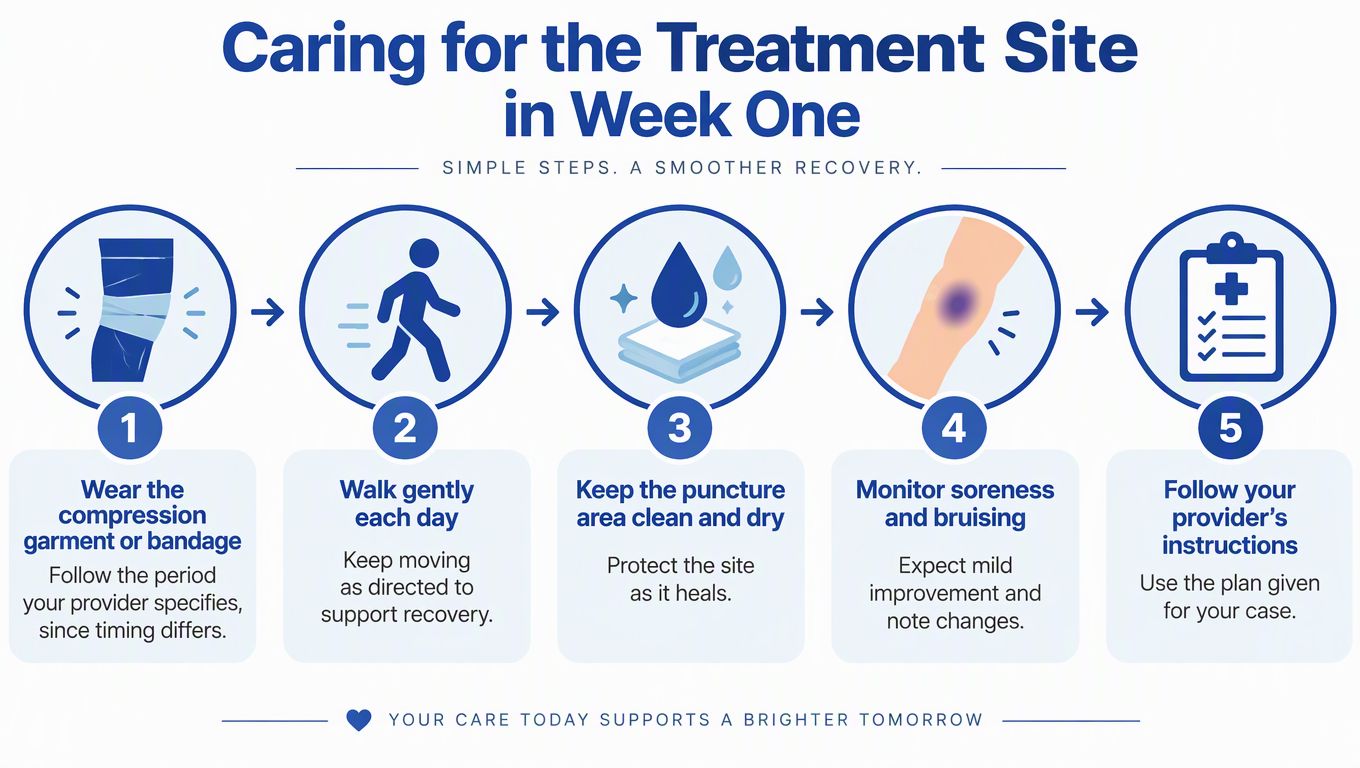
Wear the compression garment or bandage for the period your provider specifies, and keep it on through the day, not only while you are out walking. Steady pressure supports the closed vein and limits swelling while blood uses healthier routes. Our page on compression therapy for varicose veins walks through how that pressure is meant to work. The common slip is peeling it off at the desk because it feels warm, then wondering why the ankle looks puffier by evening.
Walk for short periods several times a day, starting the evening of the procedure. Early walking keeps blood moving and is part of standard recovery, even when the leg feels heavy. A lap around the house counts. The slip is skipping those walks because the leg feels tight, which is exactly when gentle movement helps more than another hour on the couch.
Keep the access sites clean and dry, and leave the dressing on for the time you were given. The puncture is small, but it is still a break in the skin. Don't soak the dressing or peel it early to "check healing." The slip is swapping the bandage for a loose adhesive strip before the skin has sealed.
Follow the bathing instructions you received. Showers are often allowed sooner than a bath, pool, or hot tub, because soaking and heat can soften the site and increase swelling. Wait for the timing you were given before you stand under water, and keep the spray off the dressing if you were told to. The slip is a long hot bath on day two because the leg feels stiff.
Check each access site and the length of the treated vein once a day. Look for spreading redness, warmth, drainage, or bleeding, and write the date next to any change. A faint bruise along the vein can be expected. A site that gets wetter, redder, or more painful is not. The slip is glancing once and assuming tomorrow will look the same.
What a working first week looks like
A normal first week is uneven, not dramatic. You walk, the stocking stays on as directed, the puncture stays dry, and tenderness eases a little between day three and day seven. Bruising can look darker before it fades. If the routine is in place and nothing on that daily check is spreading, the plan is doing its job.
Activity Limits and When You Can Return to Work
There is no single day when everyone is "back to normal." Return to work tracks your job, the compression you were given, the length and location of the treated vein, how much you bruise, and whether a phlebectomy was done at the same visit. Walking can feel easy while a 10-hour standing shift still does not.
| Activity | Typical guidance | What changes the timing |
|---|---|---|
| Walking | Start the same day and do it several times daily | Pain and swelling levels; rarely restricted |
| Desk or light office work | Often within days, if comfortable and compression is tolerated | Compression method and pain control |
| Physically demanding work | Usually later, once your provider clears you | Lifting, prolonged standing and bruising along the leg |
| Driving | When you can brake and turn comfortably without leg pain | Leg swelling and pain from the treated vein |
| Running, cycling or gym training | Hold until your provider clears you | Strain can increase swelling and bruising |
| Hot tubs, saunas and long baths | Avoid until the site has healed and you are cleared | Heat can increase swelling |
Compression is one of the clearest reasons two people with the same job get different answers. In a randomized study of 210 patients, reported return-to-work time was 2.11 ± 1.19 days with elastic stockings versus 4.39 ± 2.55 days with multilayer bandaging, as described in Vascular. A small self-paired comparison of radiofrequency and laser treatment also found similar recovery profiles, but that sample was only 8 patients and 16 limbs, so it shouldn't set your calendar.
When you can do more than walk
Move from walking to strenuous exercise only when four things are true at once. You can walk longer without stopping for pain. Pain is easing from day to day, not bouncing up after each outing. Swelling isn't growing. A bout of activity doesn't leave new bruising or a heavier leg the next morning.
Confirm the timing with us before lifting, long standing shifts, or driving, especially if the right leg was treated and you need a firm brake. If sclerotherapy was done around the same time, the dos and don'ts of sclerotherapy aftercare belong in the same plan, because surface injections add their own limits on heat and strain. A warehouse shift and a laptop job are not the same recovery.
Managing Pain, Bruising and Tenderness
Expect a specific pattern, not a pain-free leg. Tenderness follows the treated vein. Bruising often shifts from dark purple toward yellow-green as it fades. A tight, pulling feeling is common while the vein seals. Mild swelling usually eases when you walk and then put the leg up.
In a recent 50-limb series using newer-generation radiofrequency ablation, technical success was 100%, and short-term events included ecchymosis in 4%, pain in 8%, and hyperpigmentation in 2%, with no deep-vein thrombosis or thermal puncture injury during follow-up, as reported in this PubMed Central review of radiofrequency outcomes. Those figures describe that series, not a promise that your leg will be bruise-free. Many people begin noticing changes in their vein symptoms during the first several weeks after treatment, and comfort can improve on Tuesday and feel tighter again on Thursday.
What to do about ordinary soreness
- Take pain relief exactly as directed. Don't add a second medicine because a neighbor used it after surgery.
- If you take a blood thinner, ask before you use aspirin or an anti-inflammatory. Those drugs can affect bleeding at the access site.
- A cool pack over clothing, in short sessions, is reasonable only if your provider has approved it. Never put ice directly on the skin.
- Raise the leg while you rest, with the foot higher than the hip, for a short spell several times a day.
- Don't massage firmly along the treated vein. Rubbing a tender, closing vein can worsen bruising.
Bruising can take several weeks to settle, even when walking already feels fine. A yellow patch low on the calf can be blood that tracked downward. Pain or bruising that is getting worse, rather than slowly easing, is the signal to call. The warning list below is the one to match against that change.
Warning Signs That Need a Call to Your Provider
Feeling better on day four doesn't rule out a problem. Ordinary inflammation, a clot, skin injury, and nerve irritation can look alike at the kitchen table. Check the symptom against a list instead of deciding it is "just healing."
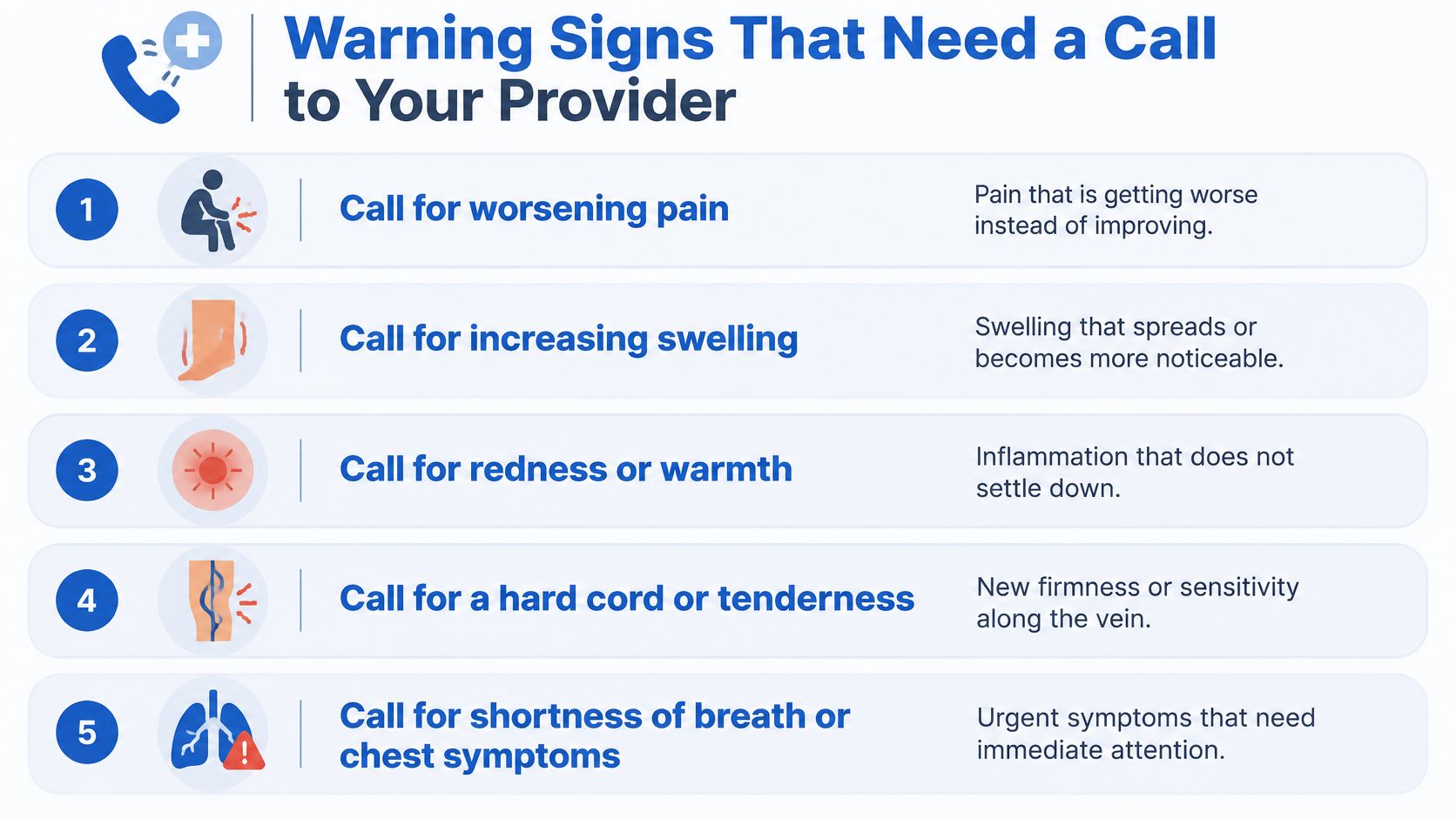
Endothermal techniques can cause ecchymosis, skin burns in about 1% of cases, and nerve injury in up to 22%, although rates vary by technique, anatomy, definitions, and study population, according to a clinical review of endothermal vein treatment. The same review notes that these treatments can mean an earlier return to work and less pain than stripping. Faster overall recovery still leaves a smaller set of procedure-specific symptoms that need a same-day response.
| Symptom | Possible cause | What to do |
|---|---|---|
| Calf pain and swelling in one leg that worsens | Possible deep vein thrombosis | Seek emergency care now |
| Chest pain or shortness of breath | Possible clot travelling to the lungs | Call emergency services now |
| Fever, spreading redness or pus at an access site | Possible wound infection | Contact your provider the same day |
| Numbness or tingling that persists beyond the expected period | Possible nerve irritation | Report it for assessment |
| Burning, blistering or discolored skin along the leg | Possible skin injury from heat | Contact your provider promptly |
| Firm cord along the treated vein that grows | Possible thrombophlebitis or recanalization | Report it and arrange a duplex scan |
| Bleeding at an access site that does not stop | Access-site bleeding | Apply firm pressure and seek care |
The first two rows are emergencies. Worsening calf pain with one-sided swelling, or chest pain with shortness of breath, needs emergency care now, not a message left after hours. Fever, pus, or redness that spreads can be a wound infection. The signs of wound infection and when to seek medical attention are worth reading if the puncture looks angry. Call the same day.
A short list for the fridge
- One leg suddenly bigger or more painful: emergency care.
- Chest symptoms or breathlessness: emergency services.
- Fever, pus, or redness that spreads: same-day call.
- Blistering, a growing firm cord, bleeding that won't stop with firm pressure, or numbness that isn't fading: call and don't wait for the routine scan.
A firm cord that stays stable can be the treated vein. A cord that lengthens, or skin that blisters, is not something to watch over the weekend.
Book Your Follow-Up Scan to Confirm Closure
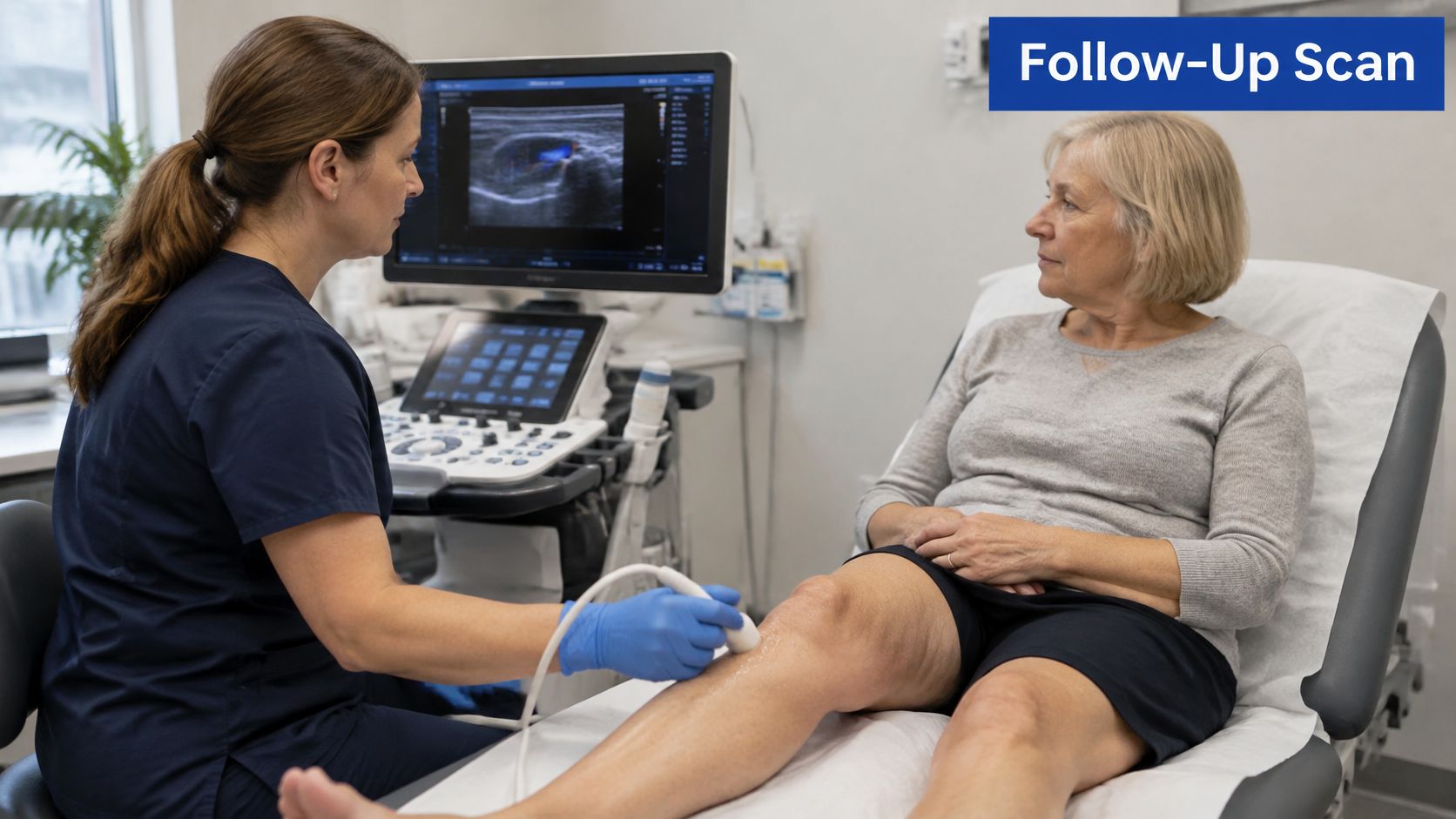
A follow-up duplex ultrasound is how closure gets confirmed, not how you feel on a Tuesday. The scan looks at whether the greater saphenous vein has shut and checks the common femoral vein, the saphenofemoral junction, and the proximal femoral vein. An accredited vascular-testing protocol commonly schedules that follow-up at about 1 week and 1 month, as set out in the Intersocietal Accreditation Commission endovenous thermal ablation protocol. A follow-up ultrasound may be used to confirm that the vein has closed, and that visit is also when residual reflux can be mapped.
Closure rates are strong, and they are still checkpoints. A meta-analysis of 29 studies found great saphenous vein occlusion of 98.35% at 1 month and 93.13% at 1 year after radiofrequency ablation, and longer-term randomized evidence reported 91.9% closure at 36 months, figures gathered in that same protocol document. Early technical success can slip later. Residual reflux, recanalization, untreated tributaries, or disease in another segment can bring symptoms back even after the first scan looked closed.
Book it before the week gets away
- Book the one-month scan before you leave the clinic, and keep the earlier check if one was scheduled.
- Bring a current medicine list, including blood thinners and pain pills you actually took.
- Write down symptoms since the procedure, with dates, especially swelling, chest symptoms, or a new cord.
- Set a reminder for later reviews if heaviness or new veins show up months from now.
Book the scan this week if it isn't already on the calendar. A closed vein on paper is only as useful as the ultrasound that proves it.
Vein and Wound Institute provides radiofrequency ablation, duplex ultrasound follow-up, and coordinated care for venous disease and chronic wounds for patients across Los Angeles, Santa Barbara, and Ventura Counties. If you are sorting out walking limits, compression, or a closure scan after treatment of the greater saphenous vein, we can match the plan to your ultrasound and your workday. Visit Vein and Wound Institute to schedule a consultation or ask about your follow-up.