
You're sitting on the edge of the bed at 7 a.m., wrestling a thick compression stocking over your ankle. Your fingers ache, the top band rolls into a tight cord behind your knee, and you're left wondering if all this pinching means the garment is working or causing harm.
That daily frustration is where compression therapy for lymphedema usually succeeds or fails. Most guides focus almost exclusively on pressure numbers printed on a box, as if tighter automatically means better. In real life, a garment sitting in your dresser drawer controls zero swelling.
What determines your results is the match between your treatment stage, the right amount of pressure, and a device you can realistically put on and tolerate every day. Breaking down how compression works, what each option does, and when a clinician needs to step in takes the guesswork out of managing a swollen limb.
Table of Contents
- Why Compression Works in Two Stages
- Compression Options by Phase and Suitability
- How Much Pressure Is Right for You
- Choosing a Device When Garments Are Hard to Manage
- How to Fit and Care for Compression Garments
- Warning Signs That Mean Stop and Call Your Clinician
- Self-Care Versus Professional Lymphedema Therapy
- Get a Fitted Assessment Before You Buy Garments
Why Compression Works in Two Stages
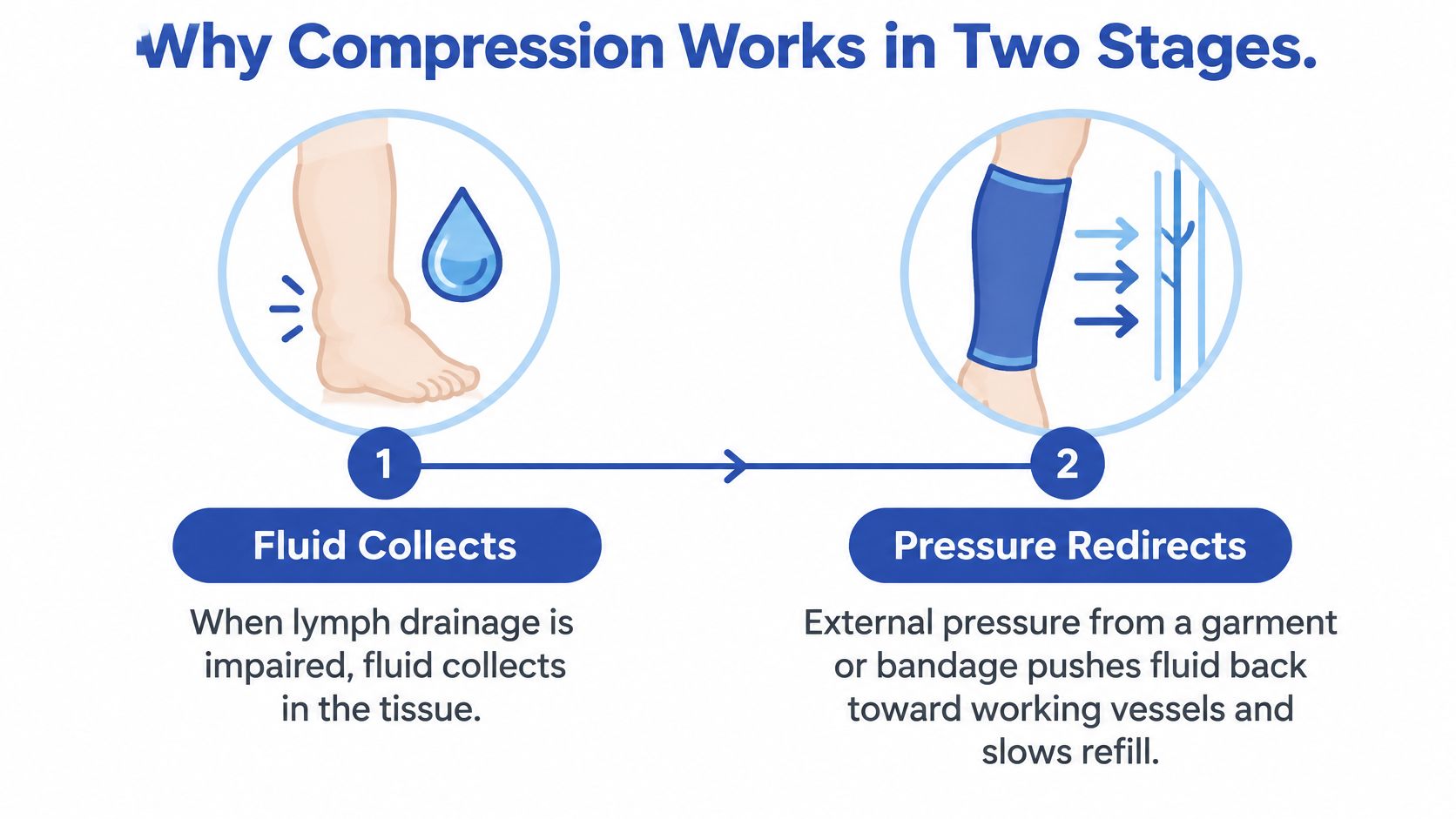
A swollen limb can feel as if fluid is moving in one direction all day: out of the bloodstream, into the soft tissue, and then staying there. When lymphatic vessels are damaged, blocked, or overloaded, protein-rich fluid cannot drain at a normal pace. The tissue stretches, and the arm or leg may feel heavy, tight, or spongy. External pressure from a bandage or medical garment pushes back against that tissue, encourages fluid to move toward working lymph vessels, and slows refilling.
A loaded suitcase works like a useful comparison here. Zipping it shut after removing clothes keeps the contents from spilling back out, but the first step is still getting the extra items out. Compression follows the same sequence. It first reduces excess fluid, then uses steady pressure to help maintain the result.
Intensive Reduction Versus Long-Term Maintenance
Treating lymphedema follows that two-stage logic. Stage one, called intensive reduction, uses firm, structured compression, often daily bandaging over several weeks, to move excess volume out of a swollen limb and soften thickened tissue. Stage two, long-term maintenance, shifts you into a fitted medical garment designed to hold onto the progress you just earned.
Clinical evidence shows why skipping the first stage can leave results behind. According to the UpToDate clinical review on peripheral lymphedema management, a randomized study of 90 patients with unilateral lymphedema compared 18 days of multilayer short-stretch bandaging followed by 24 weeks of elastic compression hosiery against 24 weeks of elastic hosiery alone. At the 24-week check, the combined bandaging-and-hosiery group cut limb volume by approximately 31%, compared with 16% for hosiery alone, nearly double the reduction.
A garment designed to maintain a stable limb rarely has the mechanical structure needed to decongest an actively swollen one.
The same review notes that reported volume reductions across different studies and lymphedema causes range widely from 17% to 60%, depending on disease severity, treatment phase, daily adherence, and the underlying cause. That spread is a reminder that pressure alone does not determine the result. A plan only works if the device matches the limb, the stage, and what the patient can realistically wear day after day.
Why Timing Dictates the Tool
Trying to squeeze a heavily swollen, misshapen leg straight into an elastic maintenance stocking usually backfires. The fabric rolls, digs into skin folds, and leaves fluid trapped below the tightest ring. Before starting either phase, a clinician evaluates arterial circulation, skin health, limb contour, tissue hardening (fibrosis), joint mobility, and whether you can physically get the device on by yourself.
Compression Options by Phase and Suitability
Different compression devices serve different jobs, so matching the tool to your treatment phase and daily routine keeps therapy sustainable. The table below compares the five main categories clinicians use.
| Option | Phase it usually serves | How pressure is set | Best suited for |
|---|---|---|---|
| Multilayer short-stretch bandaging | Intensive reduction | Sub-bandage pressure chosen by stage and tolerance | Heavy swelling and fibrosis, after training |
| Adjustable compression wraps | Intensive reduction or self-managed phase | Set by wrap tension and limb shape | People who cannot wrap bandages themselves |
| Elastic compression hosiery | Long-term maintenance | Graded by compression class | Stable limbs after reduction |
| Nighttime compression systems | Overnight, alongside daytime garments | Device-specific, lower working pressure | Swelling that returns overnight |
| Intermittent pneumatic compression | Adjunct to decongestive therapy | Set by the device cycle | Selected cases; pooled benefit not statistically significant |
What Trial Data Shows About Wraps, Night Systems, and Pumps
Traditional multilayer bandaging isn't the only way to move fluid during the intensive phase. In a prospective randomized study of 36 women with breast-cancer-related arm lymphedema reported in Cancer, 18 participants wore adjustable compression wraps and 18 received conventional compression bandaging during acute treatment. After one week, affected-limb volume dropped by 0.21 liters in the wrap group and 0.28 liters in the bandaging group (both statistically significant at p < 0.001). Excess-volume reduction reached 8.3% with wraps versus 12.6% with bandaging at week one, and 10.4% versus 15.2% at week two, with no statistically significant difference between the two groups.
That same publication highlights a separate multicenter randomized trial examining what happens overnight. Patients wearing standard daytime garments alone achieved a 1.5% excess lymphedema reduction, while adding nighttime bandaging brought reduction to 12.1% and adding a specialized nighttime compression-system garment raised it to 15.9%. If your limb looks slim at bedtime yet feels heavy again every morning, overnight support can bridge a gap daytime stockings can't close on their own.
Pneumatic pumps, which inflate and deflate sleeves around the limb, often attract patients hoping for an effortless fix. However, a 2024 systematic review and meta-analysis published in PMC evaluated adding intermittent pneumatic compression to decongestive lymphatic therapy and found a pooled standardized mean difference of 0.63 for percentage volume reduction (95% confidence interval -0.24 to 1.50), with no statistically significant difference between treatment groups (p = 0.15). Pumps can still play a supporting role for selected individuals, though they don't replace hands-on compression garments or wraps.
Reading the Options Table for Your Own Routine
Notice that you never pick a pressure level off a pharmacy shelf. A trained clinician prescribes the pressure after measuring your limb and checking your blood flow. Start by identifying your current phase in the second column, then narrow down the right-hand column to the option that matches your hand strength, limb shape, and schedule.
How Much Pressure Is Right for You
A patient orders the highest class of compression stockings online, expecting the strongest squeeze to flatten swelling quickly. Instead, the garment hurts, leaves marks on fragile skin, and becomes something they avoid wearing. Pressure that is too firm can make daily use harder. The useful level is the lowest pressure that controls swelling while still fitting your limb, skin, strength, and schedule.
| Situation | Pressure or setting | Documented outcome |
|---|---|---|
| ISL stage II or higher lymphedema | At least 45 mmHg sub-bandage pressure | International guidance recommendation |
| Higher pressure cannot be tolerated | 15 to 25 mmHg may be appropriate | International guidance recommendation |
| Upper-limb trial, short-stretch bandage | 20 to 30 mmHg | Limb volume reduced by about 1.5% after two hours |
| Upper-limb trial, short-stretch bandage | 44 to 58 mmHg | Limb volume reduced by about 2.5% after two hours; no significant difference after 24 hours |
An evidence summary in Wound Practice and Research reports that international guidance recommends a sub-bandage pressure of at least 45 mmHg for International Society of Lymphology (ISL) stage II or higher lymphedema, yet specifically notes that 15 to 25 mmHg may be appropriate whenever higher pressure can't be tolerated. In an upper-limb randomized trial cited in that same summary, short-stretch bandages delivering 20 to 30 mmHg and 44 to 58 mmHg reduced limb volume by approximately 1.5% and 2.5% after two hours, with no significant difference between groups after 24 hours. That detail matters for adherence. A lower range may be easier to wear, and easier wear gives a garment more chance to do its job across the day.
Clinical takeaway: More millimeters of mercury on a prescription only help if you can safely wear the garment for the full prescribed schedule.
Resting Pressure Versus Working Pressure
Resting pressure is the gentle squeeze you feel while lying still. Working pressure is the firm resistance a garment or short-stretch bandage creates when your muscles contract against it during walking or arm movement. Short-stretch materials stay comfortable at rest while pushing firmly against active calf or forearm muscles, which pumps fluid upward more efficiently.
Think of the limb as a pump that needs a steady wall to push against. During movement, that wall gives the muscle something to work into. During rest, the same material should feel tolerable enough that you keep it on. Posture and movement shift how hard a device presses against your skin, so clinicians document the actual interface pressure alongside factors like limb location, skin fragility, pain, fibrosis, and hand dexterity. Arms usually need less pressure than legs because gravity pulls less aggressively on upper limbs.
Circulation Checks Before Strong Compression
Strong compression is unsafe for some swollen legs. Before prescribing firm pressure, especially if you have venous disease or an open wound, your clinician must assess arterial perfusion, which means blood flow coming into the limb. Compression therapy does not take the place of diagnosing arterial insufficiency, active infection, uncontrolled heart failure, or other medical causes of leg swelling.
At your next appointment, bring three direct questions:
- What pressure level did you choose? Ask for the exact range in mmHg so you have it written down.
- Why does this setting fit my limb? Clarify how your stage, skin condition, and mobility shaped that choice.
- Can we step down if it hurts? Confirm whether a lower, tolerable pressure is an option rather than giving up on wear entirely.
Choosing a Device When Garments Are Hard to Manage
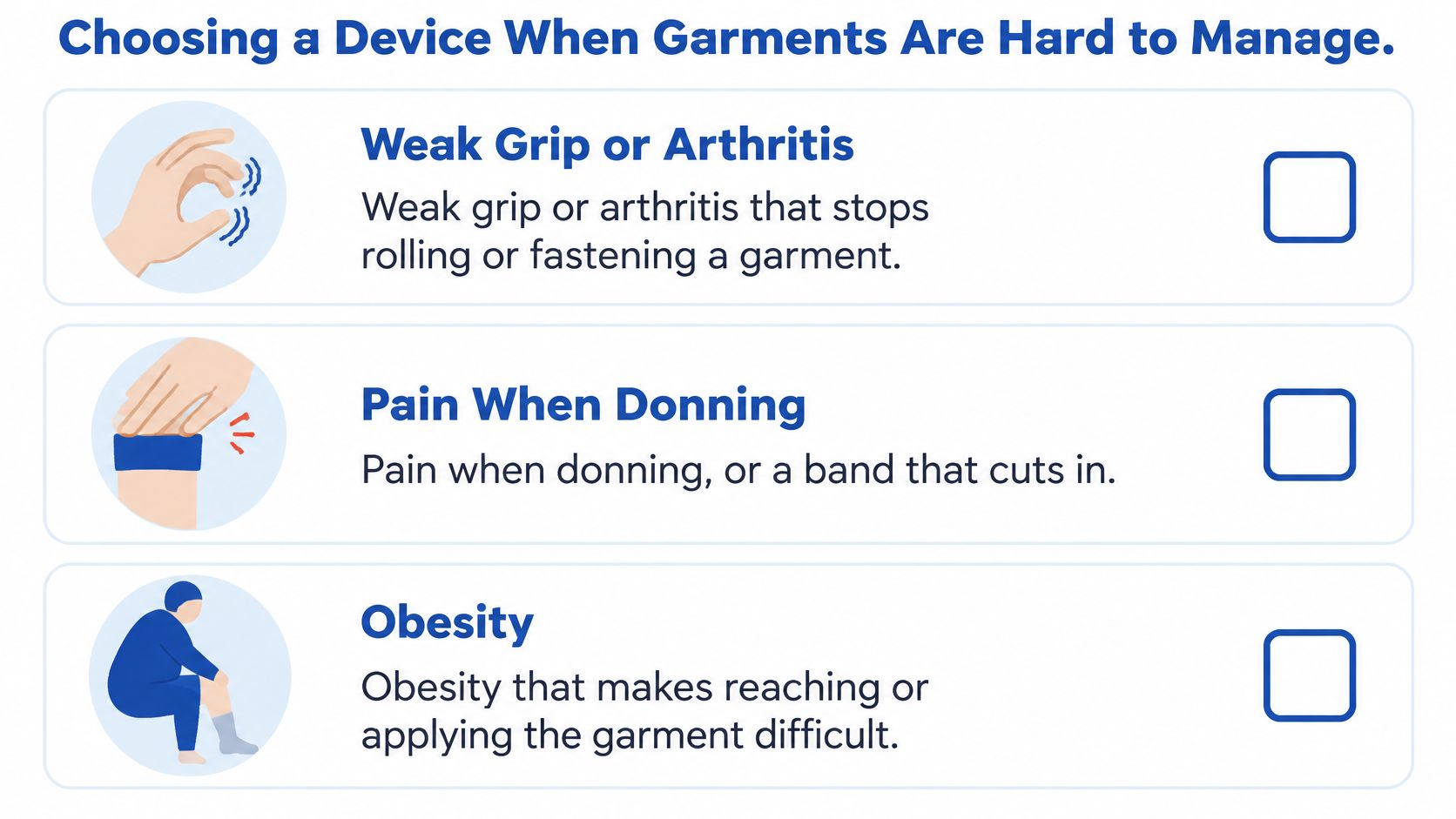
Even a perfectly measured garment fails if getting it on feels like an athletic event. Standard patient handouts often ignore the physical hurdles that stop people from wearing compression consistently. Check whether any of these five barriers sound familiar:
- Weak grip or hand arthritis: Stiff fingers or reduced thumb strength make it nearly impossible to stretch heavy knit fabric over a heel or pull a sleeve past the elbow.
- Pain during application or a cutting band: Sensitive skin, neuropathy, or a tight top cuff digging into the calf turns every morning routine into dread.
- Obesity or irregular limb shape: Deep skin folds, a wide thigh, or trouble bending down to reach your toes keep off-the-shelf circular-knit stockings from sitting flat.
- Heat and heavy sweating: Warm climates or hot workplaces make thick daytime garments feel suffocating, leading people to peel them off by noon.
- Living alone without caregiver help: Multi-layer bandaging or stiff flat-knit stockings that require a second pair of hands won't work if you dress independently every day.
Matching Real-World Barriers to Practical Devices
Look back at the comparison table to pair each hurdle with a workable alternative. People struggling with arthritis, reaching their feet, or dressing solo often do far better with adjustable compression wraps fastened by overlapping hook-and-loop straps instead of pull-on stockings. If limb contours are uneven or skin folds trap circular-knit fabric, custom flat-knit garments bridge across creases without rolling into cords. For heat intolerance, lighter daytime wear paired with a breathable nighttime system keeps swelling from spiraling overnight.
Adherence data backs up choosing comfort and independence. In the 2024 TEAYS randomized crossover study of lower-extremity lymphedema indexed on PubMed, participants achieved 81% adherence with a nonpneumatic compression device versus 56% with an advanced pneumatic device (P < .001), alongside 78% satisfaction compared with 22%. The same source notes a 2025 randomized trial of 24 patients with stage II to III bilateral leg lymphedema showing adjustable wraps were noninferior to conventional multilayer bandaging across a 10-day intensive phase, provided patients received proper indication screening and hands-on training.
Handling Daytime Swelling Shifts Safely
Sometimes a garment feels fine at breakfast, then feels painfully snug by late afternoon as gravity pulls fluid downward. With adjustable wraps, you can loosen and re-fasten individual straps to keep tension even as your limb changes size. With a fixed pull-on stocking, sudden afternoon tightness means you should raise the limb, rest, and let your clinician know the fit isn't holding steady rather than trying to fold the cuff down.
Convenience never overrides medical safety. A wrap or nonpneumatic device you can put on in two minutes still requires screening for arterial disease, acute skin infection, and other contraindications before you strap it on.
Before your next clinic visit, narrow your discussion down to two practical device options that fit your lifestyle, and write down the exact barriers (grip pain, heat, reaching your ankles, or dressing alone) that made previous garments fail.
How to Fit and Care for Compression Garments
Good compression doesn't start when you pull a stocking out of a box. It starts with a trained clinician or certified fitter taking precise circumference measurements of your limb, then rechecking those numbers whenever swelling noticeably shifts. Once you have the right size in hand, a steady daily routine protects both your skin and the elastic fibers inside the fabric.
Your Seven-Step Daily Routine
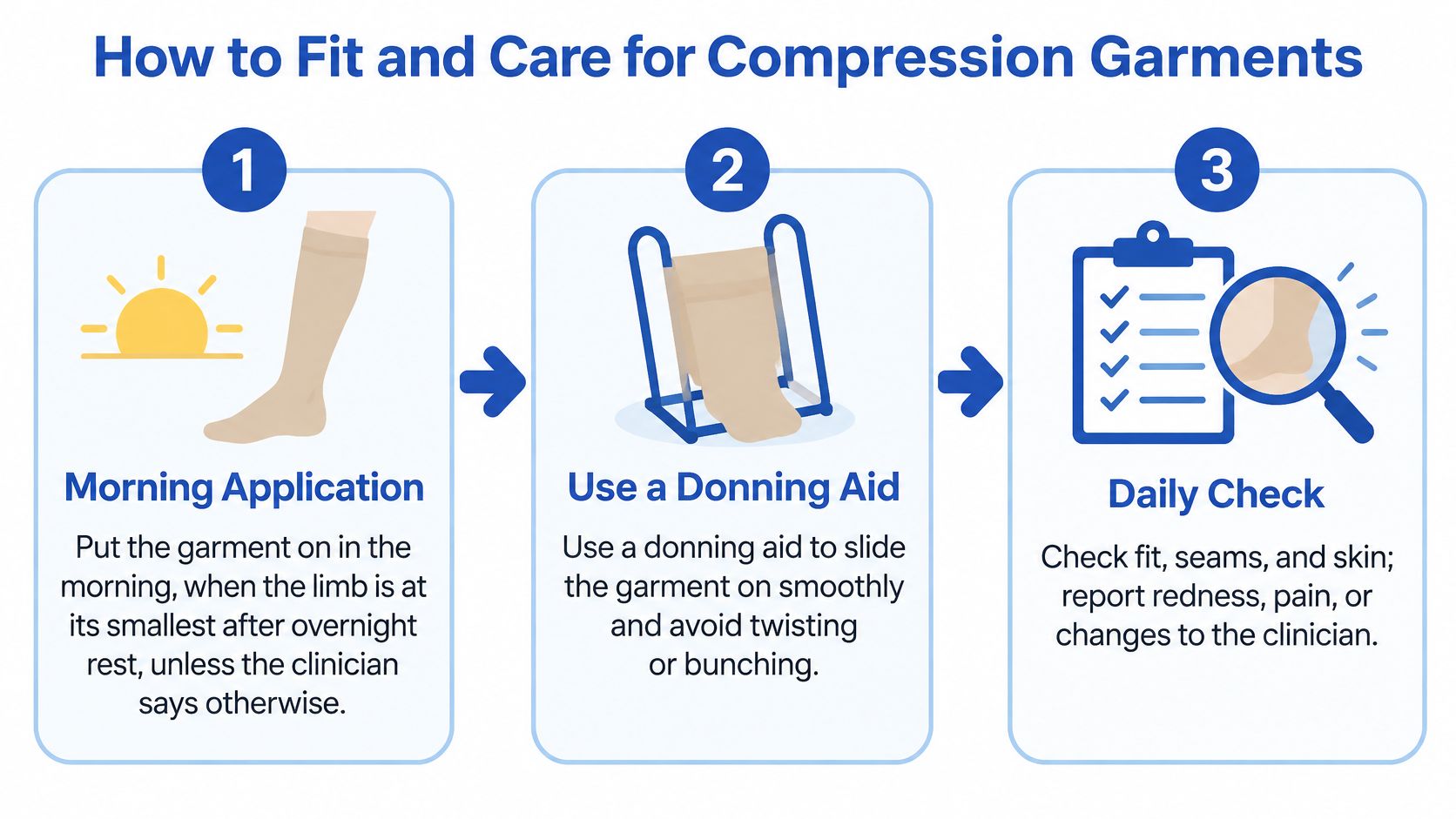
- Apply the garment first thing in the morning. Your limb is at its smallest right after lying flat overnight, making application smoother and more effective unless your clinician gave you a different schedule.
- Reach for a donning aid instead of bare fingernails. Rubber grip gloves, satin slip socks, or wire frames let you slide fabric evenly without snagging yarns or leaving tight ridges behind, and reviewing a step-by-step guide on putting on compression stockings helps lock in safe hand technique.
- Work the fabric upward from the hand or foot. Smooth every inch flat as you go so no wrinkles, creases, or doubled-over top bands form a tourniquet around the limb.
- Run a quick circulation and comfort check. Toes or fingers should stay warm and normal in color, and no seam or band should bite into your skin when you bend your knee or elbow.
- Follow your prescribed wear window. Keep the garment on for the hours your clinician ordered, and take it off before bed unless you were specifically fitted for overnight compression.
- Inspect your skin every evening. Look closely around bony spots, behind the knee, and between toes or fingers for lingering redness, blisters, cracked skin, or deep strap marks.
- Wash gently and air dry flat. Body oils and dead skin cells break down elastic yarns quickly, so hand-wash or use a gentle cycle with mild soap, then lay the garment flat on a towel away from direct heat.
Replacement Timing and Two Mistakes to Avoid
Elastic fibers gradually relax after repeated stretching and laundering. Even when fabric looks intact, a stretched-out stocking no longer delivers the pressure your limb needs, so confirm a replacement schedule with your clinician and ask for re-measurement whenever a garment starts sliding down or feeling noticeably looser.
Two everyday habits ruin garments faster than anything else. Waiting until evening to put a stocking on forces fabric over a limb that has already swelled to its daily peak, guaranteeing discomfort and poor fit. Draping a wet garment over a radiator, space heater, or hot dryer vents cooks the elastic core, stripping away its holding power in a single afternoon.
If a garment suddenly stops fitting well, treat that change as clinical information rather than a DIY project. Don't cut the band, fold the top over, or layer a second stocking on top; schedule a fit check so your clinician can figure out why your limb size changed.
Warning Signs That Mean Stop and Call Your Clinician
One stubborn myth about compression is that aching, throbbing, or deep red grooves prove the garment is "working harder." That assumption leads directly to skin breakdown and circulation injuries. Safe compression feels snug and supportive, never sharp, numbing, or burning.
When something feels wrong, your response falls into two clear levels: signs that require taking the garment off immediately, and signs that call for an urgent clinical review before you put it on again.
| Warning sign | Possible cause | Action |
|---|---|---|
| Numbness, tingling or a cold limb | Garment too tight or reduced blood flow | Remove the garment and call the clinician promptly |
| Pale, blue or dark skin below the garment | Reduced arterial flow | Remove the garment and seek urgent care |
| Blisters, skin breakdown or pressure marks | Pressure injury from fit or wear | Stop wearing it and book a reassessment |
| Redness, warmth, fever or spreading pain | Possible cellulitis or infection | Seek same-day medical review |
| Swelling or pain worsens despite wearing the garment | Garment no longer fits or the cause has changed | Book reassessment and do not increase pressure yourself |
| Leg wound or ulcer that is not healing | Arterial or venous wound complicating lymphedema | Clinician review before further compression |
Why Circulation, Skin, and Infection Need Different Speeds
Changes in skin color, temperature, or nerve sensation mean blood flow or nerves may be squeezed too hard right now. Removing the garment immediately relieves that mechanical choke point while you contact your clinician or seek urgent evaluation. Leaving a tight wrap in place overnight while hoping it loosens up can damage tissue quickly.
Blisters, chafing, or indents that don't fade tell you the fit, fabric type, or pressure distribution is wrong for your limb shape. Pausing wear until a fitter inspects the garment keeps a minor rub from turning into an open ulcer. If skin has already broken open or an ulcer stalls, coordinating dedicated lymphedema wound care protects the tissue while your compression plan is adjusted safely.
Limbs with lymphedema carry a high risk of cellulitis, a fast-moving bacterial skin infection. Spreading redness, heat, tenderness, or fever warrants same-day medical attention rather than waiting for your next routine checkup.
Safety rule: Never try to out-compress worsening swelling on your own; arterial disease, acute inflammation, and infection must be evaluated and ruled out first.
Even when everything feels stable, plan periodic reviews of your fit and pressure, and schedule an early check whenever your limb circumference, weight, or skin texture shifts noticeably.
Self-Care Versus Professional Lymphedema Therapy
Putting on a stocking each morning is a home task. If you cannot pull it on reliably, choosing a more manageable garment or wrap becomes a task to share with your clinician. Compression needs to fit your daily abilities as well as your limb.
Daily self-care includes wearing your prescribed compression, walking or moving gently, resting with the limb raised, moisturizing and inspecting your skin, and reporting changes. Professional clinical care includes accurate measurements, pressure selection, arterial blood-flow checks, and assessment for venous or wound problems. Your clinician also adjusts treatment when swelling stops responding. These roles work together: your observations help the clinician understand how the prescription works at home.
What Evidence Says About Home Self-Management
If clinic appointments feel difficult to sustain, ask which tasks you can learn to manage at home.
In a randomized noninferiority trial involving breast-cancer-related lymphedema, self-administered care produced improvements comparable to therapist-administered care after treatment; attendance was approximately 96% in both groups, while walking adherence was 75.46% versus 80.53%, without a statistically significant difference (PMC). The findings support structured, taught self-management for the population studied, rather than assuming every patient can follow the same home routine.
Compression may remain a long-term part of care. Training should therefore address what you can realistically put on and wear consistently, alongside the prescribed pressure. Tell your clinician which steps are difficult so garment choice and your routine can be reviewed together.
Knowing When Swelling Needs a Specialist First
New, unexplained swelling needs a diagnosis before you start home massage, wraps, or over-the-counter sleeves. Inner You explains when puffiness needs a doctor first, including why medical screening belongs before self-directed care.
Persistent heaviness, aching, or joint discomfort can also make daily wear difficult. Discuss lymphedema pain management alongside garment reviews so discomfort does not undermine your routine.
Agree with your care team on when to return for re-measurement and treatment review, with earlier contact if symptoms change or your compression becomes difficult to use.
Get a Fitted Assessment Before You Buy Garments
Buying compression online before a medical evaluation is the fastest way to waste money on garments that hurt, roll down, or miss an underlying vascular problem. At Vein and Wound Institute, conservative therapy may be recommended first depending on your symptoms, ultrasound findings, and insurance requirements, and not every patient needs a procedure. When compression stockings are recommended after treatment, our providers specify the appropriate compression level and exactly how long to wear them.
Bring this five-step checklist to your evaluation so every answer gets written down and compared at future follow-ups:
- Request a full circulation and skin check first. Ask your clinician to evaluate arterial flow, skin integrity, and the underlying cause of your swelling before selecting any garment.
- Confirm your current stage and phase. Clarify whether your limb needs intensive reduction first or is ready for long-term maintenance wear.
- Have your exact pressure documented. Write down the prescribed mmHg range, the reason behind it, and whether stepping down to a lower setting is safe if you run into discomfort.
- Share your real-world barriers and skin notes. Mention hand arthritis, heat sensitivity, pain during donning, or living alone, and bring notes from your evening skin checks.
- Lock in your follow-up and red-flag plan. Agree on a reassessment date and confirm the exact warning signs that warrant an immediate phone call.
If you're already wearing a sleeve, wrap, or stocking, bring it in your bag so your clinician can inspect the fabric tension and fit directly on your limb. Sometimes persistent leg swelling stems from underlying venous disease; when compression, elevation, and activity modification don't provide enough relief, a minimally invasive procedure may be considered alongside ongoing care. Scheduling a fitted assessment first gives you a plan built around your circulation, your stage, and the routine you can maintain.
If you're dealing with persistent limb swelling, recurring leg wounds, or compression garments that feel impossible to wear consistently, our specialists at Vein and Wound Institute provide thorough venous, lymphatic, and wound evaluations with onsite duplex ultrasound diagnostics across Southern California. Schedule an appointment with our team to get an individualized compression prescription, circulation screening, and follow-up plan built around your daily life.