
The most common advice for a painful, swollen limb is simple. Wear compression, raise it, massage it, and wait for the swelling to fall. That advice helps many people, but it treats pain as a side effect of swelling, and that's where it can fail you.
Pain can stay when the tape measure improves. It can also spike when massage or tighter compression is exactly the wrong response. Good lymphedema pain management starts by naming the kind of pain you're feeling, then choosing a first step that fits that pattern. Swelling matters. It just isn't the whole story.
Table of Contents
- Match Your Pain Pattern to the Right First Step
- Daily Self-Care Routine That Eases Pain
- What Manual Drainage and CDT Can and Cannot Do
- Warning Signs That Mean Stop and Get Checked
- Sorting Lymphedema Pain From Venous and Wound Pain
- Medical Options When Pain Persists Despite Self-Care
- Set Up Your Pain Review and Book an Evaluation
Match Your Pain Pattern to the Right First Step
Start with what the pain feels like and when it appears. That detail often matters more than how large the limb looks today.
| Pain pattern | How it often feels | First step |
|---|---|---|
| Background heaviness or aching | Dull fullness that builds through the day | Daily compression, elevation and gentle movement |
| Incident pain | Sharp or aching only with walking or standing | Adjust activity pacing and check garment fit |
| Procedural pain | Starts during massage or garment application | Reduce pressure and ask the provider to modify technique |
| Neuropathic pain | Burning, electric, shooting or tingling | Structured screening with DN4 or S-LANSS and specialist review |
| Inflammatory or infection pain | Warmth, spreading redness, fever or new tenderness | Same-day medical check; see warning signs below |
Why burning pain can outlast swelling
Compression moves fluid. It doesn't directly repair an irritated or injured nerve. That's why your calf or arm can measure smaller while burning, shooting, or tingling pain stays almost unchanged.
In a cross-sectional study of 100 women with breast-cancer-related lymphedema, the Pain Physician report on neuropathic pain screening found neuropathic pain in 14% using the DN4 questionnaire and 17% using S-LANSS. Advanced grade-3 lymphedema was associated with significantly higher pain and neuropathic-pain scores. Those tools don't make a diagnosis on their own, but they give your clinician a structured reason to look beyond fluid alone, especially after surgery, nerve injury, cancer treatment, or with diabetes.
If the limb gets smaller but the burning doesn't change, don't assume you need tighter compression. Report the mismatch.
Background heaviness is the pattern most readers recognize first. The limb feels full by evening, shoes or sleeves tighten, and rest helps a little. People also commonly seek care for visible or bulging varicose veins, leg aching, heaviness or fatigue, swelling related to venous insufficiency, and skin changes or complications related to chronic venous disease. If that sounds familiar, our guide to why legs feel heavy and swollen can help you sort venous heaviness from other causes.
Do a two-minute self-check
Before your next visit, write down four things.
- Where it sits: Mark the exact spot, not just "my leg."
- When it peaks: Note morning, evening, after standing, or during treatment.
- How it feels: Choose ache, pressure, burn, electric shock, tingle, or sharp.
- What changed it: Record heat, a long walk, a new garment, massage, or a missed day of compression.
Bring those notes. They turn a vague report of soreness into a pattern your clinician can act on.
Daily Self-Care Routine That Eases Pain
A daily routine works because it prevents small problems from stacking up. Skin breaks invite infection. Late compression lets fluid build first. Inactivity weakens the muscle pump that helps move lymph.
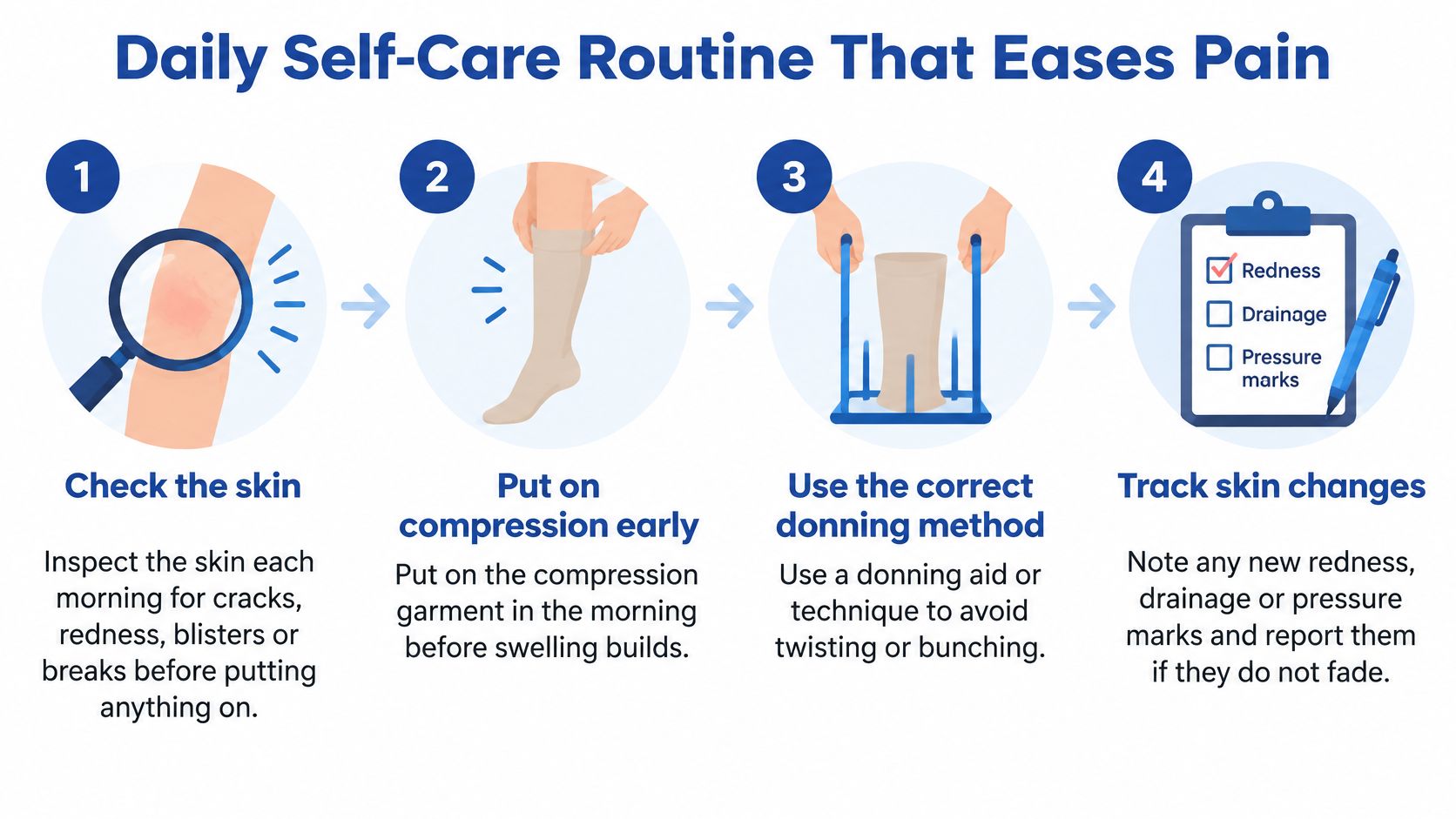
Check the skin each morning. Look for cracks, redness, blisters, or breaks before you put anything on, including between the toes or fingers and in skin folds. The common slip is checking only the front of the limb, where it's easiest to see.
Put on compression before swelling builds. Apply your garment in the morning at the class your garment provider specified, and use a donning aid if you're twisting or bunching the fabric to get it on. Bunched material creates uneven pressure and can cause the very pain you're trying to prevent.
Raise in short periods through the day. Raise the limb above heart level when you can sit or lie down, rather than saving it for one long session at night. The 2016 consensus document of the International Society of Lymphology notes that raising can help selected patients, particularly in earlier-stage disease. Don't treat a poor response to this as a personal failure. Later-stage tissue changes don't drain as readily.
Move with the garment on. Walk, cycle, do yoga, or climb stairs for about 20 to 30 minutes most days, at a pace you can repeat tomorrow. That same consensus guidance emphasizes muscle-pump exercise combined with external compression, because contracting muscles help push fluid through lymphatic vessels. The common slip is doing one hard workout, flaring for two days, then stopping.
Wash, dry, and moisturize daily. Use a mild, pH-neutral cleanser, dry thoroughly in folds and between digits, then moisturize unbroken skin to prevent cracking. Don't apply a fragranced product to broken skin and hope it settles. A new break needs attention, not perfume.
Log pain and swelling twice a day. Rate pain from 0 to 10 in the morning and evening, note whether swelling looks mild, moderate, or marked, and write down any activity that changed symptoms. Vague memory after two weeks won't show a trend.
Judge the routine after two weeks
You're looking for pain trending down, skin staying intact, the garment feeling tolerable, and activity tolerance improving. One bad afternoon doesn't erase progress, and one good morning doesn't prove the plan is finished. If pain is flat or rising despite consistent compression, movement, elevation, and skin care, that's useful information for reassessment, not a reason to work harder at the same routine.
What Manual Drainage and CDT Can and Cannot Do
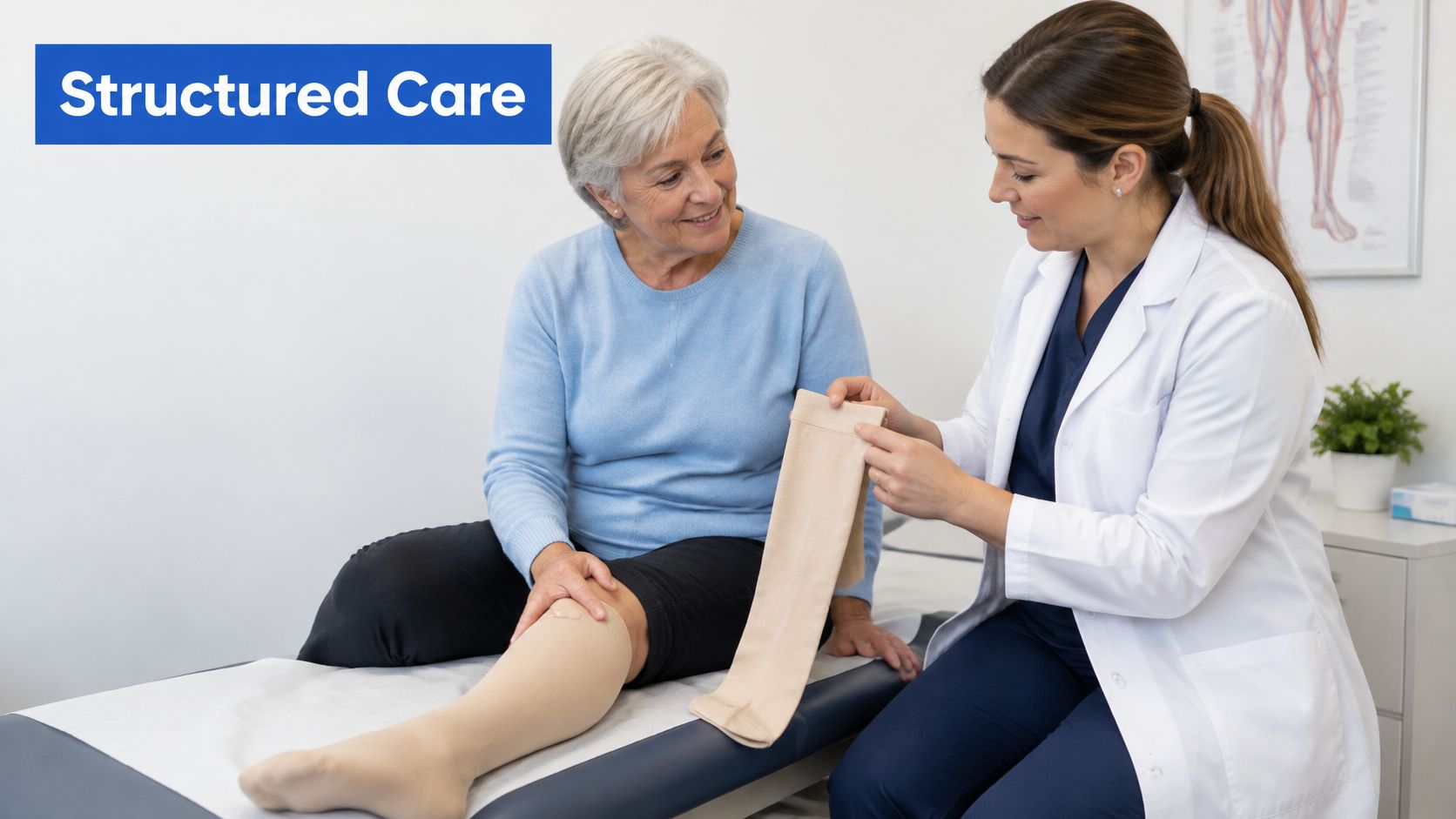
Complex decongestive therapy (CDT) is a structured program with four parts: skin and wound care, exercise, manual lymphatic drainage, and compression. Each has a different job. Skin care helps protect the skin barrier; exercise uses muscle contractions to support fluid movement; gentle, directed hand movements encourage lymph flow; and compression helps limit fluid buildup between sessions.
The U.S. National Cancer Institute lymphedema PDQ summary identifies CDT as the standard of care for stage II lymphedema. It describes an initial decongestion phase performed daily for an average of 15 days. That intensive start can surprise people expecting one weekly appointment to address swelling that has persisted for months.
Pain and volume don't always move together
Limb size and pain are separate outcomes, so they may respond differently. The National Cancer Institute PDQ summary reports that seven studies of manual lymphatic drainage for breast-cancer-related lymphedema did not demonstrate statistically significant changes in limb volume, while the review found a statistically significant improvement in pain control. The same NCI PDQ summary reports that four studies found manual lymphatic drainage reduced lymphedema incidence, with a pooled risk ratio of 0.58 and a 95% confidence interval of 0.37 to 0.93.
For example, your ankle measurement may change very little after two weeks, while evening pain drops from 7 to 4 and walking becomes easier. That can be meaningful progress, even if the limb has not fully decongested.
Practical rule: Judge CDT by more than circumference. Include pain, skin condition, mobility, and how comfortably you manage daily activities.
Manual drainage is one option within a broader care plan. A clinician may recommend it based on pain, tissue texture, or fluid distribution; compression may help maintain results between sessions. The right mix depends on the person, rather than following the same sequence for every swollen limb.
Before starting, ask which phase fits your needs: intensive decongestion or longer-term maintenance. Also ask how pain and function will be tracked alongside limb size. If the plan relies only on a tape measure, ask how it will account for the symptoms that affect your daily life.
Warning Signs That Mean Stop and Get Checked
A sudden flare tempts people to massage harder and tighten the garment. Don't follow that instinct until you've ruled out infection, a clot, or a wound problem.
| Warning sign | What it may indicate | Immediate action |
|---|---|---|
| Spreading redness or warmth | Possible cellulitis | Same-day medical assessment and stop manual drainage |
| Fever or chills with limb pain | Possible infection | Urgent medical care |
| Sudden one-sided swelling or calf pain | Possible blood clot | Emergency assessment without delay |
| Skin breakdown, drainage or odor | Possible wound infection | Prompt wound assessment |
| Pain out of proportion to visible swelling | Another cause, such as nerve or vascular problems | Examination before changing treatment |
| Pressure marks or pain after tightening the garment | Garment fit problem | Loosen or refit with the provider |
When to pause drainage and compression
The international best-practice guidance on lymphedema care advises reducing or removing compression if acute infection makes it intolerable and stopping manual or simple lymphatic drainage during acute infection. It recommends resuming usual compression and activity only after pain and inflammation have sufficiently improved, under medical supervision.
That pause isn't giving up on treatment. Working fluid through an acutely infected limb, or forcing a painful garment over hot, tender skin, can make you less able to tolerate care and can obscure how the infection is changing. Get assessed first, then restart with a plan.
Learn to separate a fit problem from a medical problem. A garment issue usually starts right after application, leaves a clear pressure line, and eases when you remove or refit the garment. Spreading redness, rising warmth, fever, new drainage, or pain that keeps escalating after removal points elsewhere.
Attribution gets harder when lymphedema coexists with venous disease, an ulcer, or a post-surgical wound. The same limb can hold several pain sources at once, which is why our overview of when to see a vein specialist is worth reviewing before a flare forces a rushed decision. Sudden one-sided swelling with calf pain shouldn't wait for a routine appointment.
Sorting Lymphedema Pain From Venous and Wound Pain
Heaviness, aching, and swelling are shared symptoms, not a diagnosis. Lymphedema can coexist with chronic venous insufficiency, a venous leg ulcer, a diabetic foot ulcer, or a post-surgical wound, and each condition can amplify the others.
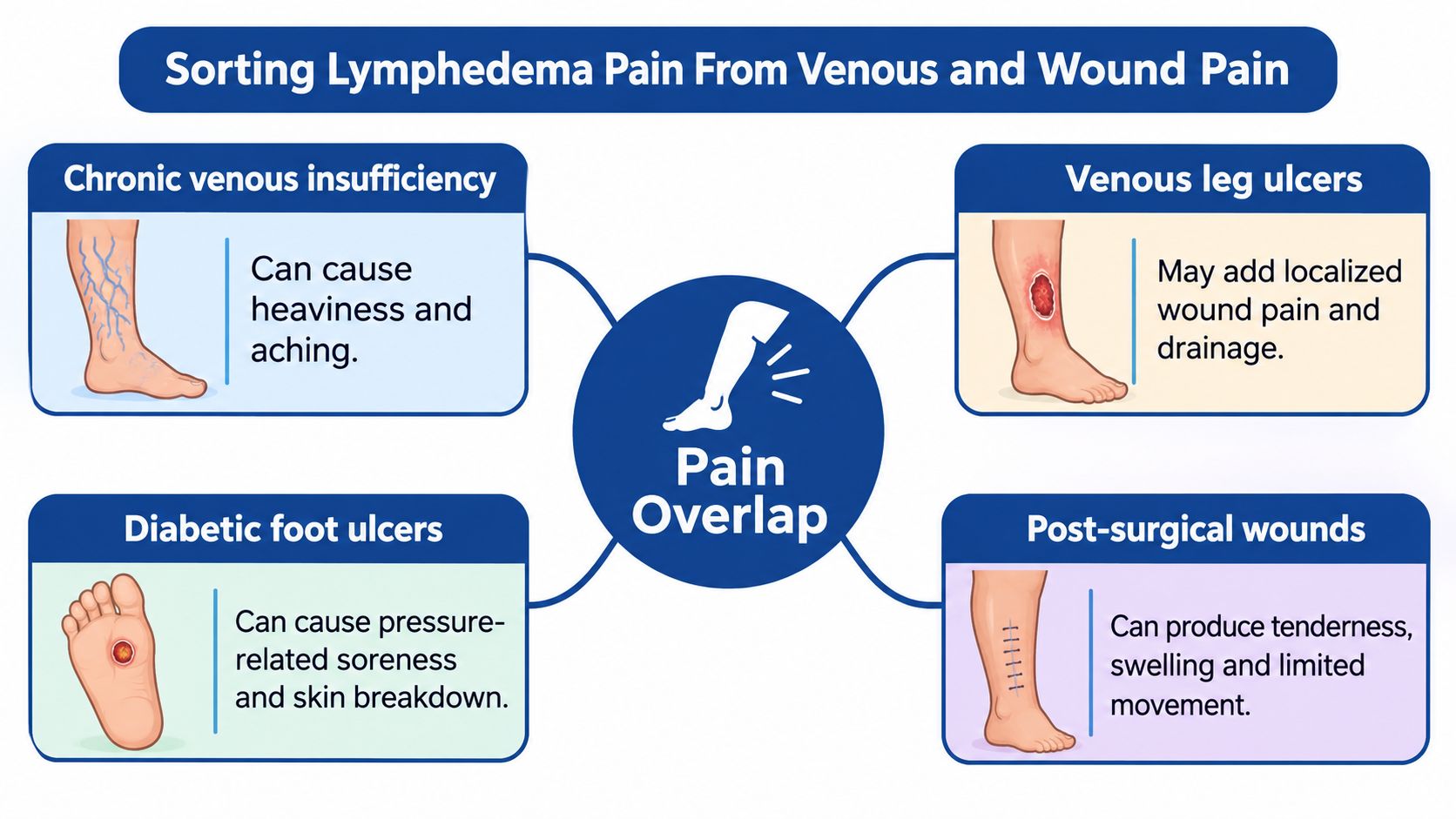
Venous insufficiency lets blood pool in the legs, raising pressure in the tissue. That extra fluid load can overwhelm a lymphatic system that's already struggling. An open ulcer then adds localized wound pain, drainage, and infection risk on top of the background ache. Our page on chronic venous insufficiency and lymphedema overlap explains how those two conditions interact.
The assessment order matters
A careful workup follows a sequence, because each step changes what the next one should be.
- Examine the limb and skin. Your clinician checks swelling pattern, tissue texture, pulses, sensation, skin changes, and any open area.
- Use duplex ultrasound when a venous contribution is suspected. Imaging shows reflux or obstruction that surface veins alone can't confirm.
- Assess any wound directly. Size, depth, drainage, odor, and surrounding skin help separate wound pain from lymphatic fullness.
- Build the pain plan last. Treatment follows the source you've identified, not the symptom that happens to be loudest that day.
At Vein and Wound Institute, we base the treatment plan on the source of the problem, not just on the veins visible at the skin's surface. A prominent vein may be a bystander. A less visible refluxing vein may be driving the pressure.
Compression is where overlapping conditions can conflict. A venous ulcer and lymphedema may call for different pressures or different garment types, and arterial circulation can limit what's safe. One clinician should set the compression plan for the whole limb rather than layering advice from separate providers. Diabetes adds another wrinkle, because neuropathy can blunt pressure sensation in one area while causing burning pain in another, so you may not feel a harmful pressure point early.
Bring three questions to the visit. Which condition is driving my pain? What's the next test, and what will it change? Which new symptom should make us revise the plan? A limb with several problems needs one coordinated plan.
Medical Options When Pain Persists Despite Self-Care
Persistent pain deserves its own treatment plan. The next step depends on whether the main pattern is pressure from a garment, nerve-related pain, inflammation, or a venous problem.
| Rung | What it can do | What to expect |
|---|---|---|
| 1. Garment review | Identifies fit or pressure problems that may be adding pain | Often a practical first check; does not address nerve pain on its own |
| 2. Intermittent pneumatic compression | Provides another form of compression for selected patients | A 2024 Cochrane evidence summary found no statistically significant pain relief over usual care (SMD 0.20, 95% CI -0.92 to 1.33) |
| 3. Prescriber medication review | Considers options for neuropathic or inflammatory pain | Discuss medication categories with the prescriber; no doses are given here |
| 4. Pain specialist or lymphedema therapist referral | Reassesses the pain pattern and revises the CDT sequence | The approach depends on the symptoms and clinician's experience |
| 5. Vein procedure for selected patients | Addresses symptoms when venous disease is a contributing cause | Considered when evaluation shows venous disease is driving persistent symptoms |
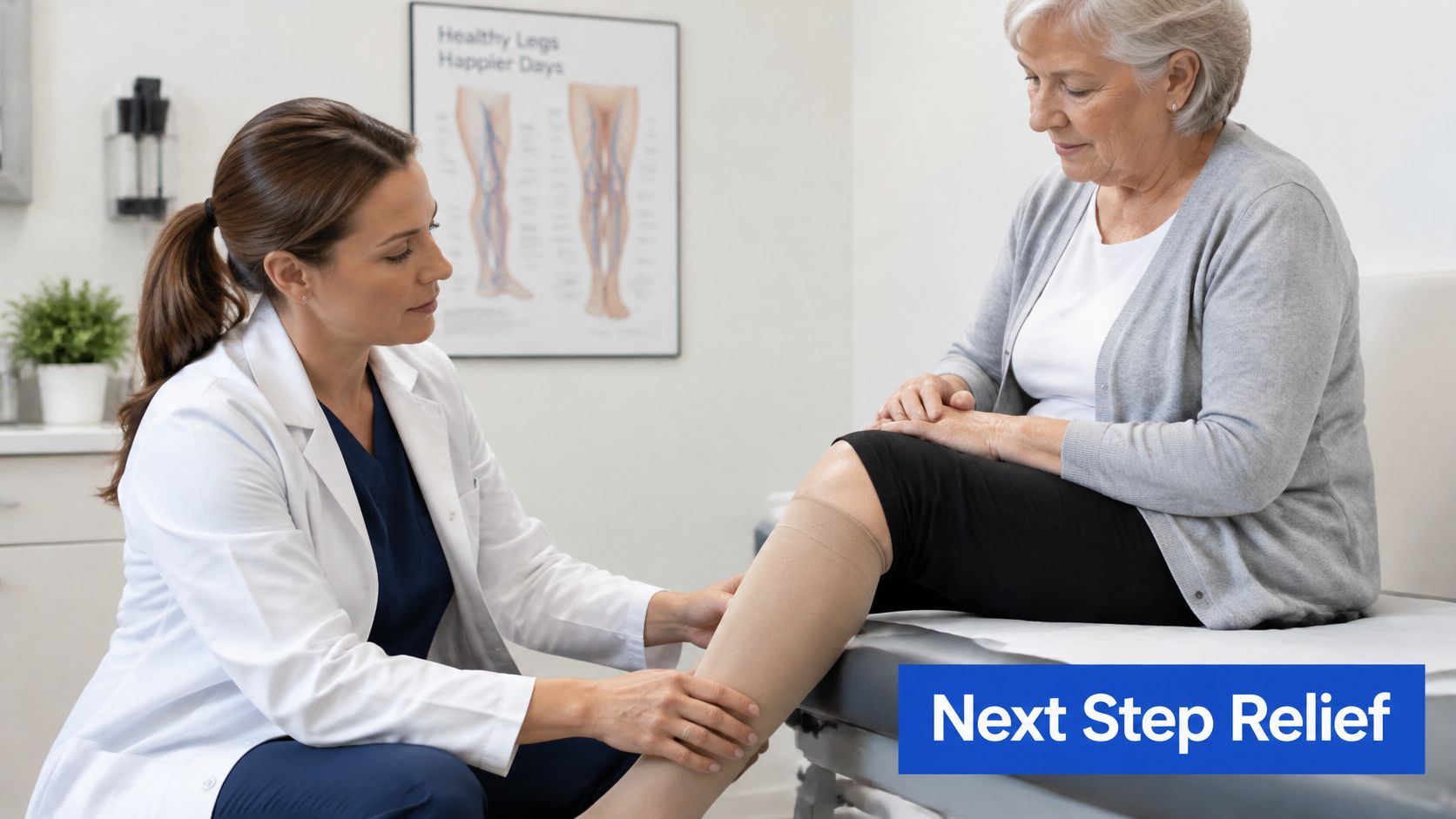
Start by checking the garment's compression class, fit, and wear schedule with your provider. Look for rolling edges, worn elastic, or a size that no longer fits a limb whose shape has changed. A garment can create a local pressure problem even when the underlying swelling has another cause.
Pneumatic compression devices may help some patients, but they are not a guaranteed pain treatment. The cited Cochrane summary found no statistically significant pain relief from combined complete decongestive therapy and intermittent pneumatic compression compared with usual care. That result does not establish that no individual can benefit; it means pain relief should not be assumed.
Medication decisions belong with a prescriber, particularly when pain has a neuropathic or inflammatory pattern. Discuss medication categories rather than asking for a specific drug or dose, and mention supplements or topical products you are considering. For background on cannabinoid research, see CBD research explained by HempWell USA. It is reading to discuss with a prescriber, not a substitute for addressing infection, venous reflux, or nerve pain.
If the pain pattern remains unclear, a pain specialist can reassess possible nerve-related features, while a therapist trained in lymphedema care can revise the CDT sequence.
A minimally invasive vein procedure may be considered when venous disease causes persistent symptoms or when compression, elevation, and activity modification do not provide enough relief. The choice depends on vein size and location, ultrasound findings, symptoms, and overall vascular health. A vein procedure treats a venous contribution. It does not treat true lymphatic failure in the same limb.
Set Up Your Pain Review and Book an Evaluation
If pain continues despite consistent self-care, book an evaluation and bring a clear timeline. Use the logging routine from the daily self-care section; extend it to show how symptoms changed over four weeks and whether any treatment or routine changes affected them.
Step 1: Prepare the visit packet. Bring your record, the compression garment you use, and a concise list of treatments or routine changes you tried. Include any questions you want answered. The garment can help the clinician assess its fit and discuss whether it suits your needs.
Step 2: Review possible causes. An evaluation can help determine the severity of chronic venous disease and whether it may be contributing to pain or swelling. Dr. Shah develops personalized treatment plans focused on circulation, symptom relief, healing, and reducing recurrence. Vein and Wound Institute treats vein conditions and wounds, so venous and wound concerns can be assessed alongside lymphedema pain.
Step 3: Agree on what happens next. Ask what the evaluation found, which symptoms each part of the plan is intended to address, and when to follow up. This helps distinguish a plan aimed at venous disease or a wound from one focused on lymphatic care.
For pain that has lasted more than two to four weeks despite the daily routine, an evaluation may help clarify the next step. Visit Vein and Wound Institute to book an evaluation.