
You've been offered treatment for the veins in your legs, but you're still thinking about what happens afterward. Will bruising look worse than the veins did? Is a tender lump expected, or could it be a blood clot? Those are sensible questions to ask before agreeing to a procedure.
Table of Contents
- Introduction to Varicose Veins Treatment Side Effects
- What the Research Says About Overall Risks
- Side Effects by Treatment Type
- Understanding Common Post-Treatment Effects
- How Clinicians Minimize Treatment Risks
- When to Call Your Doctor After Vein Treatment
- Persistent Symptoms and What They Mean
- Making an Informed Decision About Vein Treatment
Introduction to Varicose Veins Treatment Side Effects
The phrase varicose veins treatment side effects can make very different experiences sound alike. A small bruise near an injection site, persistent numbness, and a clot in a deep vein aren't interchangeable. They differ in cause, seriousness, and what you should do next.
Your proposed treatment matters just as much as the symptom being discussed. Laser and radiofrequency procedures use heat, injection treatments involve a chemical agent, and surgical approaches remove veins. It's more useful to ask what's expected after your specific procedure than to work from a generic list of everything that could happen.
Start with the procedure, not the worst-case story
Suppose you notice a firm, tender line beneath your skin after treatment. Without an explanation beforehand, that finding could feel alarming. With a clear recovery plan, you'll know whether it matches the treated vein's expected response and which changes should prompt a call.
Online accounts rarely provide that context. You may not know which procedure someone had, whether they had other medical conditions, or whether their symptoms improved without further treatment. Their experience can be genuine without predicting yours.
A useful starting question: Ask your clinician to describe both an ordinary recovery and a recovery that needs reassessment.
A helpful pre-treatment discussion should leave you able to answer:
- What's being treated? Know the procedure name and which veins your clinician intends to address.
- What might I notice? Ask about likely sensations, skin changes, and activity instructions.
- Who should I contact? Get a daytime contact, an after-hours plan, and clear emergency guidance.
You don't need to memorize every possible complication. You need enough understanding to recognize your recovery pattern and enough support to get help when something doesn't fit.
What the Research Says About Overall Risks
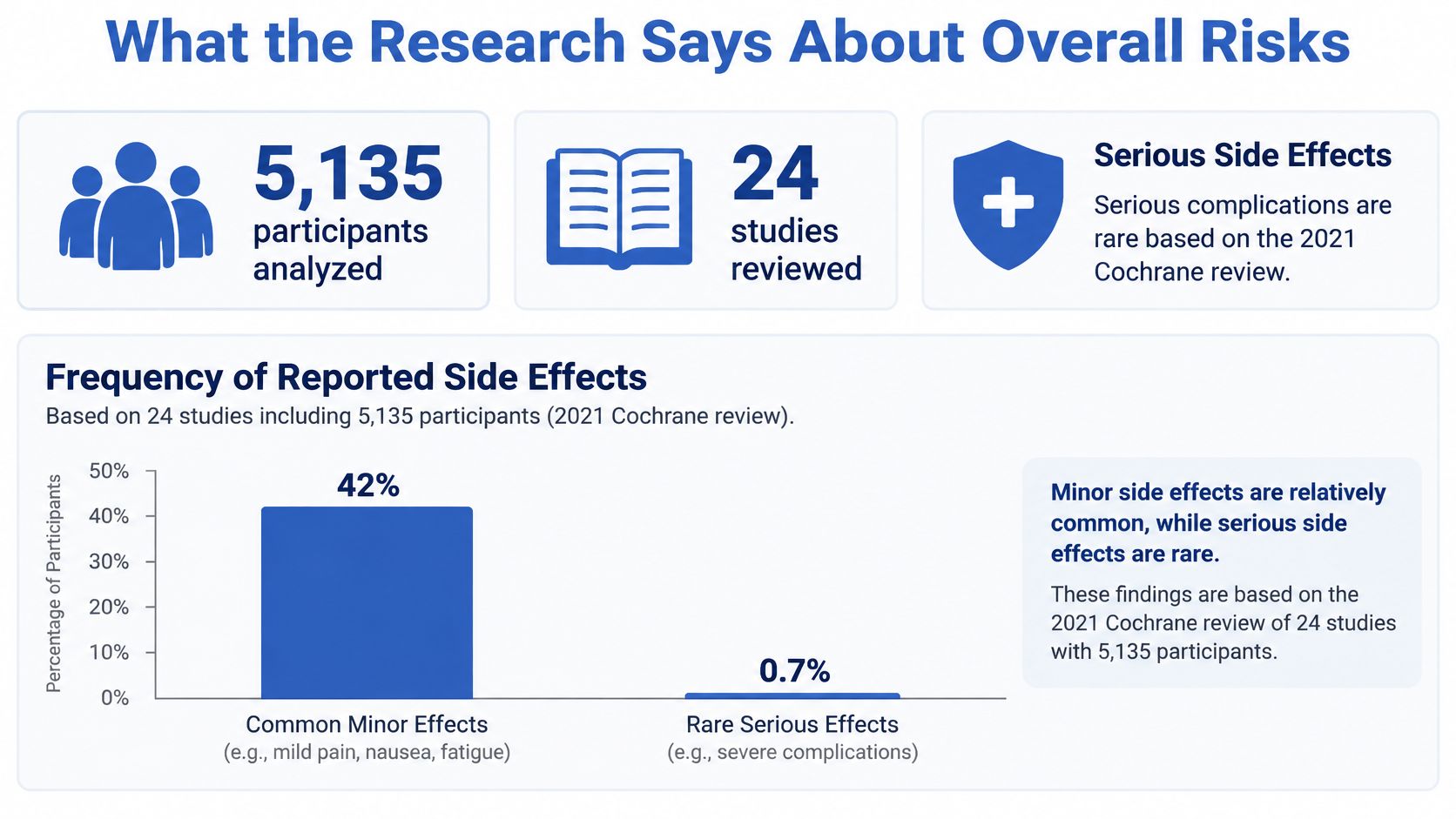
Serious complications are uncommon, but that doesn't make them impossible. A 2021 Cochrane review of varicose-vein procedures included 24 studies and 5,135 participants, finding generally low levels of unwanted effects and very few serious adverse events requiring treatment.
That's reassuring evidence, not a promise that every recovery will be uneventful. The review included people with different degrees of vein disease and evaluated different interventions. An overall finding can help frame the discussion, but it can't replace an assessment of your own health and anatomy.
Put clotting risk in context
In one comparison within that review, deep-vein thrombosis, or DVT, occurred in 1 of 161 laser-ablation patients, 0.6%, compared with 1 of 104 surgical patients, 1.0%; both reported cases resolved with medication, according to the Cochrane review linked above.
These figures describe that comparison, not a universal risk calculator. They also don't establish that the difference between the treatments applies to every patient. The useful conclusion is narrower: dangerous clotting events were rare in that study, but clinicians still needed to recognize and treat them.
DVT means a clot in a deep vein. It shouldn't be confused with every tender area or superficial vein change after treatment.
Read complication figures carefully
Before comparing percentages, ask what researchers counted:
- Severity: Did the outcome include mild bruising, or only events requiring medical treatment?
- Timing: Were symptoms assessed during early recovery or over longer follow-up?
- Monitoring: Did researchers look for problems with imaging, or record only symptoms patients reported?
- Patient selection: Were participants similar to you in health, mobility, and vein anatomy?
A broad adverse-event rate can combine temporary discomfort with more consequential problems. For decision-making, knowing what happened and how it affected patients is more useful than seeing a percentage alone.
Side Effects by Treatment Type
A treatment comparison should separate thermal procedures, nonthermal procedures, and vein-removal surgery. These categories don't produce identical tissue responses, and evidence from one technique shouldn't automatically be applied to another.
A 2025 systematic review comparing treatment categories reported adverse events of approximately 6.8% after thermal ablation, 8.0% after surgical stripping, and less than 2.5% after nonthermal methods, while noting limitations that restrict direct comparisons. Those pooled figures aren't reliable personal predictions or proof that one category is always preferable.
Side Effect Comparison by Treatment Type
| Treatment | Common Side Effects | Serious Complications | Neurologic Complication Rate |
|---|---|---|---|
| Endovenous laser ablation | Tenderness, bruising, vein hardening, local inflammation | DVT, thermal tissue injury, clinically significant nerve injury | Historical mean approximately 5% |
| Radiofrequency ablation | Local pain, bruising, inflammation, altered sensation | DVT and clinically significant nerve or tissue injury | Historical mean approximately 10% |
| Injection or foam sclerotherapy | Injection-site discomfort, hardening, pigmentation, superficial inflammation | Clotting complications, ulceration or tissue injury, reactions to the injected agent | No directly comparable estimate provided |
| Adhesive closure, including VenaSeal | Ask for the procedure-specific local reaction profile | Ask about adhesive-specific reactions and clotting precautions | No directly comparable estimate provided |
| Surgical stripping | Pain, bruising, wound discomfort, altered sensation | Infection, bleeding, DVT, nerve injury | Historical mean approximately 20% |
The neurologic estimates above come from a historical technology assessment summarized in NICE's full varicose-vein guideline. They describe reported neurologic complications, not rates of permanent nerve damage, and shouldn't be presented as current, head-to-head predictions.
What the table can't tell you
Thermal treatment deserves a discussion about local inflammation and nearby nerves. For laser treatment specifically, these key facts about laser ablation for vein treatment can help you prepare questions about technique and recovery.
Nonthermal treatment isn't a single intervention. Foam, adhesive, and mechanochemical procedures shouldn't share one assumed safety profile merely because they don't use heat. The evidence available here doesn't support a precise adhesive-specific or mechanochemical complication rate.
Surgery and phlebectomy also need separate explanations. Don't apply stripping statistics automatically to a smaller vein-removal procedure.
A higher reported adverse-event rate doesn't necessarily mean a treatment is clinically inferior. Ask whether the recorded events were temporary, treatable, or lasting.
Your clinician should explain why the proposed method fits your veins, not just describe it as less invasive.
Understanding Common Post-Treatment Effects
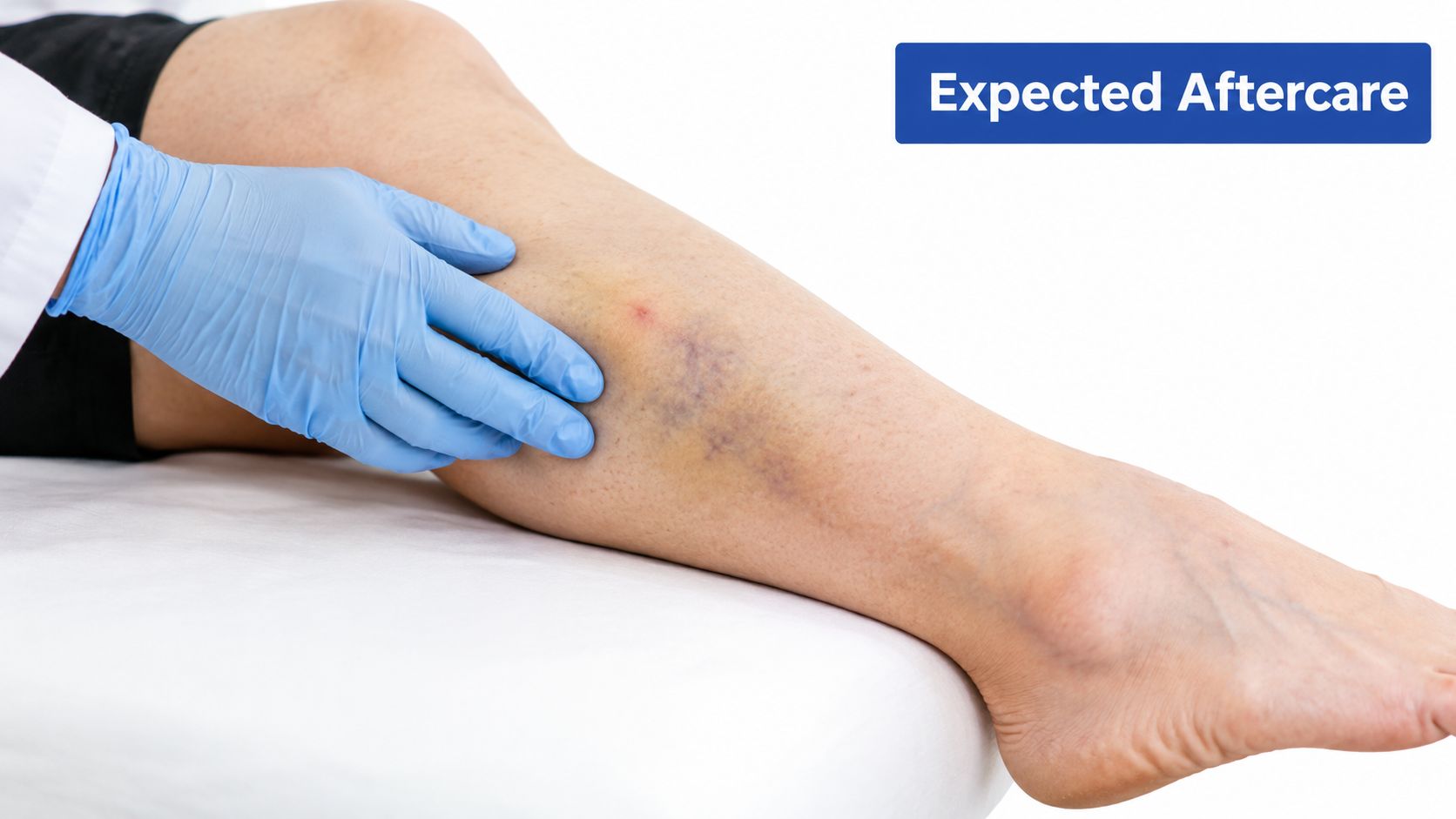
A treated vein doesn't become quiet immediately. After thermal treatment, the vein undergoes intentional injury, clotting within the treated segment, and eventual scarring. That process helps explain early soreness, bruising, inflammation, and a firm cord beneath the skin, as described in an Australian assessment of endovenous laser treatment.
Think of it as a carefully controlled repair site rather than an untouched structure. The clinician has deliberately changed the vein, and your body must respond. The analogy explains why some inflammation is expected, but it doesn't mean every painful or red area is harmless.
Translate medical terms into what you might feel
- Bruising: You may see discoloration around the treated area. Its presence alone doesn't establish that something went wrong.
- Induration: This means hardening. A treated segment may feel firmer than the surrounding tissue.
- Phlebitis: This means vein inflammation. Superficial inflammation can cause a localized tender area.
- Altered sensation: Tingling or numbness belongs in a different category from bruising and should be described clearly to your treating team.
The NICE evidence discussed earlier documents local bruising, hardening, injection-site pain, and superficial thrombophlebitis after injection treatment. Those findings reinforce why the expected recovery explanation should match the technique you receive.
Judge the pattern, not just the symptom
Mild tenderness that gradually settles is different from pain that becomes harder to tolerate. A limited bruise is different from a newly swollen leg. You can't reliably diagnose the cause at home, but you can notice whether the overall pattern is improving or deteriorating.
Follow your own discharge instructions rather than borrowing someone else's compression schedule, medication plan, or activity restrictions. After injection treatment, reviewing sclerotherapy aftercare dos and don'ts can help you identify questions to clarify with your clinician.
Keep the explanation practical: where should you expect discomfort, how should it change, and what would fall outside that pattern? That's more useful than being told that soreness is normal.
How Clinicians Minimize Treatment Risks
Safety begins before the procedure, with the decision about whether the proposed treatment fits your medical history and vein anatomy. A technically careful procedure still needs appropriate patient selection, clear instructions, and a plan for reassessment.
The strongest consultation isn't one that promises no complications. It's one in which the clinician explains what they're checking, why the proposed technique makes sense, and how they'll respond if recovery doesn't follow the expected course.
Before treatment
Your clinician should review factors that may affect clotting risk:
- Previous clots: Mention any history of DVT, pulmonary embolism, or other venous thromboembolism.
- Clotting conditions: Disclose known thrombophilia or a history that has prompted clotting investigations.
- Mobility: Explain prolonged immobility or difficulty walking.
- Other health factors: Cancer, obesity, and other prothrombotic conditions may influence planning.
Bring an accurate medication list and describe previous procedure-related problems. Don't assume information from another practice is already available.
During treatment and follow-up
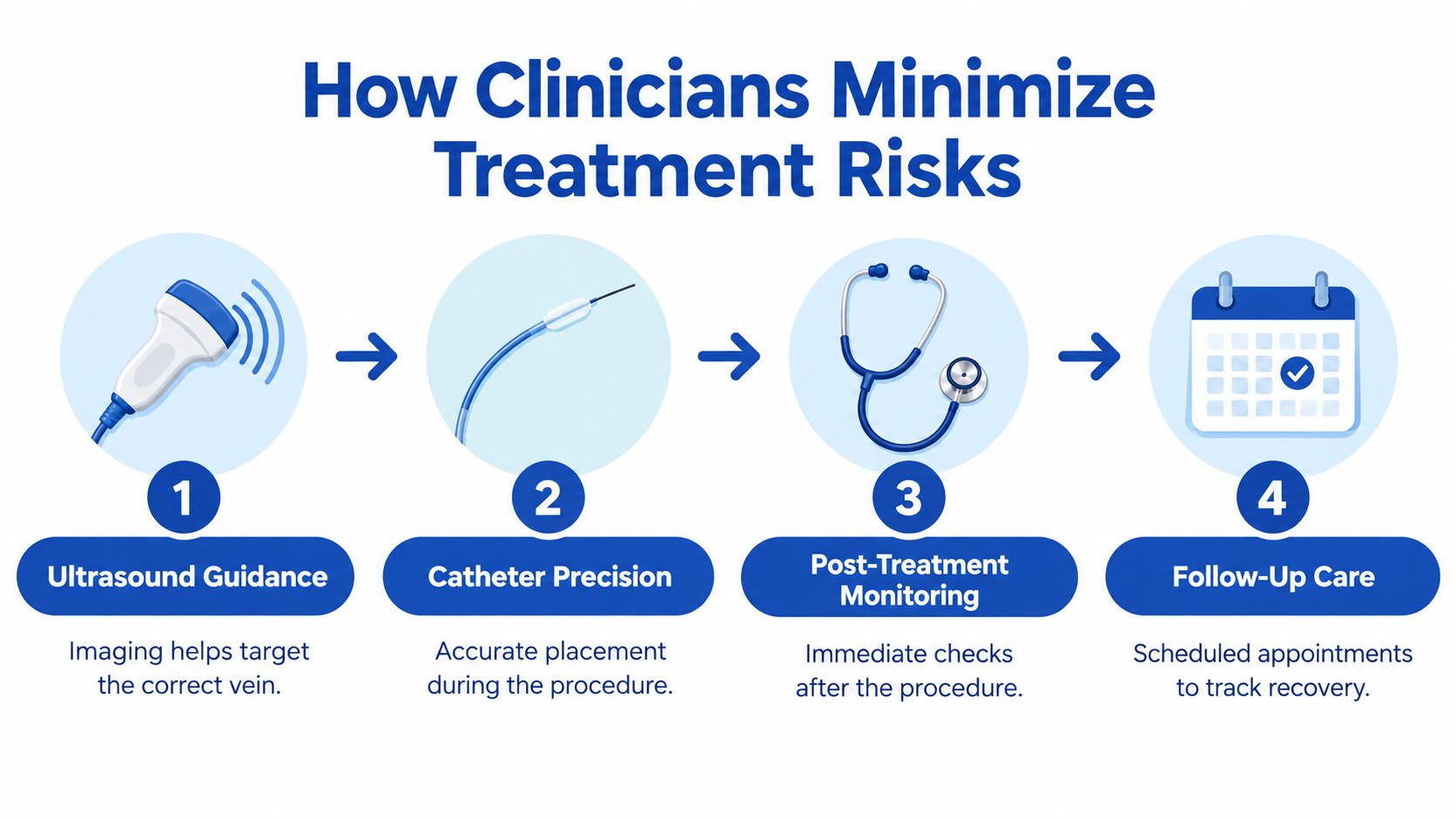
Ultrasound guidance helps clinicians position equipment in the intended vein. For thermal procedures, accurate catheter placement and control of delivered energy are important safeguards, as described in the laser-treatment assessment discussed earlier.
Follow-up serves a different purpose: checking how you're recovering and investigating symptoms when necessary. Ablation-related thrombus extension describes clot extending beyond the treated segment toward or into the deep venous system. Suspected extension or DVT requires clinical assessment rather than reassurance based only on appearance.
Depending on the findings and your risk profile, clinicians may consider repeat deep-vein imaging or anticoagulant treatment. These aren't interchangeable options, and you shouldn't start or stop clotting medication yourself.
When deciding how to choose a vein care specialist, ask who reviews unexpected symptoms and how urgent imaging is arranged. A clear answer gives you a practical route to help, not just reassurance before treatment.
When to Call Your Doctor After Vein Treatment
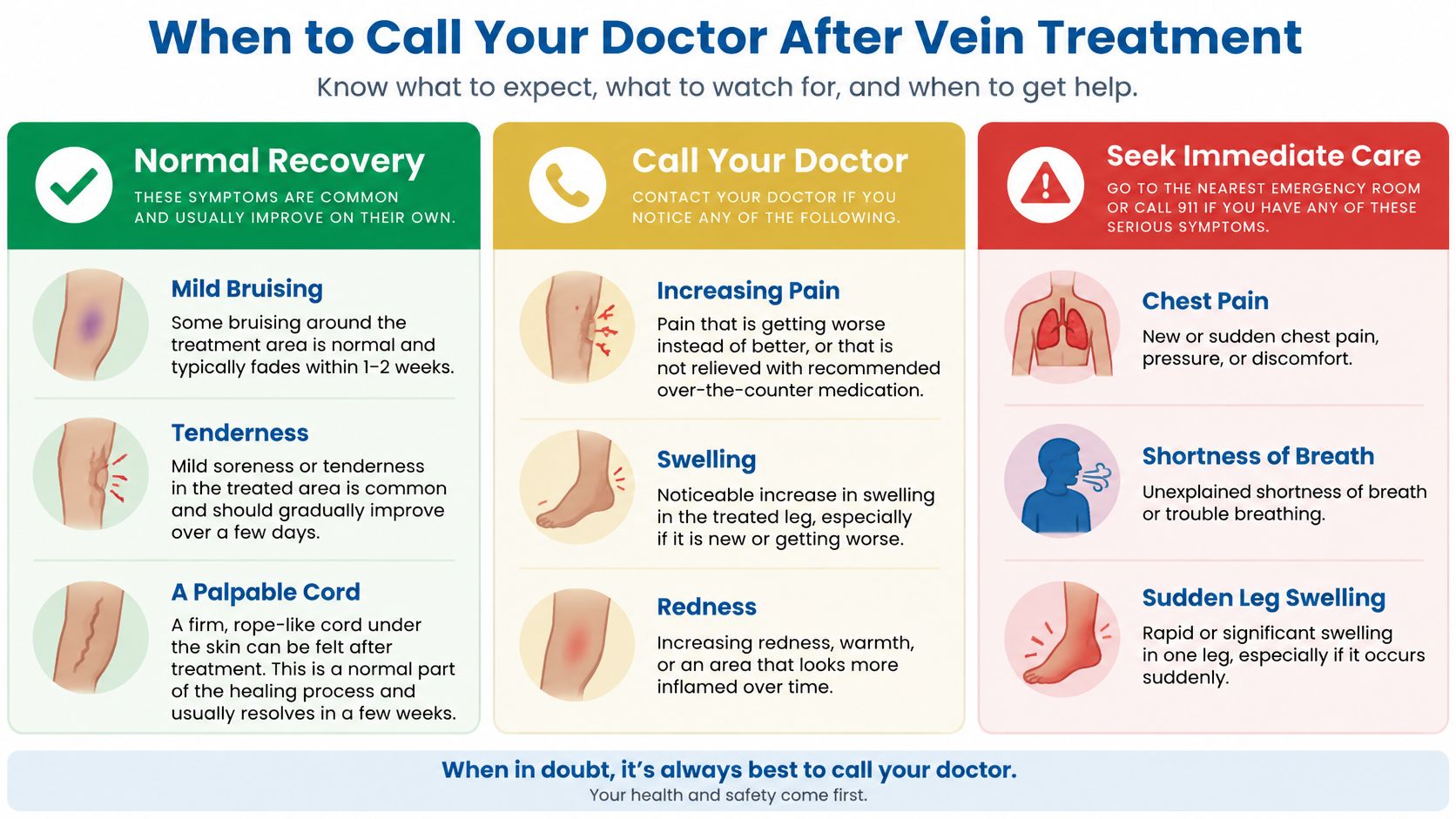
The direction of change matters more than the calendar alone. During early recovery, localized bruising and tenderness can fit the expected pattern, while pain or swelling that intensifies deserves attention. Healthdirect's guidance on endovenous ablation identifies clotting, nerve injury, skin burns, and other complications that clinicians may need to distinguish from routine healing.
During the first days and following weeks
Use your discharge plan as the reference point. Over the following weeks, improvement is generally more reassuring than symptoms that remain difficult, spread, or return after settling.
- Monitor expected changes: Note the location of bruising, tenderness, or a firm treated segment and whether they're easing.
- Contact the treating team promptly: Report increasing redness, warmth, drainage, fever, worsening discomfort, or a wound that isn't progressing.
- Request reassessment: Persistent tingling or numbness, continuing swelling, or uncertainty about recovery deserves a conversation rather than indefinite waiting.
Seek urgent or emergency care
New or rapidly worsening swelling in one leg, especially with calf pain or discoloration, needs urgent assessment. Don't wait for a scheduled follow-up or assume that the procedure explains it.
Chest pain, shortness of breath, coughing blood, fainting, or a rapid heartbeat require emergency evaluation. These symptoms shouldn't be managed through a routine message to the clinic.
Don't wait for certainty: You don't have to prove a symptom is a complication before asking for help.
If you're concerned about a possible skin burn, the BIOVELVET™ burn care guidance offers a separate resource about when burns need medical attention. It doesn't replace assessment of a treatment-related injury or advice from your treating clinician.
When you call, describe which leg is affected, where the symptom is, when it began, and whether it's worsening. Mention fever, wound drainage, or breathing symptoms immediately so the team can direct you appropriately.
Persistent Symptoms and What They Mean
A closed vein and a symptom-free leg aren't always the same outcome. If heaviness or swelling continues, it's understandable to wonder whether the procedure failed. That question deserves an assessment, but the answer shouldn't be assumed from symptoms alone.
Recognized outcomes include residual or new varicose veins, and persistent swelling can reflect untreated tributary veins, lymphatic dysfunction, deep venous disease, or immobility rather than failure of the treated segment, as outlined in the clinical considerations associated with NICE's varicose-vein recommendations.
Separate the possible explanations
| Ongoing concern | Useful question for reassessment |
|---|---|
| Persistent heaviness or visible veins | Are there remaining veins or another area of reflux to evaluate? |
| Continuing swelling | Could deep venous or lymphatic problems be contributing? |
| Numbness or tingling | Is the sensory change improving, stable, or spreading? |
| Discoloration or a non-healing sore | Does the skin or wound need a separate assessment? |
For example, someone may have successful closure of the intended vein but still need investigation for lymphatic dysfunction. Another person may need attention to a remaining tributary vein. These are different problems and shouldn't lead automatically to the same next treatment.
A wound needs its own plan
An open sore shouldn't be treated merely as an unsatisfactory cosmetic result. For someone with diabetes or a venous leg ulcer, the clinician needs to assess the wound itself as well as circulation and the broader recovery pattern.
Duplex ultrasound may help answer questions about vein closure, residual disease, or suspected clotting. A wound examination addresses different questions, including whether healing has stalled or infection needs consideration.
Bring a concise account of what has changed since treatment and what hasn't. Distinguish your original symptoms from new ones, and explain how each affects walking, sleep, or daily tasks. That information helps the clinician decide whether you need further investigation, wound care, or an adjustment to the treatment plan.
Making an Informed Decision About Vein Treatment
The most useful treatment choice isn't necessarily the one with the smallest incision or the lowest percentage on a comparison chart. It's the option your clinician can justify for your anatomy, symptoms, health risks, and priorities.
Start by explaining what you want to improve. Relief from aching, help with swelling, management of an ulcer, and cosmetic improvement are different priorities. Ask which goals the proposed procedure is intended to address and which may require additional care.
Leave the consultation with clear answers
- Why this procedure? Ask what makes it suitable for the veins being treated.
- What are the alternatives? Discuss other appropriate approaches and what their trade-offs would mean for you.
- What should recovery involve? Request written instructions for the procedure.
- What happens if symptoms remain? Clarify how the clinician will assess the outcome and plan further care.
- How do I get help? Confirm both routine and urgent contact arrangements before treatment day.
You can also ask the clinician to explain risk in plain language. Instead of accepting a label such as low risk, ask which complications matter most in your circumstances and how they would be recognized and managed.
Good reassurance includes a plan for what happens if recovery isn't straightforward.
The evidence supports a balanced view: serious problems are uncommon, while temporary effects and procedure-specific risks deserve an honest discussion. Neither alarming stories nor blanket assurances should make the decision for you.
You don't need to approach treatment expecting trouble. You should approach it knowing what you're agreeing to, what your recovery instructions mean, and when to speak up. That understanding lets you focus on the intended benefits without overlooking symptoms that need care.
Vein and Wound Institute offers evaluation of venous disorders, minimally invasive vein procedures, onsite diagnostics, and coordinated wound care. Visit Vein and Wound Institute to arrange an assessment and discuss treatment-specific side effects, your recovery plan, and follow-up for persistent swelling or a non-healing wound.