
You've kept the spot clean, tried not to disturb it, and expected the scab to fall off once the skin healed. Instead, it keeps catching on clothing, reopening, or leaving a damp patch on the dressing. A crust on the surface can make a wound look closed even when the tissue underneath hasn't healed.
A persistent leg scab needs a cause, not just another cream. Before trying compression or removing the crust, check for urgent warning signs and arrange a circulation assessment. Gentle protection is reasonable while you wait, but treatment that helps a vein-related wound can harm a leg with poor arterial blood flow.
Table of Contents
- Common Reasons a Leg Scab Will Not Heal
- Warning Signs That Need Prompt Medical Care
- Circulation Tests That Show Whether Compression Is Safe
- Safe Home Care While You Wait for an Appointment
- Treatments That Match the Cause
- Book a Wound Assessment If the Scab Stays Open
Common Reasons a Leg Scab Will Not Heal
A scab is dried material over an injured area. It doesn't tell you whether the wound underneath has enough blood supply, whether pressure keeps damaging it, or whether another skin condition is present. Repeated reopening is particularly useful information because it suggests the original problem hasn't been resolved.
Venous insufficiency is a major explanation for persistent lower-leg wounds. When leg veins don't return blood effectively, sustained pressure and swelling can damage the skin, especially around the ankle. A systematic review of venous leg ulcers reports that these wounds account for approximately 60%–80% of leg ulcerations, with an estimated three-month healing rate of about 40%.
That doesn't mean every stubborn scab is a venous ulcer. Those figures describe leg ulcers, not all small scratches or crusted skin lesions.
Clues that help separate the causes
Arterial disease creates a different problem: too little blood reaches the tissue. A cold or pale foot, pain at rest, or weak pulses needs medical assessment rather than a tighter bandage.
Diabetes can combine poor circulation with neuropathy, meaning reduced sensation. A person may not feel a shoe rubbing or notice a pressure sore developing. Understanding diabetes and circulation helps explain why a painless wound can still deserve prompt attention.
Causes of a leg scab that will not heal
| Cause | Typical clues | What confirms it |
|---|---|---|
| Venous insufficiency | Swelling, heaviness, varicose veins, brownish skin near the ankle | Duplex ultrasound and venous assessment after an arterial check |
| Arterial disease | Cold or pale foot, pain at rest, weak or absent pulses | Ankle-brachial index and toe pressures |
| Diabetes with neuropathy | Numbness, sores on pressure points, high blood sugar | Foot examination, sensation testing, and wound assessment |
| Pressure or friction | Sore under a shoe, brace, or bandage edge | Location check and assessment of the pressure source |
| Infection | Spreading redness, warmth, pus, odor | Clinical examination, sometimes wound culture |
| Repeated injury | Scratching, picking, or bumping the same spot | History and examination of the wound edges |
| Skin cancer | Sore that bleeds, grows, or persists without explanation | Biopsy when clinically indicated |
Pressure, friction, and picking can repeatedly injure fragile new skin. Infection may complicate an existing wound rather than explain how it started. Less commonly, a persistent crusted or bleeding lesion is skin cancer, which is why an unusual sore shouldn't receive endless dressing changes without reconsidering the diagnosis.
Practical rule: Use the clues to describe your wound, not to diagnose it yourself. Different causes can look alike, and more than one can be present.
Warning Signs That Need Prompt Medical Care
Don't wait for a routine appointment if the foot becomes cold, discolored, or severely painful, or if you develop spreading inflammation or feel unwell. These changes can indicate infection, a clot, or failing blood supply. Sudden symptoms are more concerning than familiar, stable swelling.
New black or grey tissue, particularly with a cold foot or worsening pain, needs emergency assessment. A dry, dark area may represent dead tissue, although an ordinary dry scab alone doesn't establish gangrene. Don't pick it off to find out.
Match the change to the urgency
The checklist below is a reminder, not permission to wait when symptoms are progressing. Increasing swelling or red streaks should receive same-day assessment, and severe illness or rapidly worsening symptoms warrant emergency care.
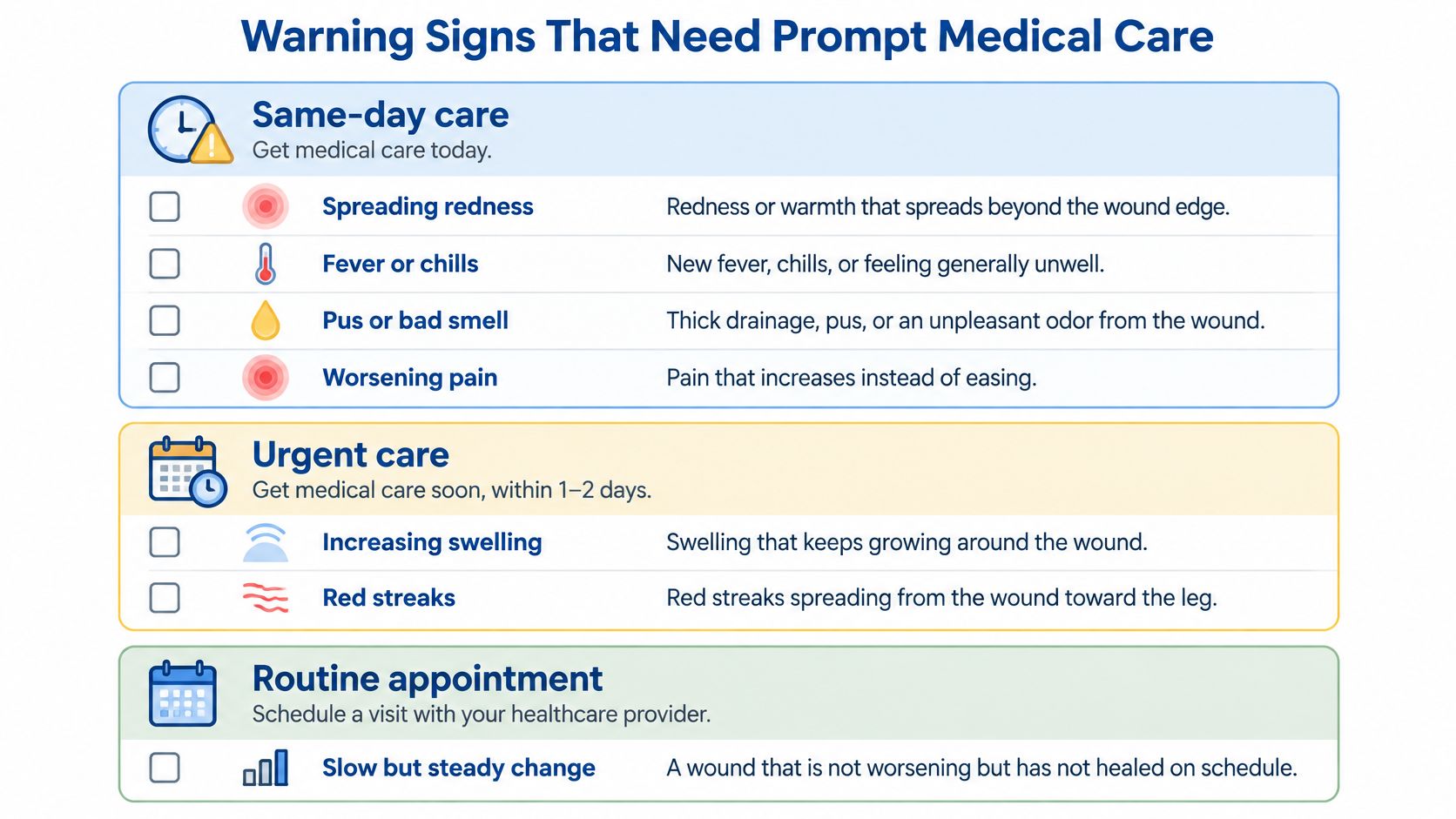
Warning signs and how fast to act
| Warning sign | What it may indicate | How fast to act |
|---|---|---|
| Black, grey, or dry dead-looking tissue in the wound | Possible gangrene or severe tissue loss | Emergency care now |
| Cold, pale, or dark toes, or pain at rest | Serious arterial insufficiency | Same day; emergency care if sudden or severe |
| Spreading redness, heat, and swelling in one leg | Cellulitis or possible deep vein clot | Same day |
| Pus, foul odor, or fever | Wound infection | Same day |
| Sudden calf pain and swelling | Possible deep vein thrombosis | Same day |
| New foot or leg sore with diabetes | A wound at increased risk of complications | Contact your clinician promptly for assessment |
| Persistent wound with known peripheral artery disease | Impaired healing from poor blood flow | Prompt evaluation, sooner for deterioration |
| Unexplained sore that remains unchanged or repeatedly bleeds | Chronic wound or possible skin cancer | Arrange clinical review rather than continuing self-treatment |
Diabetes lowers the threshold for seeking help. A CDC-hosted evidence summary on diabetic foot ulcers reports that more than 50% become infected. This finding concerns diabetic foot ulcers specifically, but it supports taking a new diabetic foot wound seriously even when it doesn't hurt.
Visible or bulging veins, aching, heaviness, fatigue, swelling, and skin changes can suggest chronic venous disease without infection. They still deserve evaluation, but a sudden change shouldn't be dismissed as your usual vein symptoms.
Record when the wound first appeared and photograph any change. Our guide to signs of wound infection and when to seek medical attention can help you describe what you're noticing. If the injury began as a burn, BIOVELVET™ also provides guidance on spotting burns that need urgent care, since burn injuries need their own assessment.
Circulation Tests That Show Whether Compression Is Safe
A dry-looking scab does not show whether enough blood is reaching the wound. Before compression is considered, a clinician checks arterial circulation because vein and artery problems can occur in the same leg.
The assessment starts with the wound's location, length, width, depth, drainage, odor, and wound-bed tissue. The clinician also checks the surrounding skin, swelling, and foot pulses. These findings provide a baseline and help show whether the wound is changing or merely forming another crust.
What an ankle-brachial index measures
An ankle-brachial index, or ABI, compares blood pressure at the ankle with blood pressure in the arm. It can help identify reduced arterial blood flow, but it does not diagnose the cause on its own or automatically determine whether compression is appropriate.
The American Family Physician review of chronic wounds describes an ABI below 0.8 as suggesting arterial disease and an ABI above 1.2 as suggesting noncompressible vessels. Stiff, calcified arteries can produce a misleadingly high result, particularly in people with diabetes, kidney disease, or older age.
Typical ABI decision ranges described in the American Family Physician review and French guidance
| ABI value | What it suggests | How treatment changes |
|---|---|---|
| Below 0.5 | Severe ischemia | Compression is generally avoided; urgent vascular assessment may be needed |
| 0.5 to below 0.8 | Arterial disease may be present | Modified treatment may be considered with specialist oversight |
| 0.8 to 1.2 | A range that may permit compression | Compression may be considered if the examination supports it and the wound cause is understood |
| Above 1.2 | Possibly stiff or calcified vessels | Toe pressures or Doppler assessment may help clarify arterial blood flow |
These ranges guide clinical decisions. They do not tell you what stocking strength to choose. Symptoms, examination findings, and additional tests can change how an ABI is interpreted, especially when the result does not fit a cold or painful foot.
A pulse you can feel does not prove that enough blood reaches a wound. A foot that looks normal can still have poor tissue perfusion, or inadequate blood flow to the tissues.
Ask for a documented circulation result and a clear explanation of the likely wound cause, not just reassurance that the scab looks dry.
If the ABI result is unreliable or does not match the examination, further vascular assessment may be needed. Uncertainty is not clearance for strong compression.
Safe Home Care While You Wait for an Appointment
Protect the wound, but don't try to correct circulation yourself. Gentle cleaning and a protective dressing don't require you to diagnose the cause. Compression, cutting away tissue, and aggressive attempts to remove a scab are different decisions.
The French national guidance on managing venous leg ulcers notes that approximately 20% of patients with venous leg ulcers also have arterial disease, and identifies an ABPI below 0.5 as a contraindication to compression, with values below approximately 0.8 requiring modified care. That's why a wound's appearance, or a pulse felt at home, can't clear you for compression.
A gentle routine that preserves useful information
Photograph the wound. Place a ruler beside it without touching the open area, and use similar lighting and camera distance for comparison. Keep the date with each image.
Record visible measurements. Note length and width, but don't insert a ruler, cotton swab, or other object into the wound to measure depth. A clinician can assess depth safely.
Describe drainage and symptoms. Write down drainage color and amount, odor, new pain, and changes in surrounding skin. Don't assume that no pain means no problem, particularly if sensation is reduced.
Clean gently. Wash your hands, then rinse the wound with clean lukewarm water or saline. Use mild soap on surrounding skin and pat that skin dry rather than scrubbing the wound.
Apply a non-stick dressing. Protect the area with a clean dressing that manages drainage without sticking. Change it when wet, dirty, or loose, and avoid leaving the surrounding skin soggy.
Leave tissue removal to a clinician. Don't scrape, cut, or pull at the scab or wound edges. Removing tissue without checking circulation can create a larger injury.
Skip new compression until assessed. Don't improvise a tight wrap or start compression stockings for an unexplained wound. If you already have prescribed compression and develop new pain, coldness, or discoloration, seek urgent advice.
Reduce rubbing and use elevation cautiously. Avoid tight socks and footwear that contact the sore. Comfortable elevation may ease venous swelling, but stop if it causes pain, pallor, or coldness.
Prepare your medical information. List medicines, allergies, diabetes status, previous circulation problems, and what you've applied to the wound. Include nonprescription creams and supplements.
This visual summarizes the protective steps, but wound-depth measurement should remain a clinical task.
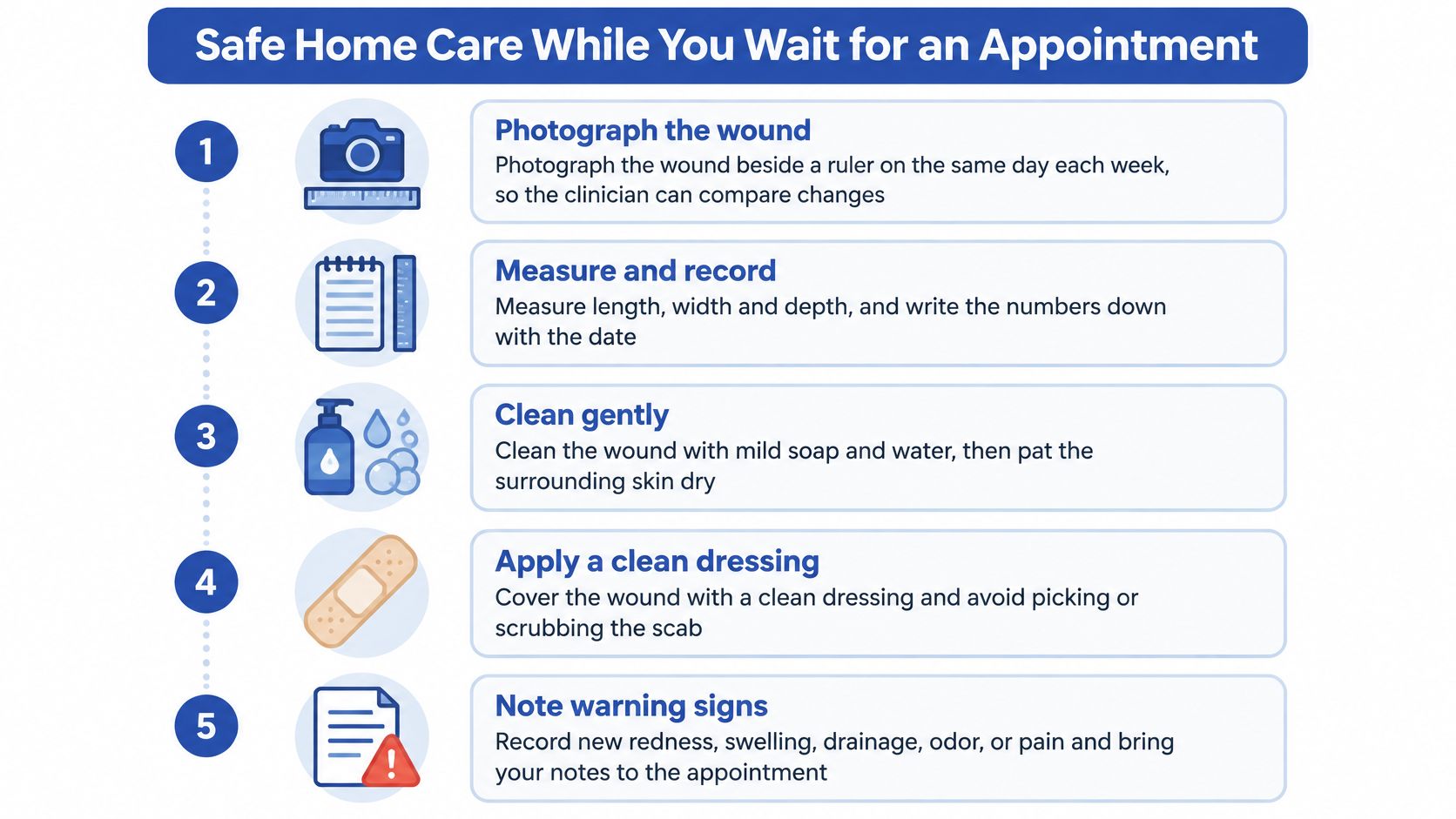
While you wait: A photograph documents change. It doesn't replace an examination, and worsening symptoms shouldn't wait for the next photograph.
Treatments That Match the Cause
A small scab can stay open when the treatment protects only the surface. Healing also depends on addressing the barrier underneath, such as poor circulation, excess moisture, or ongoing tissue damage.
For a confirmed venous ulcer, compression may help control swelling and venous pressure when arterial blood flow is adequate. A clinician selects the method and monitors how the leg responds.
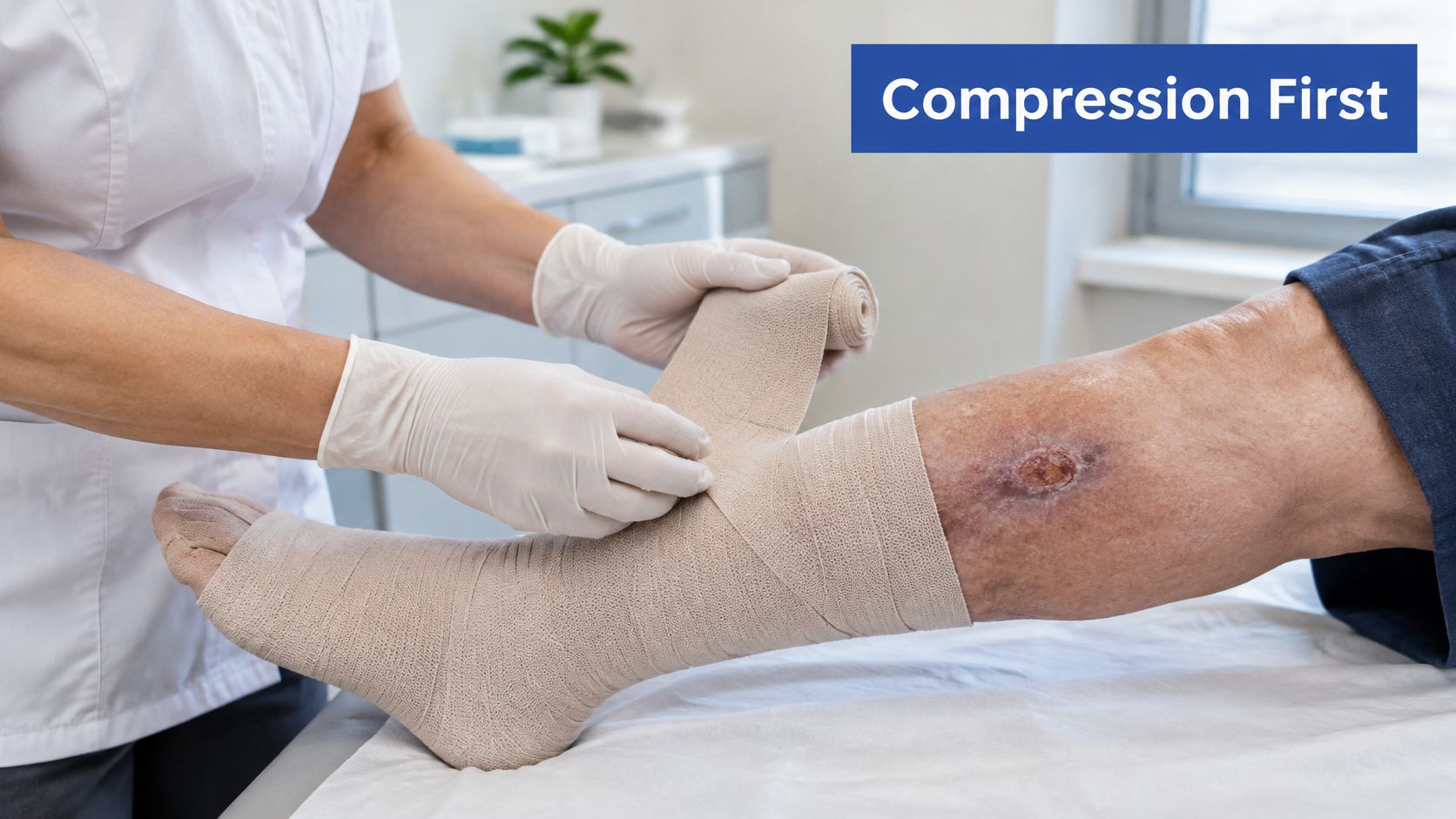
Healing and preventing another wound
Compression may also help reduce the chance that a venous ulcer returns after it heals. A Cochrane review of compression for preventing venous ulcer recurrence reported that, in a randomized comparison of 153 people with recently healed venous ulcers, compression reduced six-month recurrence, with a risk ratio of 0.46. This finding concerns recurrence after healing; it does not guarantee that an active wound will close.
Treatment choices depend on clinical assessment. Wound debridement removes dead or unhealthy tissue when appropriate and safe. Dressings are chosen according to drainage, wound depth, and the condition of the surrounding skin. A dressing for a wound with heavier drainage needs to absorb fluid, while one for a drier wound should protect the tissue without making it soggy.
Antibiotics may be used when an infection requires treatment, but they do not correct poor circulation or other barriers to healing. Wound care may also involve close monitoring and advanced treatments, such as skin substitutes, when the clinician considers them appropriate.
When ultrasound confirms venous reflux, closing or removing an unhealthy vein can redirect blood through healthier veins, reducing venous pressure and potentially improving symptoms. Treatment planning focuses on the source of the problem, not only on veins visible at the skin's surface. After a procedure, compression may be recommended; the provider gives instructions on the appropriate level and duration.
Book a Wound Assessment If the Scab Stays Open
A leg scab may look stable while the skin beneath it remains open. Track whether the wound is getting smaller and staying closed; repeated crusting and reopening calls for reassessment.
The NICE supporting documentation on leg-ulcer recommendations advises thorough assessment within 14 days of identifying a nonhealing lesion and specialist advice if an ulcer remains unhealed at 12 weeks. Use those milestones as part of a timeline, not as a reason to wait through worsening symptoms.
Put the escalation dates in your calendar
- Day 0: Record when you recognize the wound is stalled. Arrange a clinical assessment and follow the safe-care guidance above while you wait. Don't start another cycle of home remedies.
- Days 1–13: Monitor only if there are no warning signs. If the wound worsens or a warning sign develops, seek prompt medical care rather than waiting for the two-week mark.
- By Day 14: Get the wound assessed. The clinician should consider the wound, your health history, medications, pain, circulation, and any practical barriers to care. Leave with a working diagnosis and a plan for what progress will be checked.
- Before Week 12: Request reassessment if healing stalls or the plan isn't producing progress. The cause may need another look, including pressure, infection, venous or arterial disease, or an atypical skin lesion. Escalate sooner if the wound worsens.
- At Week 12: If the ulcer remains open, seek specialist advice. After closure, continue the prevention and follow-up plan. Closed skin does not necessarily mean the underlying circulation problem has resolved.
Use the photos, measurements, and health details gathered during home care when you speak with the clinician. Previous circulation test results can also help inform the assessment.
Book a wound assessment when a leg scab stops progressing toward durable closure. If a same-day warning sign appears, seek urgent medical care rather than waiting for the appointment.
Vein and Wound Institute provides diagnosis and treatment for vein disorders and wounds, including venous, arterial, diabetic, pressure, traumatic, post-surgical, and non-healing wounds. If a leg scab keeps reopening or will not heal, contact Vein and Wound Institute to arrange an assessment of the wound and circulation factors that may be delaying recovery.