Approximately 40% of pregnant women develop varicose veins, according to NICE's varicose vein guidance. That's a useful reminder that enlarged leg veins are not just a cosmetic concern related to aging. They can accompany changes in circulation that cause aching, heaviness, swelling, and skin irritation.
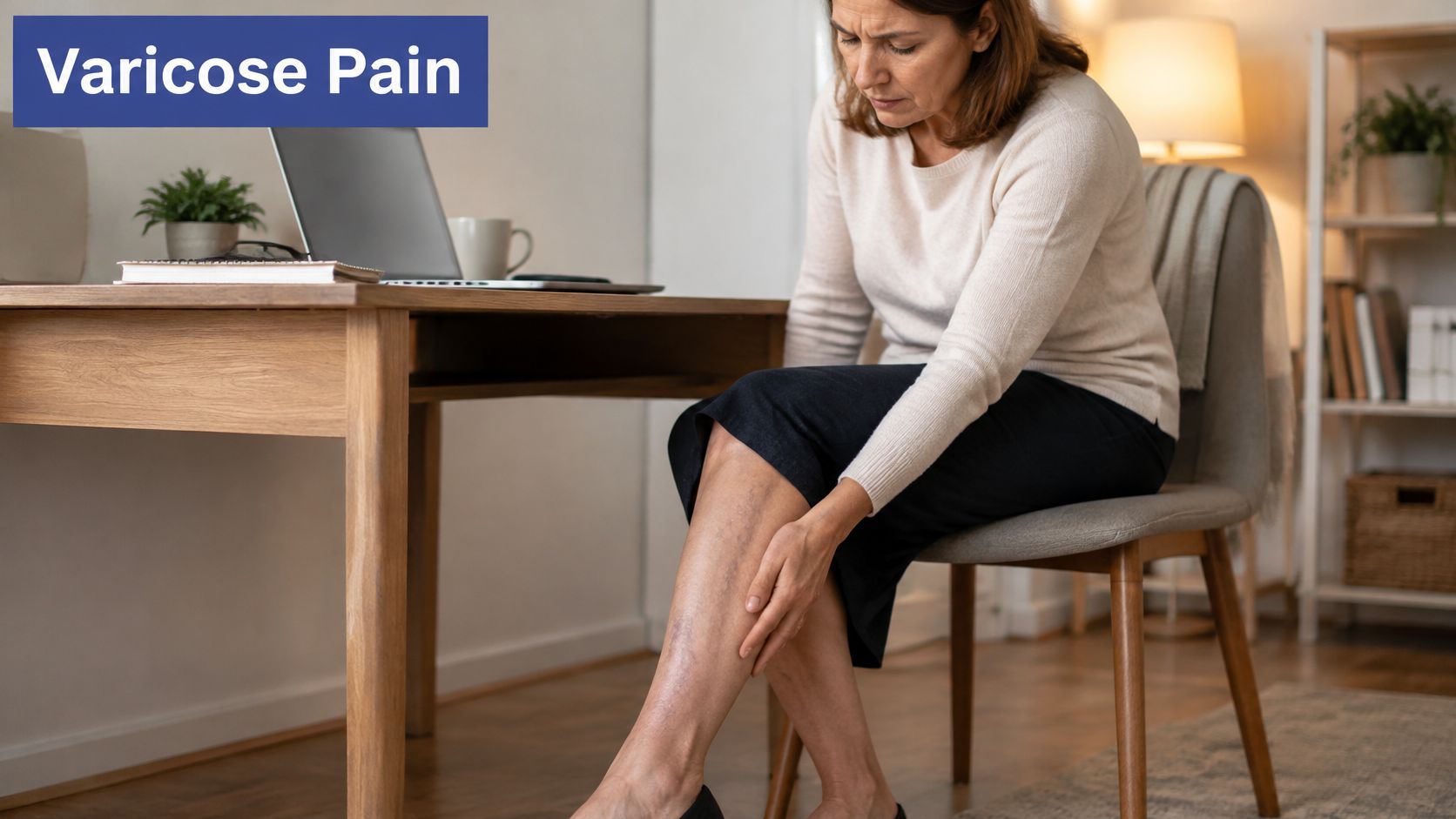
But pain near a visible vein doesn't prove that the vein is responsible. Understanding pain from varicose veins in the leg starts with the pattern: when it happens, what relieves it, and whether it developed gradually or suddenly. Those details help distinguish venous pressure from nerve, artery, muscle, or clot-related problems before treatment is chosen.
Table of Contents
- Common Leg Pain Patterns From Varicose Veins
- Why Faulty Valves Make Varicose Veins Hurt
- Telling Varicose Pain Apart From Other Leg Pain
- Red Flags That Mean Leg Pain Needs Urgent Care
- Conservative Relief and What It Can and Cannot Do
- Treatment Options When Leg Pain Persists
- Book a Vein Evaluation When Pain Keeps Returning
Common Leg Pain Patterns From Varicose Veins
| Pain pattern | Typical timing | Usual cause |
|---|---|---|
| Aching or heaviness | Builds through the day after prolonged standing | Venous pressure from valve reflux |
| Night cramps in calves | Mostly at night or during rest | Can accompany venous reflux and pressure, sometimes with restless legs |
| Burning or itching over veins | May persist or become more noticeable in the evening | Venous pressure affecting skin and nearby pain-sensitive tissues |
| Evening ankle swelling | Worse by evening, often improves overnight | Venous pooling in the lower leg |
| Relief with walking or elevation | Eases when moving or raising the legs, without a fixed timetable | Calf-muscle pumping or elevation reduces venous pressure |
These patterns offer clues, not a diagnosis. Aching and heaviness often feel like tired legs rather than sharp, pinpoint pain. A person who stands at a counter for long periods may notice discomfort building around the calves and ankles as the day goes on.
Night cramps can occur alongside venous symptoms, but cramps alone do not establish that a vein is the cause. Burning or itching over affected veins may be more suggestive of a venous problem when it occurs with swelling or skin changes. Ankle swelling that is more noticeable in the evening adds another clue, particularly if shoes feel tighter later in the day.
What the appearance can and cannot tell you
A large bulging vein may cause no pain, while a less visible vein can accompany troublesome symptoms. NICE describes symptomatic varicose veins as veins associated with troublesome pain, aching, discomfort, swelling, heaviness, or itching. What matters is whether symptoms affect comfort or function, and visible veins alone don't answer that question.
Arrange a clinical assessment if you have:
- Persistent aching or fatigue: Especially if it interferes with standing, walking, or work.
- Swelling: Including recurring ankle swelling that accompanies leg heaviness.
- Bulging veins with discomfort: Symptoms help guide assessment, while appearance alone does not.
- Skin changes: New discoloration, irritation, hardening, or a sore around the lower leg.
For an accessible introduction to garments used for symptom support, Thermo Recovery Wear's guide to gentle compression for varicose veins provides additional context. Compression selection should account for your circulation and the likely cause of your symptoms.
Self-check: Note when discomfort starts, whether walking or leg elevation helps, and whether one or both legs are affected. These observations can help describe the pattern during an assessment, but they are not a home diagnostic test.
Why Faulty Valves Make Varicose Veins Hurt
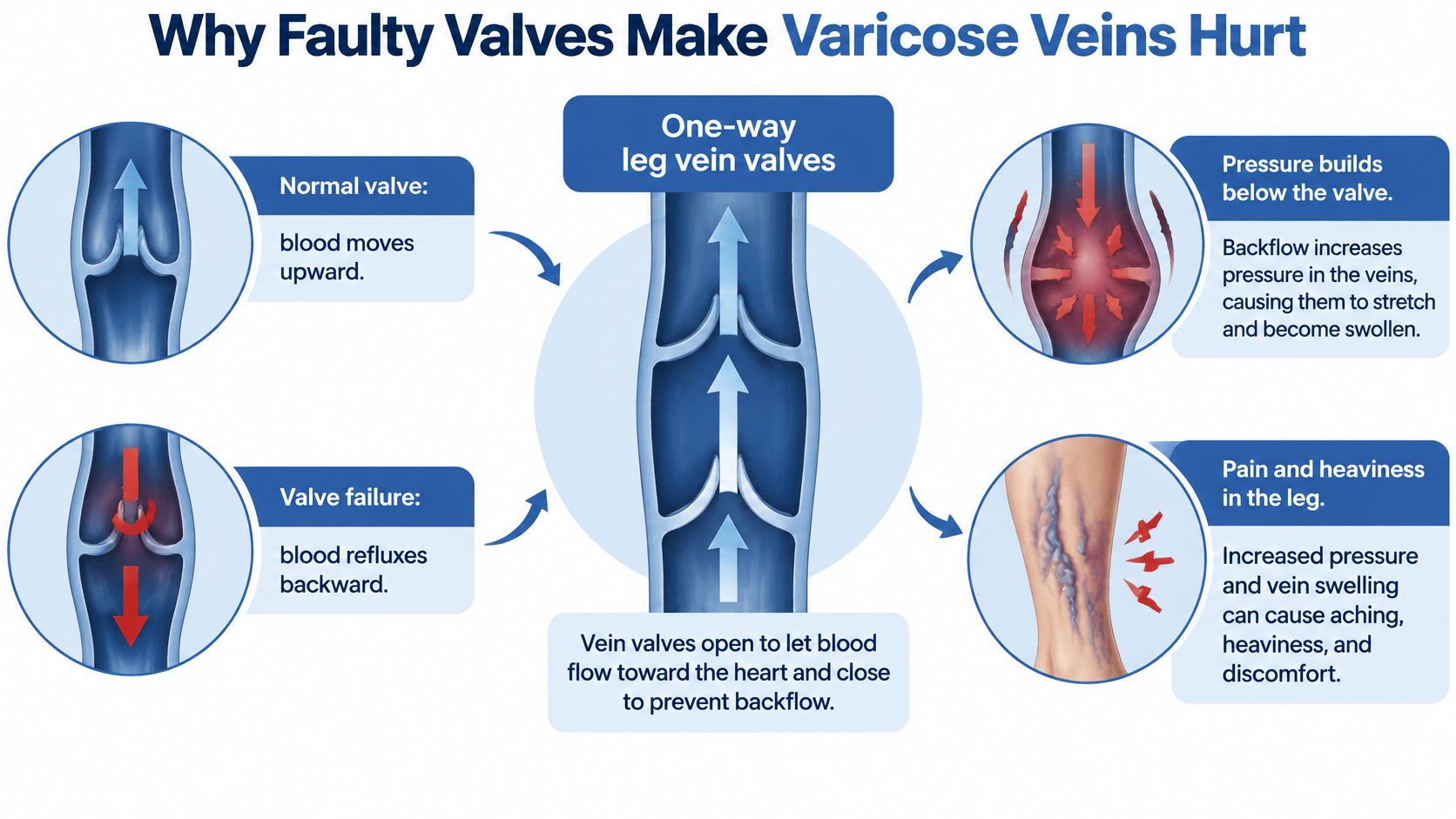
Leg veins contain one-way valves that help blood return toward the heart. Think of each valve as a door that should close behind moving blood. If it no longer shuts properly, blood can flow backward, a process called reflux.
The resulting problem is increased pressure in the veins below the faulty valve. Clinicians call persistently raised venous pressure chronic venous hypertension. This is different from the blood pressure measured with an arm cuff.
How pressure becomes discomfort
Your calf muscles squeeze the veins as you walk, helping propel blood upward. When you stand still, you lose much of that active pumping assistance. That's why standing at a workstation can feel different from moving around the same room.
Raised venous pressure can stretch vein walls, encourage local inflammation, and push fluid into surrounding tissues. It can also stimulate nearby pain-sensing nerves. Together, these changes help explain the combination of aching, burning, swelling, and heaviness.
This mechanism also explains why looking at a vein isn't enough. A clinician needs to establish whether abnormal flow in a particular segment plausibly accounts for your symptoms, while checking that the deeper veins remain open.
What ultrasound adds
Duplex ultrasound combines images of the veins with information about blood flow. The examination should be performed standing whenever possible because body position affects reflux detection.
A clinical review of chronic venous disease diagnosis describes pathological reflux as reverse flow lasting more than 0.5 seconds in superficial truncal veins and more than 1 second in the common femoral, femoral, and popliteal veins. These are technical interpretation criteria, not measurements a patient needs to calculate.
The sonographer checks flow direction, valve function, and the relevant superficial and deep veins. A complete study helps distinguish a pressure problem in a main superficial vein from other circulation abnormalities.
Practical rule: A treatment plan should connect your symptoms to abnormal blood flow, not merely identify veins that could be made less visible.
Telling Varicose Pain Apart From Other Leg Pain
| Cause | Clues that point to it | Test that confirms it |
|---|---|---|
| Varicose veins with venous reflux | Aching or heaviness, worse after standing, eases with elevation | Standing duplex ultrasound interpreted alongside symptoms |
| Peripheral arterial disease | Calf cramping on walking that stops with rest, a cold foot, or pain at rest | Ankle-brachial index and vascular examination, with additional testing when needed |
| Peripheral neuropathy | Burning, numbness, or tingling, often in both feet and at night | Neurological examination and, when indicated, nerve testing |
| Musculoskeletal pain | Pain with movement and localized tenderness related to activity or injury | Physical examination and history, sometimes supplemented by imaging |
The table offers clues, not diagnoses. More than one condition can be present, and no single sensation reliably identifies its cause.
Venous discomfort becomes more plausible when heaviness, swelling, and standing-related aching occur together. By contrast, calf pain that repeatedly starts during walking and settles when you stop raises concern about reduced arterial blood supply. Our guide to peripheral arterial disease symptoms and treatment options explains why that pattern deserves a circulation assessment.
When a different explanation fits better
Burning accompanied by numbness, tingling, or altered sensation suggests that nerves may be involved. Calling every burning sensation a vein symptom can delay the right evaluation.
Musculoskeletal pain is often more closely tied to a particular movement, joint, tendon, or tender spot. For example, pain reproduced by bending a knee after an injury needs a different assessment from diffuse calf heaviness after standing.
The American College of Surgeons' synopsis of chronic venous disease guidance supports duplex ultrasound for patients with varicose veins or relevant symptoms. A normal-looking leg doesn't exclude clinically important reflux, just as prominent veins don't establish the cause of pain.
Persistent or activity-limiting symptoms warrant assessment even if the visible veins seem minor. At our consultation, the history, examination, and duplex findings help identify where abnormal reflux occurs and whether it fits the symptoms. If the pattern points elsewhere, that problem needs attention before a vein procedure is selected.
Red Flags That Mean Leg Pain Needs Urgent Care
A sudden change is different from familiar end-of-day aching. Don't assume new pain or swelling is a flare of existing varicose veins.
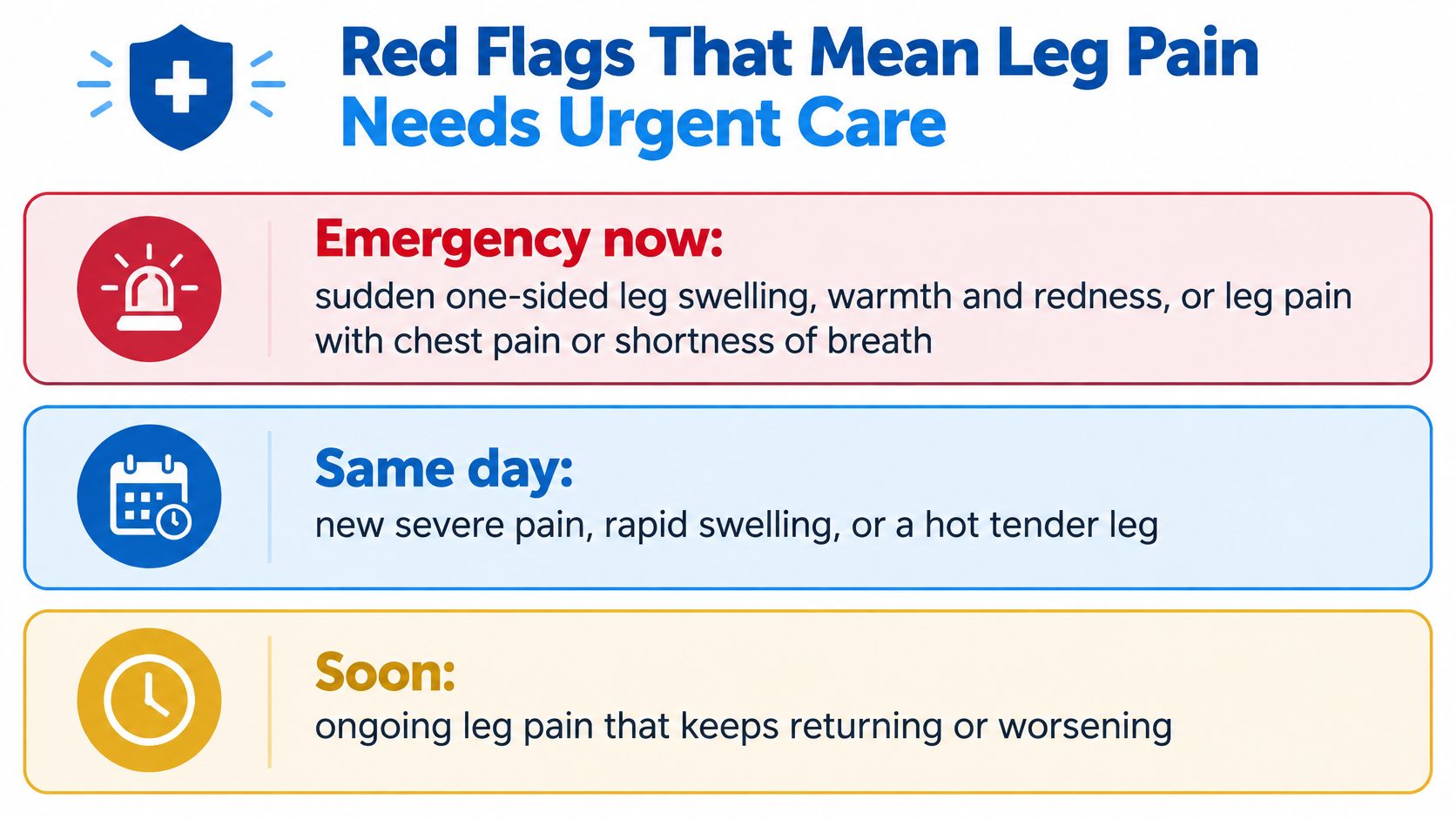
Use the following urgency guide to decide where to seek help. These symptoms don't prove that a clot or another serious complication is present, but they warrant assessment rather than watchful waiting.
Emergency now
- Leg pain with chest pain or shortness of breath: Call emergency services. This combination can indicate a pulmonary embolism, including when leg symptoms seem mild.
- Sudden one-sided swelling with warmth, redness, or pain: Seek urgent emergency assessment for a possible deep-vein clot. Don't wait for a routine vein appointment.
- Heavy or uncontrolled bleeding: Apply firm, continuous direct pressure and seek emergency help if it doesn't stop, is substantial, or causes faintness.
Our explanation of varicose veins versus deep vein thrombosis describes why a suspected deep clot requires a different response from ordinary vein care.
Same-day assessment
- A tender, firm cord along a vein: Especially with redness, this can indicate superficial thrombophlebitis. A clinician should assess its extent and whether deeper veins need investigation.
- New severe pain or rapidly increasing swelling: Arrange same-day assessment. If the changes are sudden and one-sided, or accompanied by breathing symptoms, use the emergency pathway instead.
- Bleeding that has stopped: Contact a clinician promptly because the underlying vein still needs attention.
Arrange a review within days
- Brown discoloration or hardened skin: These can reflect chronic tissue changes and shouldn't be managed indefinitely with home care.
- An itchy rash or a non-healing ankle sore: Arrange vascular and wound assessment.
- Pain disrupting sleep or daily activity: Book a review if elevation and the agreed conservative measures aren't providing adequate relief.
Start with the appropriate action: emergency services for breathing or chest symptoms, urgent assessment for possible clot symptoms, or a prompt vascular review for ongoing skin and function changes. If a wound becomes increasingly painful, hot, or associated with feeling unwell, seek same-day care rather than waiting for a scheduled review.
Conservative Relief and What It Can and Cannot Do
Compression won't correct a faulty valve, but it can reduce symptoms while you decide on next steps. It may help ease aching, heaviness, or swelling, much as support around a strained area can make movement more comfortable without removing the underlying cause.
The SCAI chronic venous disease guideline evidence review reports a standardized mean difference of 0.68 for compression's effect on discomfort in symptomatic varicose veins. This measure compares outcomes between study groups; it is not a percentage improvement or a prediction of any one person's response.
Build a practical relief plan
- Graduated compression: Wear well-fitted stockings during the day if recommended. Have circulation assessed before choosing stronger compression, especially if you have a cold foot or suspected arterial disease. The guide to compression stockings for chronic venous insufficiency explains their role in managing venous symptoms.
- Leg elevation: When comfortable, rest with your legs supported above heart level. A low stool may not raise them enough to ease pressure.
- Walking and calf exercises: Short walks, ankle movements, and calf raises keep the calf muscles active.
- Position changes: Break up long periods of sitting or standing rather than holding one position throughout a shift.
- Comfortable clothing: Avoid garments that tightly constrict the waist, groin, or backs of the knees.
- Weight management where relevant: Make changes part of a sustainable health plan, not a prerequisite for asking for care.
Measure benefit without overlooking deterioration
Track pain, heaviness, swelling, walking tolerance, sleep, and skin condition separately. For example, ankle swelling might ease while burning in the feet continues. That difference can help show that not every symptom has the same cause.
Set a trial length and review point with your clinician. The right interval depends on your symptoms and situation, so assess whether daily comfort and function are improving rather than waiting for a fixed deadline.
Improvement means better comfort and function, not necessarily disappearance of the visible veins.
If the agreed trial does not help, seek reassessment rather than continuing it indefinitely. A wound also needs a coordinated plan: care for damaged tissue and evaluation of the underlying circulation address different parts of the problem.
Treatment Options When Leg Pain Persists
| Option | Typically used for | Key point |
|---|---|---|
| Endovenous laser or radiofrequency ablation | Refluxing trunk veins, such as the great or small saphenous vein | Closes the vein so blood redirects through healthier veins |
| Ultrasound-guided foam sclerotherapy | Smaller varicose or reticular veins, including appropriate cases without axial reflux | Injected sclerosant irritates the lining so the vein closes |
| Ambulatory phlebectomy | Recurrent or bulging tributary varicosities | Removes vein segments through small incisions |
Conservative measures can help while an assessment is arranged, but they aren't a mandatory prolonged waiting period for everyone. A minimally invasive procedure may be considered when venous disease causes persistent symptoms or when compression, elevation, and activity changes don't provide enough relief.
The NCBI Bookshelf review of varicose vein treatment assessment emphasizes duplex ultrasound to confirm the diagnosis, establish the extent of reflux, and plan intervention. It also notes insufficient evidence to establish stockings as a universally effective sole initial treatment for uncomplicated varicose veins without ulceration.
Match the procedure to the pressure source
Trunk veins are the main superficial channels. Tributaries are branches feeding into them. Treating a bulging branch alone may leave symptoms unresolved if pressure continues to come from an untreated refluxing trunk.
Deep-vein obstruction or mixed superficial-and-deep disease changes planning further. A clinician must establish whether closing a superficial vein is appropriate, rather than assuming every abnormal-looking vessel should be removed.
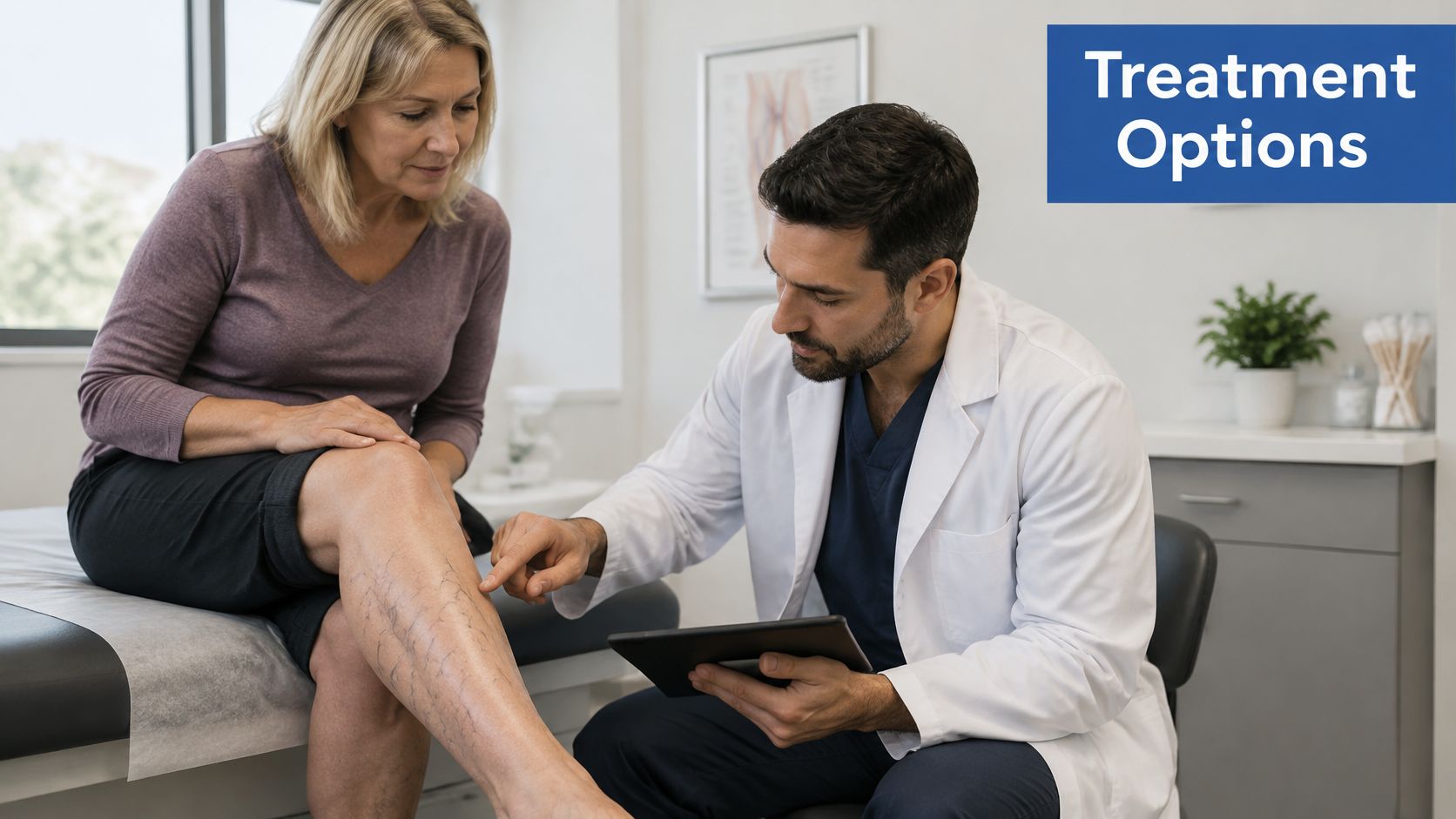
The choice depends on vein size and location, ultrasound findings, symptoms, and overall vascular health. When an unhealthy vein is appropriately closed or removed, blood naturally redirects through healthier veins, which can reduce venous pressure and improve symptoms.
A worked example
Consider a nurse who develops thigh heaviness during long shifts and has bulging thigh veins. If ultrasound confirms a refluxing superficial trunk supplying those branches, the plan might include ablation of the trunk and phlebectomy of selected tributaries, either together or in stages.
Someone with small spider veins and no axial reflux may instead be considered for sclerotherapy. But if that person's main complaint is numbness in both feet, treating the spider veins shouldn't be presented as the solution to the numbness.
Procedures can relieve venous symptoms without eliminating every source of leg pain. Improvement isn't always immediate, and persistent or worsening pain after treatment deserves reassessment for residual venous disease, complications, or a separate diagnosis.
Book a Vein Evaluation When Pain Keeps Returning
Arrange an evaluation if leg discomfort continues despite the self-care measures you have tried, interferes with work or sleep, or occurs with swelling or skin changes. A vein does not need to look dramatic, and a sore does not need to appear, before you seek advice.
An evaluation can help determine the severity of chronic venous disease and whether it may be contributing to your symptoms. It also helps establish whether treatment is appropriate or another assessment is needed.
Bring information that changes the decision
- Symptom onset: Note when the problem began and whether it developed gradually or suddenly.
- The pain pattern: Describe where it hurts, what the discomfort feels like, when it occurs, and whether one or both legs are affected.
- What helps or worsens it: Include standing, walking, elevation, compression, and particular movements.
- Your medication list: Bring current prescriptions, nonprescription medicines, and supplements.
- Previous vein care: Include earlier procedures, clot history, and any available ultrasound reports.
- Your symptom log: Record changes in swelling, sleep, walking tolerance, and skin condition.
Set goals that matter to you
Name the activities symptoms are limiting. You might want to finish a workday with less heaviness, sleep without recurring discomfort, or address swelling around a healing wound. Specific goals help guide recommendations to your condition and priorities.
Clinical examination and duplex ultrasound can identify abnormal reflux and help clarify whether it relates to your symptoms. Vein and Wound Institute provides vein evaluation and diagnostic testing, with recommendations personalized to the patient's condition and goals.
If a procedure is considered, ask which symptoms it is intended to improve and what changes should prompt reassessment. Symptoms may change gradually, so compare progress with the goals you discussed, not appearance alone.
For recurring, stable symptoms, schedule an assessment. Sudden one-sided swelling needs urgent assessment; chest pain or shortness of breath means emergency care now, not a scheduled appointment.
Visit Vein and Wound Institute to arrange an evaluation and discuss whether venous disease may be contributing to your symptoms.