
You finish a long day on your feet, and by evening the ankle is tight, the skin looks rusty brown, and a shallow sore just above the inner ankle is still wet through the dressing. You have changed that dressing. The sore still hasn't closed. That pattern is typical of a venous leg ulcer. The covering manages the surface, while high pressure in the veins keeps feeding the wound.
Compression therapy for venous leg ulcers is the treatment that pushes back on that pressure. The useful target isn't the highest number printed on a box. It's the strongest compression you can realistically wear, chosen only after arterial testing, and aimed at the vein problem rather than at how the ulcer looks.
Table of Contents
- How Compression Helps a Venous Leg Ulcer Heal
- Compression Options and Pressure Levels Compared
- Check Arterial Flow and Apply Compression Safely
- Matching Compression to Pain, Mobility and Daily Life
- Preventing Recurrence After the Ulcer Closes
- Treating the Vein Problem Behind the Ulcer
How Compression Helps a Venous Leg Ulcer Heal
Picture a shift spent standing at a counter or walking a warehouse floor. Late in the day the ankle swells, the skin darkens, and a sore that will not close sits over the inner ankle. Fluid sits in the tissue. Oxygen has a hard time reaching the skin cells that should rebuild it.
Think of a garden hose that has ballooned in the middle. A hand laid along that swollen section narrows it, and water starts moving again. Compression does the same job for a stretched vein.
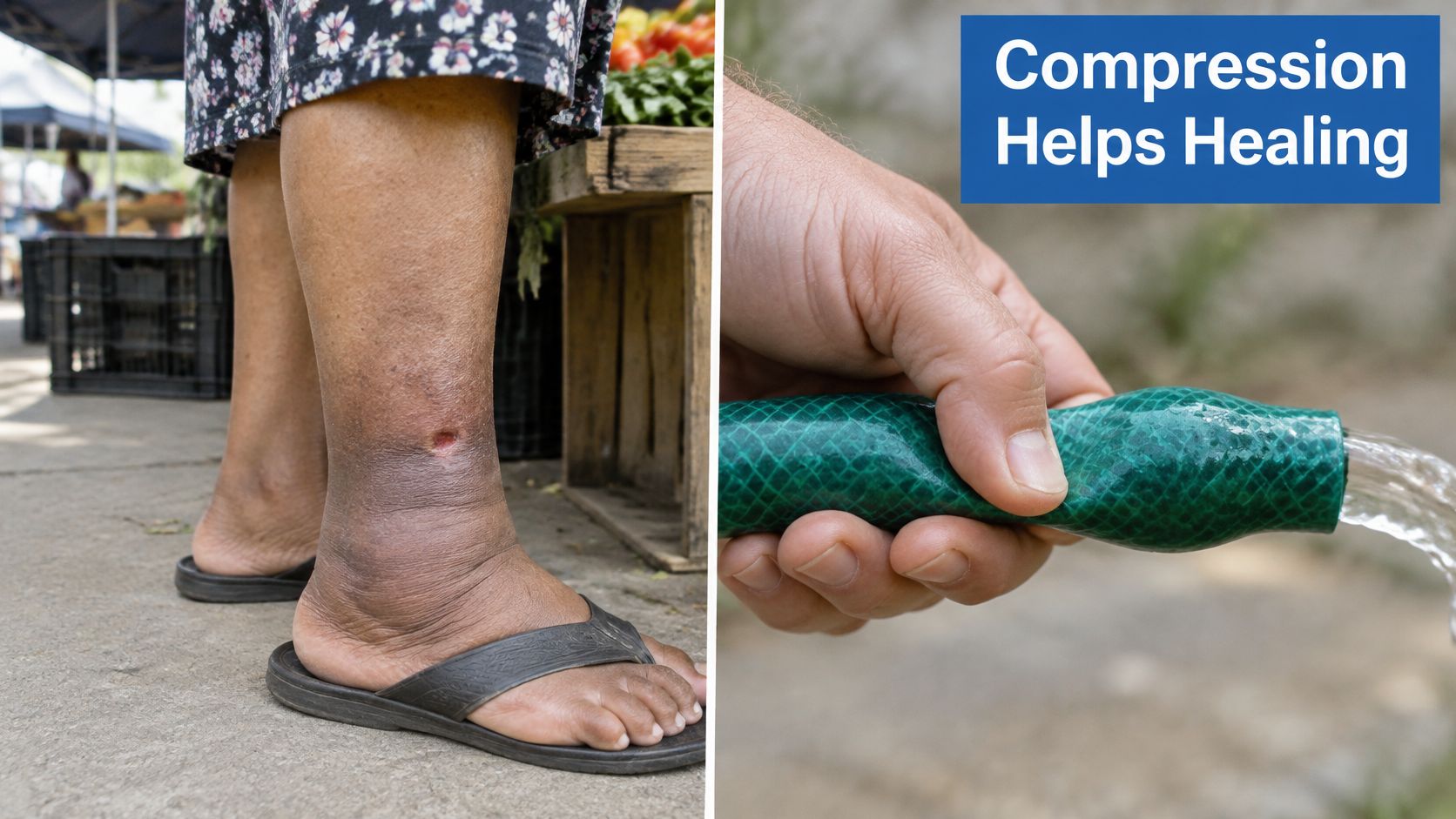
Standing sends blood down the leg. When the valves fail, blood slips backward and pressure builds in the lower leg. That standing pressure is ambulatory venous hypertension. Fluid leaks out, oxygen can't diffuse well, and the cells that close skin slow down.
External pressure works on four linked problems:
- Narrows the vein: It reduces the distended venous lumen so blood isn't pooling in a wide, slack channel.
- Helps the valves meet: Better coaptation means less backward leak with each step.
- Supports the calf pump: A firmer calf pushes blood upward more efficiently when you walk.
- Clears edema: Less swelling lets oxygen and healing cells reach the wound bed.
A Cochrane review of compression for venous leg ulcers reports that compression improves healing versus no compression, and that multi-component systems, particularly those with an elastic component, perform better than mainly inelastic systems. For an active ulcer, a multilayer system is generally favored over a single bandage. Pressure is documented at the ankle. Common stocking classes are about 18–24 mmHg for class 2 and 25–35 mmHg for class 3. Arterial inflow is checked before any therapeutic dose, because compression can worsen tissue ischemia when arterial insufficiency is present.
A dressing treats the surface. Compression, with vascular assessment, edema control, skin protection, and wound-bed care, treats the reason the ulcer stays open.
In one sentence, compression lowers the standing pressure in the veins so oxygen can reach the skin again.
Compression Options and Pressure Levels Compared
Pressure is measured at the ankle, and a higher number isn't automatically the better choice. Use the table as the reference when someone names a product. Then match the row to your arteries, your pain, and whether you can put the device on every day.
| Option | Typical ankle pressure | Where it fits | Watch for |
|---|---|---|---|
| Two-layer hosiery (class 2) | 18–24 mmHg | Mild to moderate disease, often once the wound is closing | Less pressure than class 3; check fit and symptoms |
| Class 3 stocking | 25–35 mmHg | Maintenance after closure and recurrence prevention | Higher noncompliance; confirm the person can put it on |
| Four-layer bandage (multilayer, elastic) | Clinician-applied, product-set | Active venous leg ulcers; evidence-based standard | Applied by trained clinicians; pressure set by the product |
| Adjustable compression wrap | Wearer-adjusted tension | People who value comfort and self-management | Comfort and removability, not a proven faster close |
| Inelastic system | Manufacturer-directed | Pain at rest; less pressure while the leg is still | Pressure rises as the calf works, so check fit when walking |
| Strong elastic compression | About 40 mmHg | Only when arterial blood flow is confirmed normal | Never apply before arterial testing |
Two-layer hosiery in the class 2 range is often the step down once drainage slows and the wound is closing. It is easier for many people to live in, and it still needs a smooth fit. Bunching at the ankle creates a tight ring, which is the opposite of graduated pressure.
Class 3 stockings sit in the maintenance lane after the skin has closed. They ask more of the hands and of daily patience. If the stocking stays in a drawer, it prevents nothing.
A four-layer elastic bandage is the workhorse for an open, draining ulcer. A trained clinician builds the layers so pressure is consistent between visits. You don't guess the tension at home with a single roll of gauze.
Adjustable wraps help when arthritis, weak grip, or a changing limb shape makes hosiery unrealistic. Comfort and the chance to shower matter. They aren't a shortcut to faster healing just because they feel newer.
An inelastic system, including a paste bandage such as an Unna boot, gives less squeeze while you rest and firms up when the calf muscle pushes against it. That can suit a painful leg, as long as the fit is rechecked once you are walking. Strong elastic compression near 40 mmHg belongs only after arterial flow is confirmed normal.
The same garment doesn't close every ulcer at the same pace. A 2024 clinical study of double-layer compression stockings reported 20-week venous-leg-ulcer closure rates ranging from 50.0% in patients meeting two baseline severity criteria to 69.0% in patients meeting none. Baseline severity changes what you should expect, so ask which ankle pressure and which arterial test apply to you, not only which brand is in the cupboard.
Check Arterial Flow and Apply Compression Safely
High compression isn't a universal good. It can cut off the little blood flow a leg still has. Before any therapeutic compression, arterial inflow needs an ankle-brachial pressure index or an equivalent vascular test. Compression can worsen tissue ischemia when arterial insufficiency is present. If the ulcer has come back, or the leg stays swollen despite a correct garment, ask for a venous duplex as well. An evaluation can help determine the severity of chronic venous disease. A vein consultation and duplex ultrasound help identify where abnormal reflux is occurring and which treatment is most appropriate.
Bring the facts that change the plan. Ulcer measurements and photographs, a medicine list, a pain history, any past compression and what happened with it, your workday, and the name of the person who will help you apply the device. Then ask four plain questions. Which ankle-pressure class applies? Which arterial test was done, and what was the result? Was reflux checked? Which product fits the way you live?
NICE guidance on compression wraps describes strong compression as approximately 40 mmHg at the ankle for elastic systems, or manufacturer-directed pressure for inelastic systems, and says the decision is made jointly with you. High compression is preferred when arterial blood flow is normal. When pain is the problem, an inelastic system may be preferable because it exerts less pressure at rest. If venous and arterial disease coexist, the dose is reduced or withheld until the arterial side is clear. Ulcer appearance alone doesn't tell you which of those paths you're on. Poor flow is a tissue perfusion problem, not a dressing problem.
Apply it in order
- Raise the leg first so swelling drops before you measure or wrap.
- Measure the limb and confirm the class already chosen for your arterial result.
- Smooth every wrinkle, pad bony points, and keep the skin clean and dry. A fold becomes a pressure point.
- Apply layers from the toes upward with even overlap so pressure falls as you go up the leg. A band yanked tight only at the ankle is the usual slip.
- Check the toes for color, warmth, numbness, or tingling, and loosen the device if any of those appear.
- Treat pain as a signal. It can mean too much pressure, infection, ischemia, or a bad fit. It isn't something you are supposed to tolerate.
- Remeasure ulcer area and symptoms at every change so you aren't judging progress by memory.
When comfort isn't the same as faster healing
Adjustable wraps are easier for many people, and that ease is real. Results from the VenUS 6 randomized trial indicate that compression wraps were unlikely to shorten healing time compared with evidence-based four-layer bandages or two-layer hosiery. Participants reported less discomfort and valued being able to adjust the wrap and remove it to shower. Choose a wrap for those reasons. Don't choose it because you were told it heals the ulcer faster.
Rising pain, a cold or numb toe, an ulcer that is getting larger, or signs of infection need urgent review the same day. Loosen the device and don't wait for the next routine visit.
Matching Compression to Pain, Mobility and Daily Life
The strongest stocking on paper is useless if it never gets past the ankle. NICE's 2025 recommendations say product selection should account for daily activities, adherence, quality of life, and whether you can apply the product independently. Shared decision-making is part of the plan when you're reluctant, not a failure of the prescription.
Some people are set up to struggle with a tight stocking before the box is even opened. Older adults, people with arthritis or reduced hand strength, obesity, limited mobility, cognitive impairment, or no one at home to help all face a real barrier. A garment that needs two strong hands and a dry, slim ankle will fail in that household even when the pressure class is medically right.
The trade-off in numbers
Higher-grade stockings can prevent more recurrence, and they are also harder to live with. A 2025 evidence summary reported that stronger UK class 3 hosiery reduced reulceration compared with class 2 hosiery, with an absolute risk reduction of 18.8% and a number needed to treat of 6. Noncompliance increased, with a number needed to harm of 14 for treatment withdrawal. Six people treated at the higher class may prevent one extra recurrence. About one in fourteen may stop the treatment. That is a clinical trade, not a moral one.
What to sort out before the prescription
- Donning, tested in the room: Ask the person to pull the sample on, not to nod that they can. Watch the grip, the reach to the foot, and whether the heel lands in the right place.
- Aids and backup: A hosiery applicator, an adjustable wrap, a caregiver, or home nursing is appropriate when that test fails or when pain, shift work, or showers make a fixed bandage impossible.
- When it misbehaves: Slipping, bunching, new pain, or a job that won't allow the garment means a refit or a different device. Don't keep wearing a ridge of fabric that cuts in, and don't stop without a replacement plan.
The decision rule is simple. Prescribe the strongest compression the person can consistently use, and review that choice at every visit as the limb, the pain, and the helper situation change.
Preventing Recurrence After the Ulcer Closes
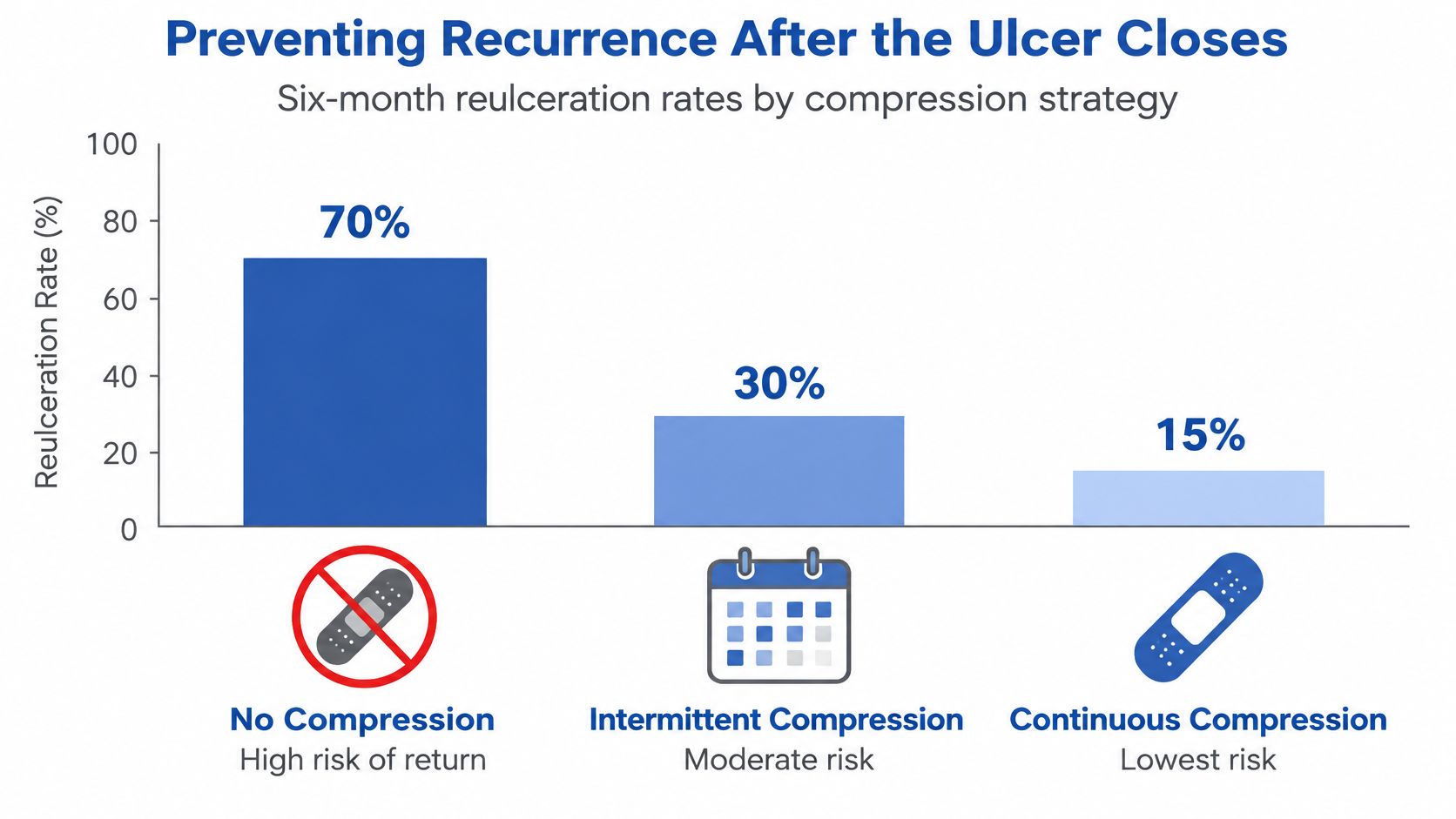
Compression doesn't retire on the day the skin closes. Epithelialization means the surface has sealed. The vein pressure that opened it is still there, so maintenance hosiery is a recurrence treatment, not an optional extra.
| Comparison | Recurrence per 1,000 at six months | Note |
|---|---|---|
| No compression | 457 | Reference group in the European class 3 study |
| European class 3 stockings | 210 | Risk ratio 0.46 (95% CI 0.27–0.76); low certainty |
| UK class 2 hosiery | 530 | Lower compression; higher recurrence |
| UK class 3 hosiery | 342 | Higher compression; more noncompliance reported |
A Cochrane review of compression to prevent venous leg ulcers returning found that European class 3 stockings reduced six-month reulceration compared with no compression. About 210 of 1,000 patients recurred with class 3 stockings versus 457 of 1,000 without compression. In one randomized study of 153 participants the risk ratio was 0.46 (95% CI 0.27–0.76), and certainty was rated low. Read those figures as a signal, not as a guarantee for every leg.
Higher compression also looked more protective than lower compression. UK class 3 hosiery was associated with recurrence in about 342 of 1,000 patients versus 530 of 1,000 using UK class 2 hosiery. The gap is large. It only counts for the days the stocking is on.
What changes the week the ulcer closes
Move promptly from the healing bandage to a maintenance garment you can tolerate for months. Compression stockings may be recommended after treatment, and the provider tells you the appropriate compression level and how long to wear them. Schedule reviews for fit, limb-volume change, donning ability, skin integrity, and adherence. A leg that shrinks will swim in last month's size, and a loose stocking doesn't hold pressure.
Individualize the plan if arterial disease, neuropathy, severe pain, or intolerance shows up. If the ulcer returns, look again for persistent venous reflux or another cause. Turning the pressure up without that check misses the reason it opened.
Treating the Vein Problem Behind the Ulcer
Some ulcers close under a good bandage and then open again in the same spot. The bandage wasn't imaginary. The reflux that refills the lower leg is still running. The treatment plan is based on the source of the problem, not merely on the veins visible at the skin's surface.
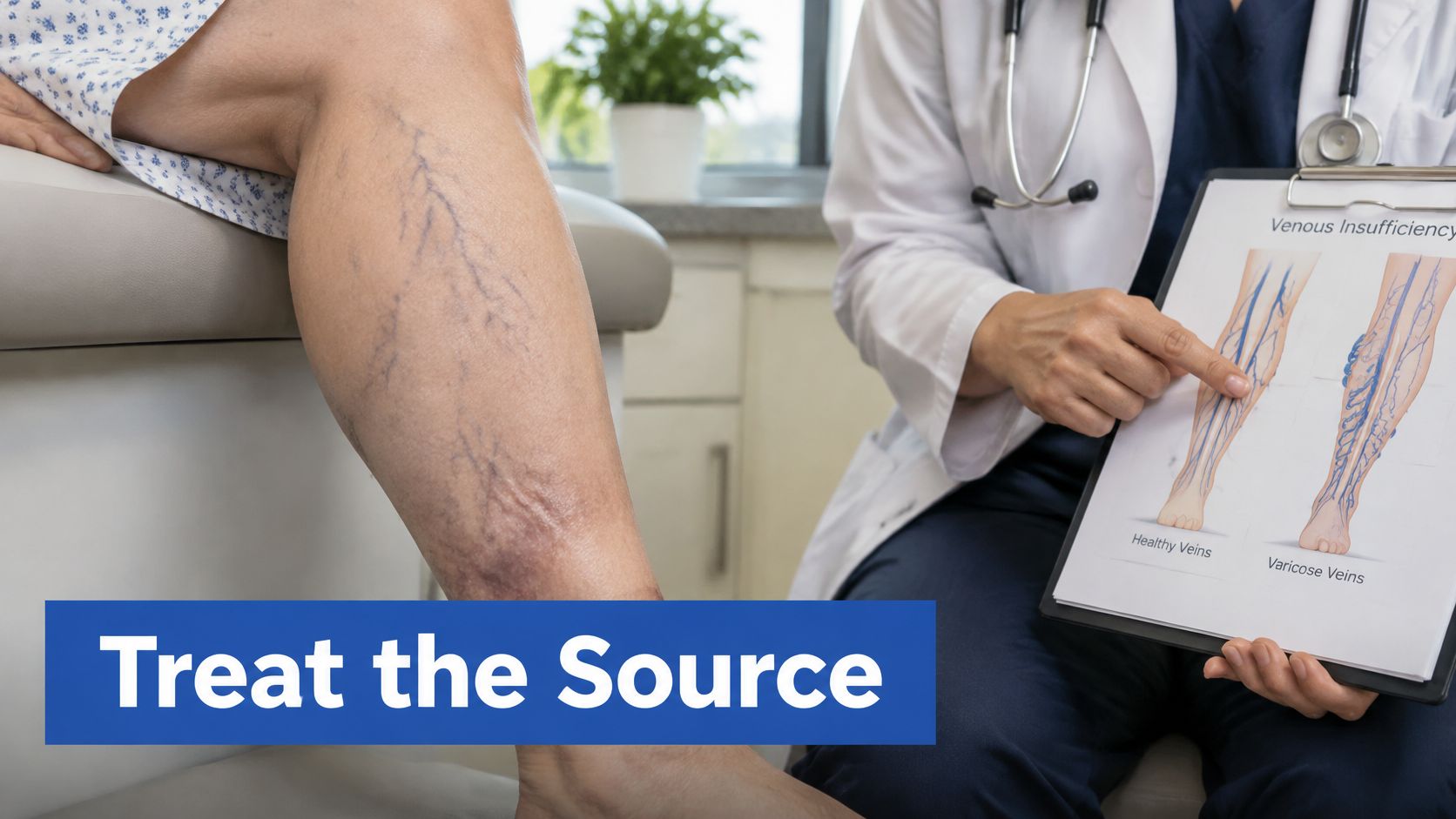
A vein consultation and duplex ultrasound map where abnormal reflux is occurring and which treatment fits that map. Bulging veins you can see are only part of the picture. The feeding vein may sit deeper, and closing the wrong segment leaves the pressure in place.
A minimally invasive procedure may be considered when venous disease causes persistent symptoms, or when compression, elevation, and activity changes don't give enough relief. Endovenous treatment uses a small catheter or access point to close the problem vein from within. Traditional vein stripping removes the vein through incisions. When an unhealthy vein is closed or removed, blood naturally redirects through healthier veins, which can reduce venous pressure and improve symptoms.
Care in one setting
When vein care and wound care happen together, an open ulcer and the reflux under it can be treated in the same plan rather than in separate waiting rooms. Venous reflux disease treatment is aimed at that source, while compression and wound-bed care keep the surface moving toward closure.
After a vein procedure, you may be asked to wear compression, avoid strenuous exercise for a period, and follow specific bathing or wound-care directions. Those instructions vary by procedure, so the written plan for your case is the one that counts.
The ulcer is healed by compression and wound care. It stays healed when the reflux is addressed.
Vein and Wound Institute evaluates chronic venous disease and non-healing wounds together, including duplex testing, compression therapy, and minimally invasive treatment of the reflux that keeps a venous leg ulcer open. If your sore isn't closing, or it keeps returning after the skin seals, bring your measurements and your daily routine to a visit. Start with Vein and Wound Institute to plan arterial testing, a garment you can wear, and care for the vein problem underneath.