
Could walking resume while bruising and compression continue for weeks? Recovery after ambulatory phlebectomy unfolds on separate timelines. Many patients return to normal daily activities within a short period after minimally invasive treatment, though the physician's instructions depend on the procedure performed.
Walking, work, and tissue healing can progress at different speeds. For example, someone may feel ready to take a short walk while still noticing bruising or tenderness. Compression may also continue after everyday activities resume, according to the provider's directions.
This distinction helps set expectations: returning to routine does not mean the leg has fully healed. Follow your clinician's guidance on activity, compression, and wound care, since recommendations vary by procedure.
Table of Contents
- Recovery Timeline From Day One to Week Six
- Activities You Can Resume and When
- Bruising, Swelling and When to Call Your Provider
- Compression Protocols and Blood Thinner Considerations
- Factors That Lengthen or Shorten Your Recovery
- Confirm Your Personal Recovery Plan With Your Provider
Recovery Timeline From Day One to Week Six
Why can you walk the same day and still see color on the leg in week five? Those are different jobs. Once the local anesthetic fades, the calf pump is ready to move blood, so ordinary walking starts early. The small sites where veins were removed keep settling long after that, the way a scraped knee lets you walk while the mark underneath is still changing.
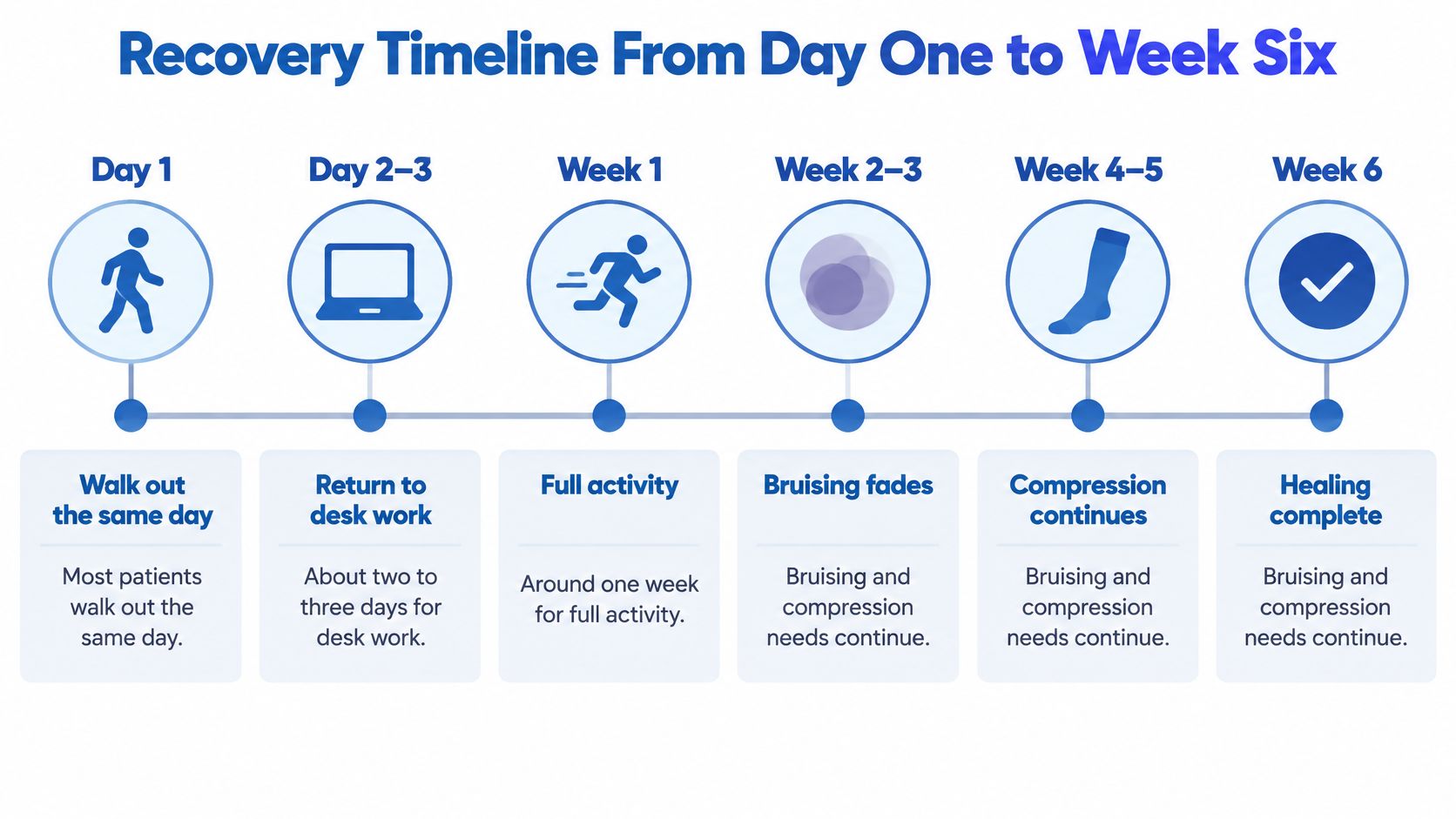
Read the windows as layers. The early stretch is the protective phase, when compression and activity limits do their work even though you are already moving through ordinary days. Under the stocking, the leg can feel settled and still show faint brownish marks later. Bleeding, superficial thrombosis, infection, temporary sensory changes, and compression-related skin problems can occur. A change that tightens or worsens, instead of easing, deserves a call.
| Window | What Usually Happens |
|---|---|
| Procedure day | Office procedure under local anesthesia; walk soon after treatment |
| Day 1 | Initial bandage removed; shower and dressing care per provider instructions |
| Days 2 to 3 | Many patients return to normal daily activities and desk work |
| Days 4 to 7 | Strenuous activity usually resumes; compression continues as directed |
| Weeks 2 to 3 | A peer-reviewed clinical review of ambulatory phlebectomy describes class 2 compression stockings at 30 to 40 mmHg for at least 2 weeks; swelling and bruising keep improving through this window |
| Weeks 3 to 6 and beyond | Residual pigmentation, tenderness, or sensory changes may linger in some patients |
How to check yourself at the end of week one: walking should feel easier than it did on day two, and swelling should be trending down rather than climbing. A bruise that changes color gradually is behaving normally; a leg that feels tighter each morning is not.
Activities You Can Resume and When
The calendar and the leg rarely agree on the same day. You can be back at a desk while the treated area is still bruised, swollen, and inside a compression stocking. Walking can start within a day. Full tissue healing takes weeks. Those are separate clocks.
Most patients are encouraged to walk soon after treatment. There is no minimum distance to hit, only comfort. Walking works like a calf pump: each step squeezes blood up the leg so it does not sit in the treated veins, and it tells you whether the leg is settling or fighting back.
Driving, lifting, and running need a different test than "can I walk to the kitchen." Driving waits until you can brake hard without hesitation in the stocking. Lifting depends on how much vein was removed and which leg was treated. Running sits past easy walking and short of the older limit on hard lower-leg aerobic work. Jogging and ordinary gym work often fit the first-week window for people whose jobs are not built around heavy loads.
| Activity | Typical Timing | Notes |
|---|---|---|
| Walking | Same day or soon after treatment | Short, frequent walks; stop if pain climbs |
| Desk work | Within the first few days | Sitting is fine once the stocking and leg feel tolerable |
| Driving | When braking in the stocking feels sure | Ask your provider if the treated leg is the braking leg |
| Lifting heavy objects | After the provider clears the treated leg | More vein removed, or both legs treated, usually means a longer wait |
| Physically demanding work | About a week for most, longer for heavy jobs | Jobs with repeated lifting sit at the longer end |
| Running or jogging | About 5 to 7 days | A typical first return, not a race day |
| Strenuous lower-leg aerobic exercise | Up to 2 weeks | Older guidance; follow the instructions for your procedure |
Why does one person feel routine again in a few days while another still limits the leg for weeks? Return to daily activity and full tissue healing measure different milestones. A randomized trial comparing endovenous treatment with and without concurrent phlebectomy found that compression reduced early pain without materially changing how quickly people got back to their routines. A longer stocking schedule does not, by itself, buy a faster return to work.
Instructions still follow the procedure that was done. When phlebectomy is paired with a catheter-based closure, the plan has to cover both. The practice's radiofrequency ablation after care page explains how that half of recovery differs: small access, local numbing, and activity limits set for the closure as well as the phlebectomy.
Practical rule: move to the next activity only when the current one feels comfortable, not when the calendar says you should.
Bruising, Swelling and When to Call Your Provider
How can you tell whether a colorful, tender leg is healing normally or needs medical attention? Bruising is the predictable result of removing veins through tiny openings. Because the access points are small, temporary bruising, tenderness, and swelling can occur, while significant scarring is uncommon. These visible changes may last longer than the time it takes to resume walking or daily activities, so judge recovery by the direction symptoms are moving, not by appearance alone.
What Normal Looks Like at Two and Three Weeks
A review of 900 patients found that postoperative hematomas generally resolved within 3 weeks, although residual pigmentation could remain longer. A firm, discolored area around day ten can still fit that recovery pattern. The same review reported lower median pain scores with elastic compression stockings worn for 7 days than with conventional 24-hour bandaging alone (1.0 versus 1.5), as well as a smaller mean limb-volume increase (43.7 versus 99.8), in a randomized study of 104 limbs undergoing phlebectomy.
Compression may help limit discomfort and fluid buildup, but the appearance of bruising does not have to disappear before you can walk or return to ordinary tasks. Swelling that was present before treatment, the extent of vein treatment, and underlying venous disease can all shape how the leg looks and feels as it heals.
Four Habits That Shorten the Bruising Phase
- Wear compression as directed. Follow your provider's instructions for the stocking and its duration. Recommendations vary by procedure.
- Raise your legs when you sit. Short periods with your legs raised up can be easier to fit into the day than waiting for one long rest.
- Walk in short, frequent blocks. Walking supports a gradual return to activity. Stop and contact your provider if it brings on worsening pain or tightness.
- Follow bathing and wound-care directions. Keep the small access sites clean and follow instructions about bathing. Avoid adding creams or soaking the sites unless your provider advises it.
Warning Signs That Need a Same-Day Call
Contact your provider the same day about:
- Bleeding that continues to soak through the dressing despite firm pressure.
- Rapidly increasing swelling, or a leg that becomes tight, hard, and painful rather than sore.
- A firm growing lump or tender hard cord along the path of a treated vein.
- Spreading redness, warmth, fever, or pus at an access site.
- New numbness, tingling, or skin breakdown under the stocking.
Calf pain can be difficult to interpret because muscle soreness and a clot may feel similar. A guide to calf pain red flags to watch explains symptoms that may need prompt assessment. Seek advice rather than trying to diagnose the cause yourself.
What to Bring to Follow-Up
A follow-up ultrasound may be used to confirm that the vein has closed. The visit can also give your provider a chance to review swelling, wound healing, and stocking fit. Bring your medication list, including any blood thinners, and the stocking details, including its pressure rating. A brief daily log of swelling, symptoms, and activity can show whether things are improving or getting worse.
If you are tracking changes in your leg after treatment, this guide to varicose vein treatment side effects covers common effects and symptoms to discuss with your provider.
A bruise that fades through yellow and green is changing as it heals. A leg that gets tighter each morning needs a call, not just more time.
Compression Protocols and Blood Thinner Considerations
A stocking schedule depends on the procedure and your clinician's instructions. The table compares protocols described here; it is a reference, not a substitute for the plan you receive.
| Protocol | Compression | Duration | Activity Guidance |
|---|---|---|---|
| Older procedural guidance | Class 2, 30 to 40 mmHg | At least 2 weeks | Avoid strenuous leg aerobic exercise for 2 weeks |
| Thermal ablation with or without phlebectomy | Elastic compression | At least 1 week | Daily activities may resume earlier |
| 2025 retrospective protocol | Overnight stockings, then daytime compression | 7 days daytime | Dressing removal and shower on day 1 |
| Provider-individualized plan | Set by the provider | Adjusted to your case | Adjusted for arterial disease, neuropathy or fragile skin |
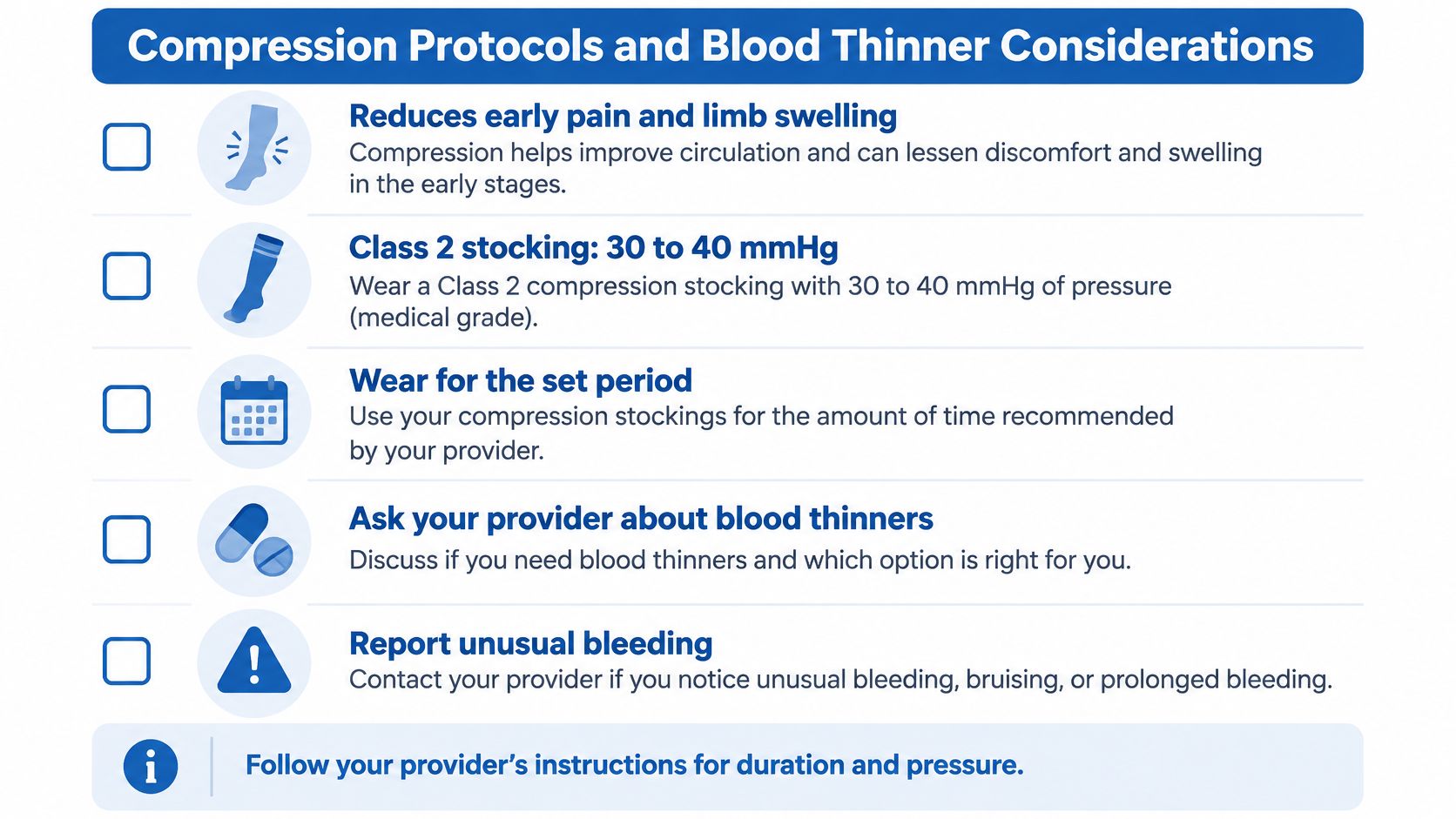
The 2025 retrospective study linked below describes one protocol: stockings overnight, dressing removal and showering on day one, then daytime compression for seven days. The thermal-ablation protocol in the table uses compression for at least a week, while older procedural guidance describes at least two weeks. The right schedule depends on which procedure you had and your clinician's directions. Compression can continue while walking and daily activities resume, so activity returning does not mean the tissues have fully healed.
Where Blood Thinners Fit
A 2025 retrospective study on anticoagulation during ambulatory phlebectomy reported that continuing anticoagulants did not increase postoperative bleeding risk in the group studied. Your prescribing clinician should guide any medication changes. Ask before stopping, starting or adjusting a blood thinner.
Living With the Stocking
- Put it on before standing in the morning, while the leg is still at its least swollen.
- Check the fit and skin at the top band and behind the knee. Report numbness or color changes in the toes.
- Ask about adjustments if you have arterial disease, neuropathy or fragile skin.
- Keep the fabric smooth so it does not bunch at the ankle. The guide to putting on compression stockings explains how to roll and slide the stocking into place.
To compare the protocols, start with the procedure: thermal ablation, phlebectomy, or both. Then confirm the compression level, whether the stocking stays on overnight, when dressings can come off, and how many days to wear it. If any part of the schedule is unclear, ask your provider before changing it.
Factors That Lengthen or Shorten Your Recovery
Why can one person walk the dog the next morning while a coworker treated for varicose veins is still limiting shifts later on? The calendar has several moving parts. Five of them matter more than the rest: how many legs are treated, how much vein is removed, what the job asks of the legs, whether an ablation happens in the same sitting, and how that person's tissues bruise and swell. Baseline venous disease, swelling that was already there, diabetes, or an open wound moves the plan off a standard schedule.
A historical ambulatory-surgery series gives a concrete feel for the procedure itself. It reported an average operating time of 50 minutes per leg, with a range of 40 to 100 minutes, an average hospitalization of 8 hours (ranging from 6 to 14 hours), no postoperative complications, and no postoperative analgesia for 12 patients, or 33%.
Those figures describe the operation and the pain load, not the day the leg looks finished. Treatment in that series finished inside a day. Walking is encouraged soon after, because gentle movement supports circulation better than staying in bed. Bruising, swelling, and a compression stocking can still be part of the picture for weeks after those first steps feel easy.
Daily activity and tissue healing run on different clocks.
Matching Your Job to the Range
The spread between a shorter recovery and a longer one works like a dial, not a promise. Desk work with limited standing sits toward the easier end: desk workers are often back at a keyboard within a few days, with the leg propped between calls. Warehouse, nursing, landscaping, and trades work sits toward the longer end, because twelve hours on concrete asks more of a freshly treated leg than twelve hours in a chair. If both legs are treated, or a large amount of vein comes out, plan for the slower side and treat an earlier return as a bonus.
Circulation sits in the same picture. If vascular risk factors are also on the list, supporting healthy cholesterol levels naturally covers everyday dietary habits that sit alongside the vein plan, not in place of it.
Procedure choice follows the leg in front of the clinician, which is why two people with visible varicose veins can leave with different instructions. One patient might have a short cluster of surface veins on a single calf, removed in one sitting, with a desk job waiting at home. Another might have bulging veins fed by a larger pathway that ultrasound shows is still open, so that pathway is closed and the surface branches are removed together, on legs that then spend the workday standing. Where the vein sits, how large it is, what the symptoms are, and how the rest of the circulation is doing decide which path fits. The second plan has more tissue to settle, so swelling and compression outlast the first walks.
Confirm Your Personal Recovery Plan With Your Provider
Before the procedure, get your timeline in writing. Ask these six questions and write the answers down, because the details blur by the time you're home with a bandage on.
- How many veins and which legs will be treated at this session?
- Will endovenous ablation be combined with the phlebectomy, and how does that change the plan?
- Which compression level do I need, and for how many days exactly?
- When can I drive, lift, exercise and return to my specific job, not a general category of job?
- Do my blood thinners or other medications change the plan, and who decides that?
- When is the follow-up ultrasound, and which symptoms should send me in sooner rather than later?
Vein treatment recommendations are personalized based on your condition and goals, so answers that sound specific to you are the right kind. A minimally invasive procedure may be considered when venous disease causes persistent symptoms, or when compression, elevation and activity modification don't provide enough relief, and it may be considered for a wound that isn't healing on its own.
Then take one action: open the timeline table from the first section, fill in your own dates for the end of compression and the follow-up visit, and stick it on the fridge. If symptoms persist past those dates, or a wound on the leg isn't closing, book a consultation rather than waiting for the next scheduled appointment.
At Vein and Wound Institute, ambulatory phlebectomy is performed in the office under local anesthesia, and most patients walk out and return to light daily activities quickly. We pair that with procedure-specific instructions on compression, activity, bathing and follow-up, and because our practice treats both venous disease and chronic wounds, we can manage a healing leg and an open wound in the same care plan rather than sending you between offices. If you're in Los Angeles, Santa Barbara or Ventura County and want your own timeline instead of a general one, visit Vein and Wound Institute to schedule an evaluation.