
An Unna boot is an inelastic compression dressing made of gauze coated with zinc oxide paste, wrapped from the toes to below the knee and applied by a clinician, mainly for venous leg ulcers and leg swelling from chronic venous insufficiency.
If it looks like a bandage, why does your circulation need checking before it goes on? Because an Unna boot doesn't just cover a wound. It applies pressure to the leg, and that pressure must be matched to the blood supply reaching your foot.
Table of Contents
- What an Unna Boot Is and What It Is Made Of
- How an Unna Boot Creates Compression While You Walk
- Conditions an Unna Boot Treats and Who Qualifies
- How a Unna Boot Is Applied and How Long It Stays On
- Benefits, Risks and Warning Signs During Wear
- When to See a Clinician Before Using an Unna Boot
What an Unna Boot Is and What It Is Made Of
An Unna boot is a clinician-applied compression treatment, not footwear or a removable brace. The name comes from Paul Gerson Unna, a German dermatologist associated with zinc oxide paste bandaging, as described in Wikipedia's overview of the Unna boot.
Say you have a shallow wound near your ankle and swelling caused by poorly functioning leg veins. A simple dressing can cover the wound and absorb drainage. An Unna boot has another job: it helps control the excessive venous pressure and swelling that interfere with healing.
The paste-coated gauze dries into a semi-rigid support. Think of it as a firm sleeve rather than a stretchy sock. It isn't intended to immobilize your leg like a fracture cast, but its stiffness is an important part of the treatment.
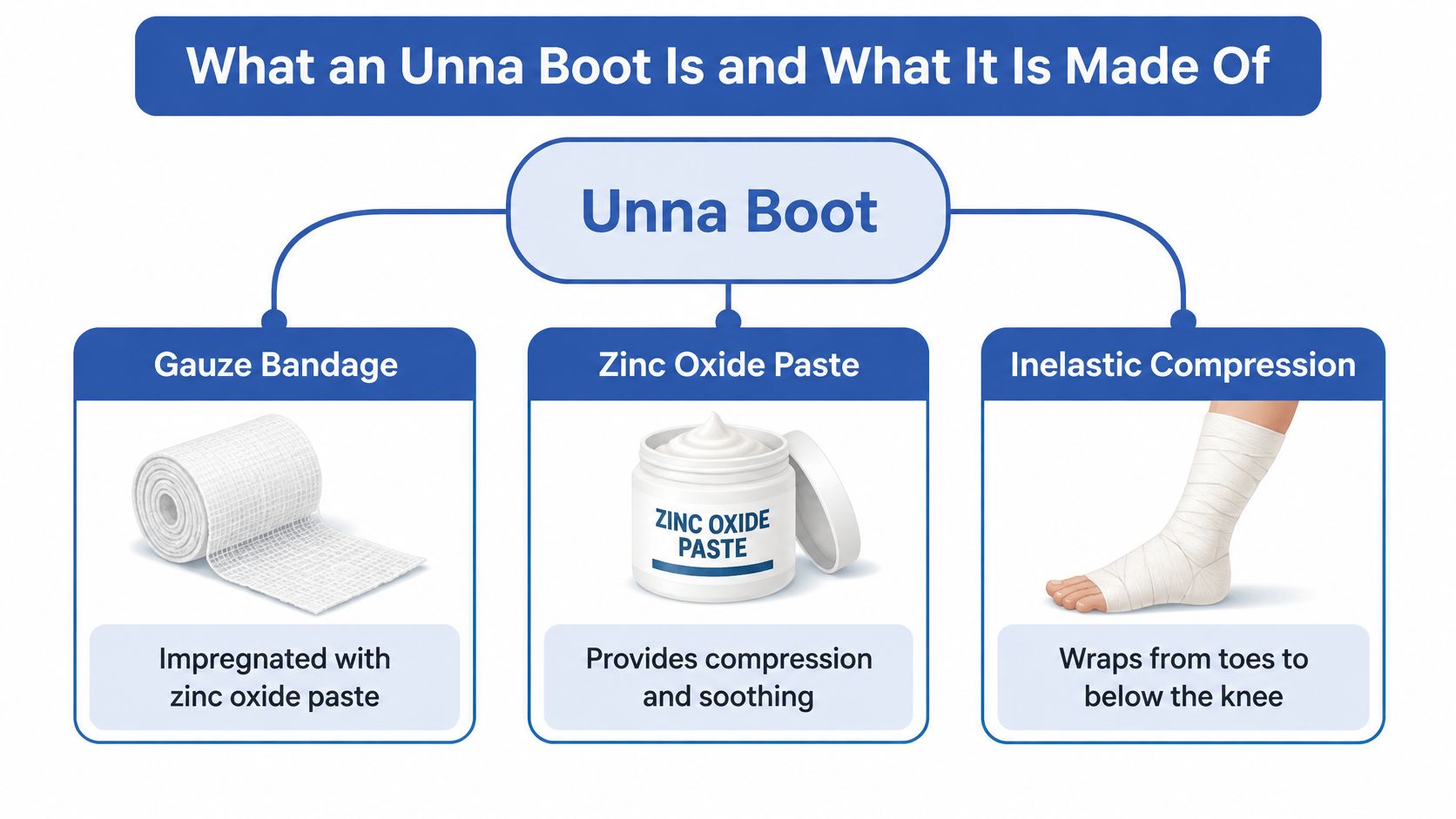
Unna Boot Components and Their Roles
Different formulations contain different additives. The defining materials are gauze and zinc oxide paste, while the completed clinical dressing may include padding and an outer wrap.
| Component | Role in the boot | Present in |
|---|---|---|
| Gauze bandage | Carries the paste and forms the wrap layers | All formulations |
| Zinc oxide paste | Hardens as it dries to create a semi-rigid support | All formulations |
| Gelatin | Adds body to the paste | Some formulations |
| Glycerin | Helps keep the paste pliable | Some formulations |
| Calamine | Soothing additive in some pastes | Some formulations |
| Petrolatum | Softening additive in some pastes | Some formulations |
| Water | Carrier for the paste mixture | Common formulations |
| Outer wrap | Adds support and protects the dressing | Typical clinical application |
The additives don't turn the boot into a stand-alone medicine for every wound. The completed compression system, including how it fits your leg, matters more than choosing a paste ingredient.
Elastic compression stockings belong to a different category. They stretch and are generally put on and taken off as part of a daily routine. An Unna boot is molded around the leg during application and remains in place between clinical dressing changes.
How an Unna Boot Creates Compression While You Walk
The stiffness can seem counterintuitive, yet that resistance is the whole point. Your calf muscles need something firm to press against, and a stretchy dressing would give way instead of pushing back.
At rest, the wrap generally produces relatively low resting pressure. During walking, your calf expands against the inelastic dressing, creating higher working pressure. The clinical review of compression therapy for venous leg ulcers describes how this supports the calf-muscle pump and limits venous pooling.
This is also why the boot is a clinician-applied treatment rather than a dressing you pick up and wrap yourself. Pressure this purposeful has to be matched to your circulation first. Before application, the clinician confirms that arterial blood flow to the foot is adequate, because compressing a leg that already struggles to receive blood can cause harm. That circulation check comes before the first layer of gauze goes on.
What Happens With Each Step
The sequence is straightforward:
- Your calf muscles contract as you walk.
- The stiff dressing resists their outward expansion.
- That interaction compresses veins within the leg and helps move blood upward toward the heart.
- As the muscles relax, the pressure changes again.
This is why walking ability matters when choosing the treatment. Someone who walks regularly can activate this pumping action; someone who spends most of the day seated gets less of that movement-related benefit.
Pressure Changes During Wear
The following mean interface pressures were reported at application and after seven days in a 2024 venous-society newsletter.
| Body position | At application (mmHg) | After seven days (mmHg) |
|---|---|---|
| Supine (lying down) | 29 | 17 |
| Standing | 37.6 | 22 |
These measurements illustrate two points: posture affects pressure, and pressure can decrease during wear. They are illustrative figures rather than a guarantee of what your own dressing will deliver.
A practical review of compression treatment describes a commonly used Unna boot profile of approximately 20–30 mmHg. Construction, application technique, leg shape, and activity all influence the result. Two boots carrying the same product name can deliver different pressures on different legs, which is one more reason application belongs in trained hands.
Practical rule: Tell the clinician your real walking distance and daily activity level before the boot goes on.
The zinc paste also helps maintain a moist wound interface, though it cannot correct faulty venous valves. The clinician must consider both the wound surface and the circulation problem underneath it.
Conditions an Unna Boot Treats and Who Qualifies
Not every leg wound should be bandaged the same way. Venous leg ulcers and swelling from chronic venous insufficiency are common reasons to consider an Unna boot, especially when the patient is mobile. A wound caused by inadequate arterial blood flow needs a different assessment.
Veins carry blood back toward the heart. Arteries deliver blood to the tissues. If too little blood is reaching the foot, applying routine compression may worsen the problem rather than help it heal.
A study of Unna boot treatment excluded obstructive arterial disease before treatment. This distinction is central to safe selection: the clinician needs to establish the wound's cause before choosing compression.
Unna Boot Suitability by Condition
| Condition | Suitable for Unna boot? | Check before use |
|---|---|---|
| Venous leg ulcer with normal arterial flow | Usually yes | Arterial assessment and evaluation of venous reflux |
| Leg edema from chronic venous insufficiency | Usually yes, when mobile | Confirm venous cause and circulation |
| Ulcer with arterial or mixed disease | Modified or avoided | Arterial assessment first |
| Reduced ankle-brachial index | Modified or avoided | Vascular review |
| Advanced peripheral arterial disease | Contraindicated for routine compression | Vascular review |
| Abscess or septic phlebitis | Contraindicated | Treat infection first |
| Uncontrolled heart failure | Contraindicated until stabilized | Medical stabilization first |
Advanced neuropathy also requires particular caution because reduced sensation can prevent a person from noticing harmful pressure. This table isn't a self-screening checklist that clears someone to apply a boot at home.
Why Similar-Looking Wounds Can Need Different Plans
Consider a person who walks daily, has a swollen ankle, and has a confirmed venous ulcer with adequate arterial circulation. An Unna boot may fit that person's needs.
Now consider someone with a painful ulcer and cold toes. That person needs prompt assessment for inadequate arterial blood supply, not an assumption that all swelling calls for compression.
An ankle-brachial index compares blood pressure at the ankle with pressure in the arm. Other vascular testing may be needed when that measurement doesn't adequately answer whether compression is safe.
For chronic venous insufficiency and ulcers, our vein consultation and duplex ultrasound help identify where abnormal reflux is occurring and which treatment is most appropriate. The arterial assessment and venous evaluation answer different questions, and neither should be replaced by looking at the wound.
How a Unna Boot Is Applied and How Long It Stays On
The first thing that happens at an Unna boot appointment has nothing to do with gauze. Before any wrapping begins, the clinician confirms that your arteries deliver enough blood to the leg for compression to be safe. That check is the gate the whole procedure passes through, because a boot applied over poor arterial flow can damage the skin it was meant to protect.
What Happens During Application
Circulation and the wound are assessed. The clinician reviews arterial blood supply, wound appearance, drainage, and signs of infection. These findings determine whether an Unna boot is appropriate and what supporting dressings are needed.
The wound and surrounding skin are prepared. The wound is cleansed, and fragile skin and prominent areas such as the shin and ankle receive protection as needed. Padding spreads pressure so no single spot bears the load.
The paste-coated gauze is wrapped smoothly. The clinician works from the toes toward just below the knee, shaping the dressing to the leg. Wrinkles, folds, or tight bands can create pressure points under a dressing you cannot adjust.
Additional layers are added according to the chosen system. Gauze, padding, and an outer wrap may help manage drainage and support the dressing. The completed system must match the prescribed compression plan.
The paste sets into a semi-rigid dressing. Before you leave, you should understand how to protect it, when to return, and whom to contact if something changes.
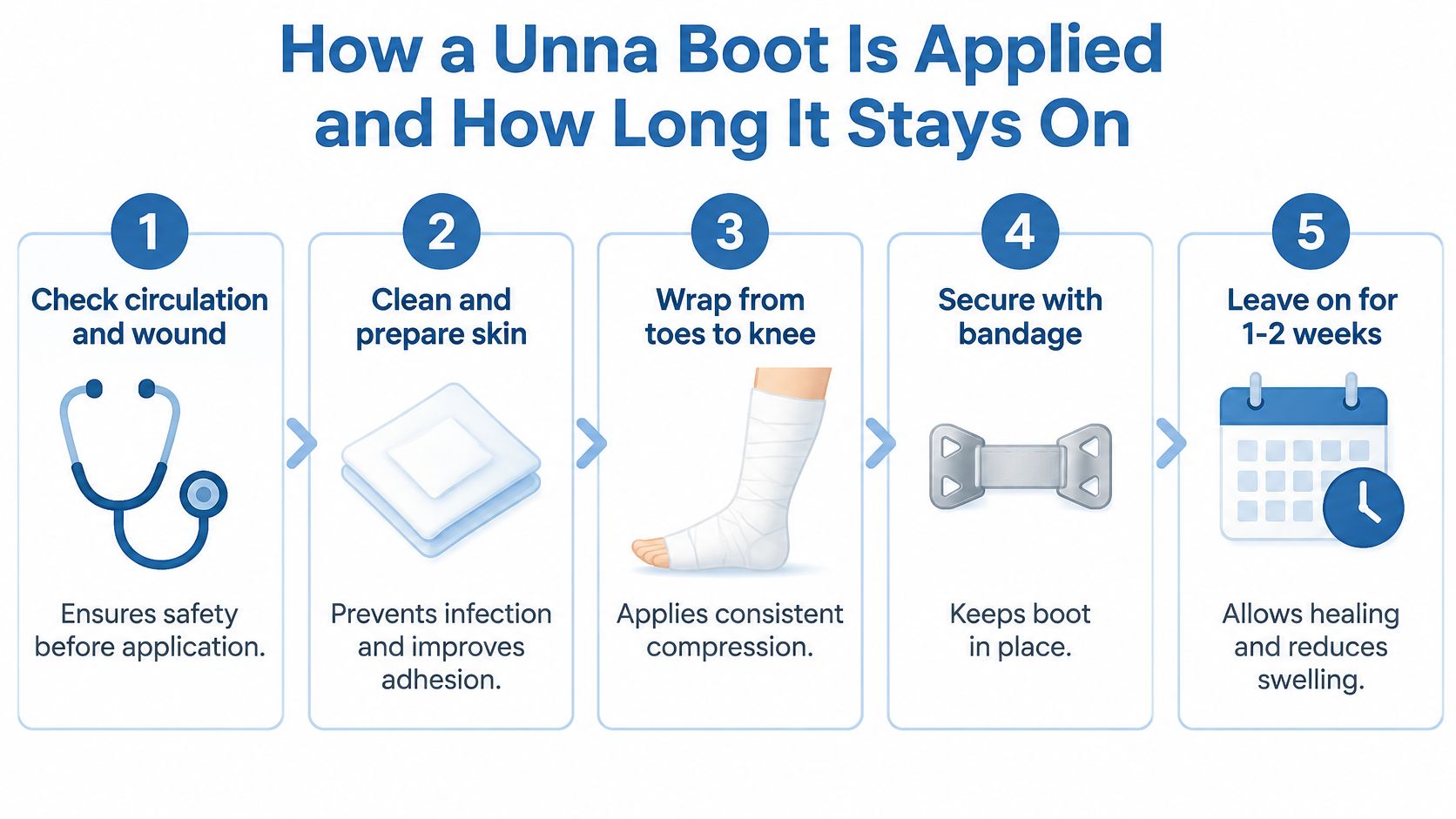
The Dressing-Change Plan
Wear schedules commonly center on roughly one week, although the specific system and clinical findings determine the interval, as described in the University of York compression evidence reference. Your written dressing-change instructions always take priority over general timing.
A patient who works on their feet might keep the dressing in place until the planned clinic change rather than unwrap it after each shift. That plan needs reconsideration if drainage soaks through, the dressing slips, or discomfort develops. Any of those changes means the boot is no longer doing its job the way it was applied to do it.
Do not remove or reapply the boot without clinical instructions. Contact the treating team for advice, and use the warning signs in the next section to judge when a change in symptoms needs urgent assessment. Rewrapping the leg yourself cannot correct a circulation problem underneath it.
Before leaving, make sure you know the return date, how to keep the dressing protected during bathing, and the contact route for problems outside office hours.
Choosing a venous stasis ulcer dressing also means matching the wound's drainage to the materials used beneath compression. Heavy drainage may require a different dressing strategy or closer review.
Benefits, Risks and Warning Signs During Wear
An Unna boot works as a prescribed compression treatment applied by a clinician, and its benefit comes from one thing: sustained pressure. Steady compression on the lower leg helps the veins move blood back toward the heart, which lowers the fluid pressure that keeps a venous ulcer swollen, weeping, and slow to close.
The supporting evidence is solid. A Cochrane review of compression versus no compression found faster complete healing with compression, with a pooled hazard ratio of 2.17 across 5 studies involving 733 participants, and a higher likelihood of complete healing within 12 months, with a pooled risk ratio of 1.77 across 10 studies involving 1,215 participants. Those results describe compression treatments as a group, so they support compression in general and leave the choice between a boot, a wrap, or stockings to the clinician matching treatment to your circulation, mobility, and follow-up schedule.
What the Benefits Mean in Practice
For a suitable leg, the practical advantages are specific: support while you walk, steadier control of swelling, and a wound surface that stays protected between clinic visits. Skipping daily self-application also removes a step many patients find difficult to do correctly on their own.
Compression is still one part of healing. An ulcer may also need infection treatment, a different drainage-management plan, or treatment of the underlying vein problem before it closes.
New or worsening pain during wear needs assessment. Compression fitted correctly should not cause escalating pain.
The risks follow from the same mechanism that makes the boot work. Pressure on a leg with poor arterial inflow can starve the tissue of blood, which is why the circulation check comes before any compression goes on. The stiffness that delivers that pressure creates another risk: a slipped or badly positioned bandage can press hard on one spot, which is how pressure injuries start at the ankle or shin. The paste layer can also irritate skin, and infection can develop or progress beneath the dressing.
Warning Signs That Need Prompt Attention
Contact the treating team promptly for:
- New severe pain, especially pain that is escalating or feels different from your usual wound discomfort.
- Numbness or tingling, which may signal pressure on nerves or impaired circulation.
- Cool, pale, blue, or otherwise discolored toes, particularly when the change is new.
- Increasing drainage, including fluid soaking through the outer layers.
- Fever or feeling unwell, especially with worsening wound symptoms.
- Rapidly worsening swelling, or a dressing that has shifted and is digging into the leg.
Toes that turn cool or pale between appointments need urgent assessment rather than a wait until the scheduled change. Seek urgent medical assessment for cold or discolored toes, severe pain, or rapidly worsening symptoms, particularly if you can't reach the treating clinician promptly.
When to See a Clinician Before Using an Unna Boot
Compression only helps a leg wound when arterial blood flow can support it. Arrange an assessment before the first boot goes on, because a clinician's evaluation is what establishes whether the ulcer is venous, whether circulation is adequate for pressure, and whether compression is the right initial treatment. That circulation check, often an ankle-brachial index or a similar arterial test, is the safety step that decides whether a boot will help or cause harm.
A non-healing wound, recurring ankle ulcer, or persistent swelling deserves an explanation rather than repeated covering. Understanding poor tissue perfusion matters most when the foot is cool, painful, or slow to heal, since reduced arterial supply changes whether compression is safe at all.
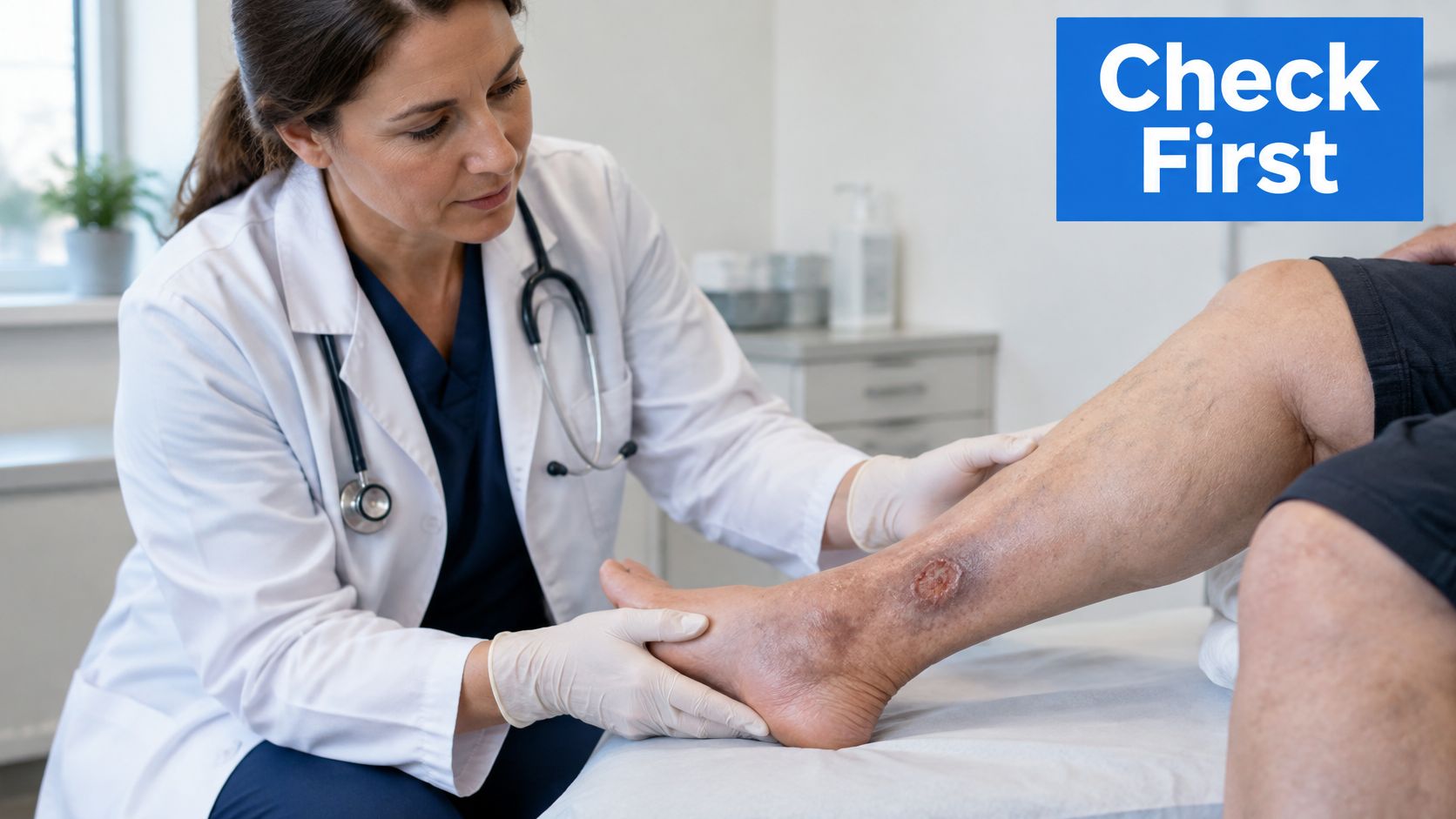
Questions to Bring to Your Visit
- Wound cause: Is this ulcer venous, arterial, mixed, or caused by something else?
- Circulation results: What does my ankle-brachial index or other arterial test mean for compression?
- Change schedule: When should the dressing be changed, and what could require an earlier visit?
- Problems at home: What should I do if the boot slips, gets wet, or feels painful?
- Daily activities: Would a removable wrap, multilayer system, or stockings better suit my bathing, work, and mobility?
- Long-term care: Does the underlying venous disease need treatment beyond wound dressings?
Bring previous vascular test results and describe any difficulty walking, reaching your feet, or managing dressings at home. Those details can change which treatment is practical.
The wound plan may include debridement, different dressings, infection management, or referral rather than immediate boot placement. Coordinating vein and wound assessment helps when both an active ulcer and abnormal circulation need attention, since treating one while ignoring the other often explains why a wound keeps returning.
Book a vascular and wound assessment before starting compression on an undiagnosed wound.
Vein and Wound Institute offers coordinated diagnosis and treatment for vein disorders and complex wounds, including assessment of whether compression is appropriate. Visit Vein and Wound Institute to arrange a vascular and wound evaluation that begins with the right safety checks.