
A simple non-sticky dressing is typically changed 1 to 3 times per week, but compression remains the primary therapy for venous ulcers, and no single dressing material has proven superior for healing. Choose the dressing according to drainage, wound characteristics, compression compatibility, and comfort, rather than assuming an advanced product will heal the ulcer faster.
You may be dealing with a wound just above the ankle that leaks through its dressing, leaves the surrounding skin damp, and makes every change feel like a small ordeal. It's understandable to think that a more expensive or technologically advanced product must offer better healing. In venous disease, however, the most important question is usually not “Which dressing is strongest?” but “Which dressing protects this wound without interfering with the treatment that improves circulation?”
A venous stasis ulcer dressing has a supportive role. It should protect the wound bed, manage moisture, reduce trauma during removal, and sit comfortably beneath compression. The choice becomes more individual when drainage, wound depth, odor, fragile surrounding skin, or pain changes.
Table of Contents
- Why Venous Stasis Ulcer Dressing Choice Matters More Than You Think
- The Evidence Behind Dressing Selection for Venous Leg Ulcers
- Step-by-Step Process for Applying a Venous Stasis Ulcer Dressing
- Comparing Common Dressing Types for Venous Ulcers
- How Often to Change Venous Stasis Ulcer Dressings
- When to Seek Professional Wound Care Instead of Home Management
- Quick Reference Checklist for Venous Ulcer Dressing Care
Why Venous Stasis Ulcer Dressing Choice Matters More Than You Think
A patient may arrive with several unopened dressing products at home, each promising better absorption, faster healing, or antimicrobial protection. Yet the wound may still be wet because the compression wrap is poorly fitted, or painful because the primary dressing has dried onto the wound bed. Buying another product won't correct those problems.
The practical priorities are easier to understand when you look at what happens during a dressing change:
- Protect the wound bed: The contact layer should reduce sticking and trauma when the dressing comes off.
- Control moisture: It must absorb or retain fluid appropriately without leaving the surrounding skin waterlogged.
- Work beneath compression: The dressing must stay in place and avoid creating bulky pressure points.
- Support adherence: A patient who can tolerate the dressing and change routine is more likely to follow the wider treatment plan.
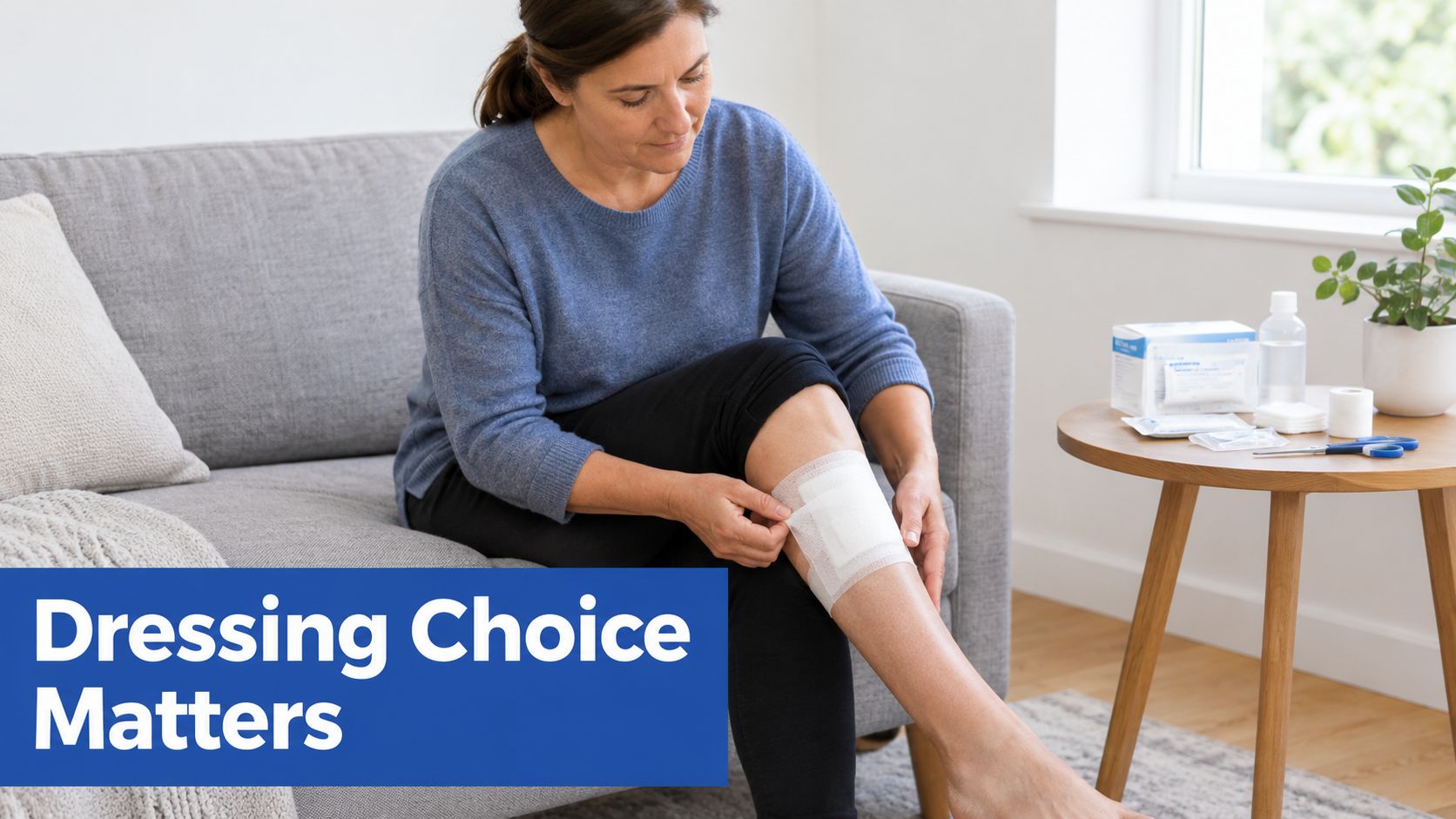
The wound determines the product
A lightly draining ulcer may need little more than a simple, low-adherent primary dressing under a suitable compression system. A heavily draining wound may need a more absorbent layer, with regular checks to prevent fluid from reaching and damaging nearby skin. A deep wound may need a clinician to assess whether the dressing is filling the space appropriately rather than just covering its surface.
The dressing shouldn't be selected in isolation. A practical guide to venous leg ulcers can help explain the underlying condition, but an individual wound still needs assessment.
Comfort is a clinical consideration
Pain during removal can lead patients to delay changes, pull off compression, or avoid care altogether. Evidence reviewed by Cochrane found some support for ibuprofen dressings for pain relief in painful venous ulcers and for EMLA to reduce debridement pain, while also noting limited evidence about side effects and healing outcomes in these settings. The Cochrane review of topical agents and dressings for venous ulcer pain supports a broader point: the dressing that causes fewer problems may be more useful than the dressing with the most impressive marketing description.
Practical rule: If a dressing causes repeated pain, leakage, maceration, or displacement under compression, it needs reassessment even if the package describes it as advanced.
The Evidence Behind Dressing Selection for Venous Leg Ulcers
The evidence does not support a universal “best” venous stasis ulcer dressing. Guideline reviews describe dressings as a way to cover the ulcer and promote a moist healing environment, while recommending selection according to wound size, depth, moisture balance, infection concerns, comfort, odor, cost, and change frequency. They also describe dressings as supportive care alongside compression, not as a replacement for it. The guideline review on dressings for venous leg ulcers summarizes this consensus and describes dressings as simple, low or nonadherent, low cost, and acceptable to the patient.
Compression deserves priority because venous ulcers develop in the setting of impaired venous return. A historical guideline identified Class 3 high compression, including three-layer and four-layer systems, short-stretch bandages, and paste-containing systems, as indicated for venous ulcers. Later clinical summaries also describe multicomponent, stretchy systems as healing ulcers faster than single-layer systems. Clinical references describe compression from 14 to 17 mm Hg for light compression up to 60 mm Hg for extra-high compression, with common therapeutic ankle targets around 30 to 40 mm Hg. These figures come from the published guideline on compression treatment for venous leg ulcers, and the appropriate level still depends on clinical assessment, arterial status, and the prescribed system.
Why premium does not automatically mean better
Hydrocolloids are a useful example of how product popularity can exceed healing evidence. A systematic review covering eight trials reported a relative risk for healing of 1.02, with a 95% confidence interval of 0.83 to 1.28, when hydrocolloids were compared with simple low-adherent dressings under compression. The review concluded that choice should reflect local cost and patient or practitioner preference rather than an expectation of superior healing. The systematic review of hydrocolloid dressings for venous leg ulcers supports using advanced occlusive products selectively, not automatically.
The clinician's reasoning is therefore straightforward. Use the least complex dressing that safely manages the wound's drainage and protects the tissue, then direct attention to compression, cleansing, debridement when indicated, mobility, and the cause of venous hypertension. An advanced dressing can have a place when the wound has a specific need, but its price or feature list isn't proof that it will close the ulcer faster.
Step-by-Step Process for Applying a Venous Stasis Ulcer Dressing
A consistent routine reduces avoidable trauma. Follow the clinician's prescribed products and compression system, and don't improvise compression if arterial circulation hasn't been assessed.
Prepare the area. Gather the clean dressing, fixation materials, prescribed compression layers, cleansing solution, gloves, and waste bag before removing the old dressing. Wash your hands, use fresh gloves, and position the leg so you can work without pulling on the wound.
Remove the old dressing gently. If the contact layer is stuck, moisten it according to your care instructions instead of tearing it away. Pulling can disturb new tissue and make the next change more painful.
Cleanse and inspect. Rinse the wound with the solution recommended by the care team, then pat the surrounding skin dry. Look at the amount and character of drainage, the wound edges, and the condition of nearby skin. Don't scrub healthy tissue.
Clear loose material only as directed. Clinical wound guidance supports atraumatic removal of loosely attached debris and crusts during dressing changes, along with regular removal of loose scales from surrounding skin. Firmly attached tissue should be assessed by a trained clinician rather than forcibly removed at home.
Apply and secure the primary layer. Center a simple non-adherent dressing over the wound without stretching it. Smooth the outer layers and avoid wrinkles, excessive tape, or pressure directly across fragile skin.
Apply compression as prescribed. The bandaging system should provide the intended graduated support without causing numbness, new severe pain, color change, or cold toes. A clinician should teach the technique and confirm that the system fits properly.
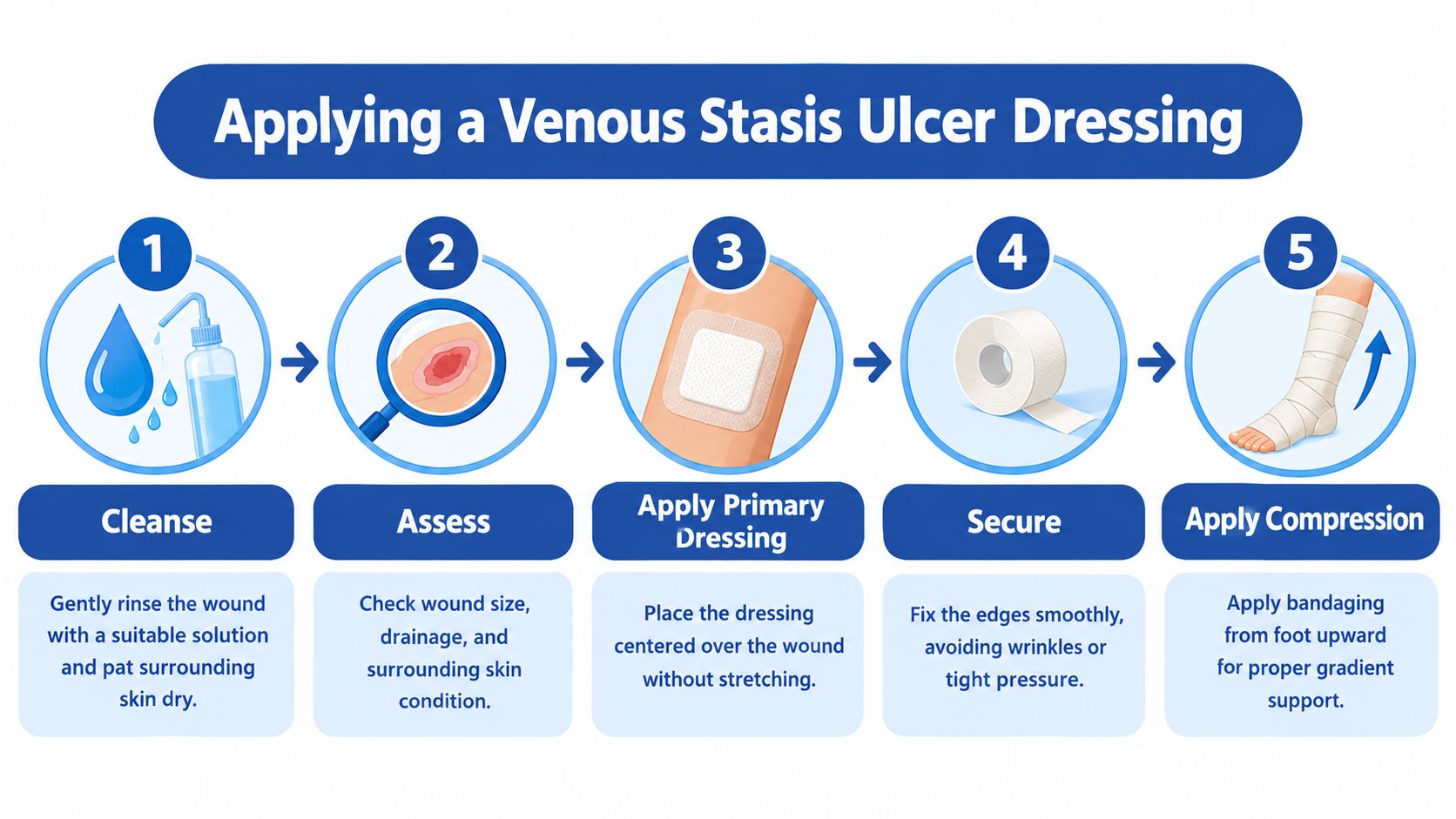
The sequence matters because each layer has a job. Cleansing removes loose contamination, the primary dressing manages contact with the wound, and compression addresses the venous pressure contributing to ulcer formation. If the wrap slips, bunches, or becomes painful, contact the care team instead of adding unplanned layers.
Comparing Common Dressing Types for Venous Ulcers
Think of dressing categories as tools for specific wound conditions, not as a ranking from basic to superior. A simple low-adherent dressing is often a sensible baseline when drainage is limited or moderate and the main need is protection beneath compression. More absorbent materials may be appropriate when fluid is heavier, but they still need monitoring for saturation and moisture damage.
| Dressing Type | Best For | Exudate Level | Key Consideration |
|---|---|---|---|
| Simple low-adherent dressing | Protecting a clean wound bed under compression | Minimal to moderate | Usually low cost and less likely to traumatize tissue during removal |
| Hydrocolloid dressing | Selected wounds where occlusion is clinically appropriate | Low to moderate | Does not have proven healing superiority over a simple low-adherent dressing under compression |
| Foam dressing | Managing more noticeable drainage | Moderate to heavy | Check surrounding skin for maceration and ensure the foam remains compatible with the compression wrap |
| Absorbent secondary layer | Adding fluid management over a primary contact layer | Moderate to heavy | Avoid unnecessary bulk, slippage, and pressure points beneath bandaging |
| Compression bandage system | Delivering therapeutic support for venous disease | Not applicable | It is the treatment layer, not a substitute for a wound-contact dressing |
Match absorption to the actual wound
A dressing that is too absorbent can dry a wound that needs a balanced moist environment, while one that is not absorbent enough can leave fluid against the surrounding skin. Inspect the dressing after removal. Saturation, leakage, softened wound edges, or damp surrounding skin indicate that the plan may need adjustment.
A compression therapy overview explains why the wrap or stocking must be considered alongside the primary dressing. The material should stay flat, remain secure during movement, and avoid creating a rigid or bulky area that changes pressure distribution.
Be cautious with antimicrobial claims
Silver, honey, and other antimicrobial or specialty products may be considered for a specific clinical indication, but they shouldn't be used routinely without a reason. Marketing language can make a dressing sound like an active healing treatment when its practical value may be only absorption, protection, or easier removal.
The right choice is the one that controls drainage, protects healthy skin, minimizes pain, and allows compression to function. If the wound characteristics change, the dressing choice should change with them.
How Often to Change Venous Stasis Ulcer Dressings
For a typical venous ulcer managed with compression, NHS guidance describes a simple non-sticky dressing being changed 1 to 3 times per week. That schedule is a starting point, not a fixed rule. The NHS guidance on venous leg ulcer care should be considered alongside the instructions from your own wound-care team.
Change frequency usually depends on what the dressing shows. Heavy drainage may saturate the material sooner and require an earlier change. Light drainage may allow the dressing to remain in place for the planned interval, provided it stays clean, secure, and comfortable. Some compression systems also require a particular primary dressing to maintain the intended fit and pressure.
Use each change as an assessment
Before applying a fresh dressing, note whether:
- Drainage has increased: More fluid, leakage, or repeated saturation can signal a change in wound status.
- The surrounding skin is softer or whiter: This can indicate excessive moisture exposure and may require better fluid management.
- Pain has changed: New or escalating pain deserves attention, especially if the compression system also feels different.
- The wrap has moved: Slipping, bunching, or tight areas can compromise comfort and pressure distribution.
- The wound looks different: A larger appearance, new odor, or altered tissue should be reported rather than covered up and ignored.
Keep a simple record of dressing dates, drainage, pain, and any changes in the surrounding skin. This gives the clinician useful information and can prevent repeated trial and error. The best schedule is consistent enough to protect the wound, yet flexible enough to respond to exudate and symptoms.
When to Seek Professional Wound Care Instead of Home Management
Home dressing changes can support treatment, but they can't diagnose the reason an ulcer is worsening. Seek professional assessment when pain increases, redness spreads beyond the wound, drainage changes substantially, odor becomes foul, fever develops, or the wound appears to enlarge instead of improve. These changes may indicate infection, pressure problems, inadequate compression, or circulation issues that require more than a fresh covering.
A clinician should also review a wound that repeatedly leaks through its dressing, causes significant pain during removal, or develops fragile, irritated surrounding skin. The solution may involve debridement, a different contact layer, revised compression, treatment of venous reflux, or investigation of another cause of delayed healing. Continuing to buy dressings without reassessing the wound can prolong the problem.

Know what home supplies can and cannot do
A household first-aid resource such as first aid from Material Handling USA may help you organize basic wound-care supplies, but general supplies aren't a substitute for a venous ulcer assessment or prescribed compression. Don't use a product just because it is available if it sticks, causes irritation, or changes the fit of the compression system.
For guidance on symptoms that warrant evaluation, review these signs of wound infection and when to seek medical attention. Urgent symptoms should be addressed promptly, particularly when the person has diabetes, known arterial disease, reduced sensation, or a history of difficult-to-heal wounds.
Professional wound care is also appropriate when the care routine has become unmanageable. A dressing that repeatedly causes pain or requires unscheduled changes can undermine adherence even if it looks technically suitable. A clinician can simplify the plan, teach compression application, and select materials based on the wound rather than on packaging claims.
Quick Reference Checklist for Venous Ulcer Dressing Care
Use this checklist during each change, but follow your own clinician's instructions if they differ. The goal is not to perform more steps. It's to make each step deliberate and to identify problems before they become harder to treat.
- Inspect first: Look for increased pain, spreading redness, new odor, heavier drainage, wound enlargement, or changes in the surrounding skin.
- Prepare clean supplies: Have the fresh primary dressing, fixation materials, cleansing solution, gloves, and prescribed compression ready before removing the old layers.
- Cleanse gently: Rinse as directed and pat the surrounding skin dry. Don't scrub healthy tissue or pull firmly attached material from the wound.
- Protect the contact surface: Use a non-adherent primary layer that fits the wound and won't create unnecessary bulk beneath compression.
- Secure without tension: Keep the dressing centered and smooth. Avoid wrinkles, tight tape, and pressure over fragile or irritated skin.
- Reapply prescribed compression: Use the bandaging or stocking system taught by the care team. Stop and seek advice for new severe pain, numbness, coldness, or concerning color change.
- Record meaningful changes: Note drainage, pain, odor, dressing condition, and the appearance of the wound so the clinician can adjust care based on trends.
- Escalate when needed: Contact a wound-care professional if symptoms worsen, the dressing plan repeatedly fails, or the ulcer isn't progressing as expected.
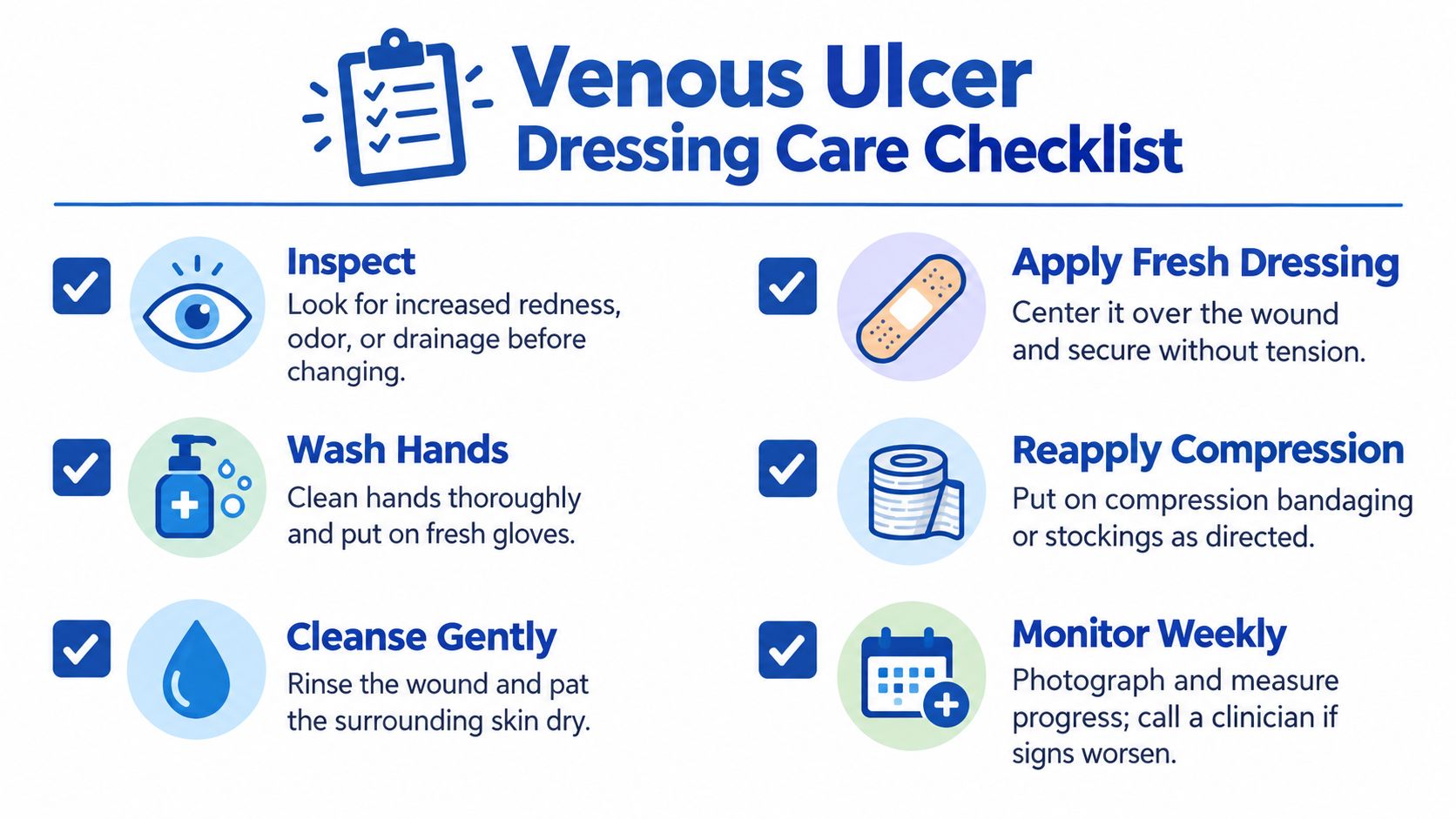
The central decision is simple: choose a dressing that matches drainage and protects the wound, then make sure compression and the underlying venous problem receive proper attention. A more expensive product isn't automatically a more effective one, and a straightforward dressing can be the right choice when it supports comfort, moisture balance, and reliable compression.
Vein and Wound Institute evaluates venous disease and chronic wounds, provides compression and advanced wound management, and can coordinate diagnostic follow-up for patients who need more than home dressing changes. Visit Vein and Wound Institute to request an evaluation and discuss a wound-care plan matched to your ulcer, circulation, and daily routine.