
Insurance usually covers varicose vein treatment when it's medically necessary after a documented six-week conservative trial and duplex-confirmed reflux, and usually denies it when the only goal is cosmetic appearance. So why do two people with equally visible veins get opposite answers from the same insurer?
The difference rarely sits on the surface of the leg. It sits in the chart. A reviewer who never sees you reads symptoms, ultrasound numbers, and what you already tried, then decides if treatment fixes a medical problem or only changes how the leg looks. If you're asking is varicose vein treatment covered by insurance, start by asking what your records prove.
Table of Contents
- When Insurance Pays for Varicose Vein Treatment
- Medical Necessity and the Records That Prove It
- How Each Procedure Clears a Payer Rule
- How to Confirm Benefits Before You Schedule
- What to Do After a Coverage Denial
- Schedule an Evaluation With the Right Chart
When Insurance Pays for Varicose Vein Treatment
Does insurance cover treatment for every visible varicose vein? Usually, coverage depends on the medical problem recorded in your file and the effect it has on your health or daily activities.
| Situation | Typical coverage | What the chart must show |
|---|---|---|
| Pain or swelling limiting daily activity | Often yes | Persistent symptoms after about six weeks of conservative care |
| Bleeding, recurrent phlebitis, stasis dermatitis, or venous ulcer | Often yes | The complication and duplex evidence of reflux |
| Swelling that does not settle with elevation | Often yes | Tried compression, elevation, and activity changes without enough relief |
| Spider or surface veins treated only for appearance | Usually no | Cosmetic intent without documented functional disease |
| Procedure with severe arterial disease or deep-vein obstruction | Often denied | A contraindication identified on exam or ultrasound |
The Pattern Behind the Rows
Medicare coverage policies may consider sclerotherapy, ligation with or without stripping, and endovenous radiofrequency or laser ablation medically necessary when symptoms persist despite conservative care. That care can include compression, walking, leg elevation, weight management, or spending less time standing still. Dates and details help show what you tried and whether it relieved your symptoms.
Covered conditions may include pain or swelling that limits daily activity, bleeding from a diseased vein, recurrent superficial phlebitis, stasis dermatitis, venous ulcers, and dependent swelling that persists. Each one affects how you walk, work, sleep, or heal.
Two situations often fall outside coverage. Spider-vein treatment requested only for appearance is generally considered cosmetic. A procedure may also be denied when severe arterial disease or deep-vein obstruction makes closing a surface vein unsafe or unlikely to help.
A covered category isn't the same as an approved claim for your member ID. The category makes the treatment eligible for review; your records determine the decision.
Coverage varies by policy. In a 2025 cross-sectional study indexed by PubMed, 36 of 57 U.S. insurance policies (63.2%) covered endovenous radiofrequency or laser ablation for varicose veins. The remaining policies either did not cover the procedures or did not clearly state coverage. A visible vein alone does not settle the question: the chart must show how the condition affects you and what care has already been tried.
Medical Necessity and the Records That Prove It
Think of a refluxing vein like a leaking pipe. Blood that should move upward falls backward, pressure builds in the lower leg, and that pressure drives aching, swelling, and skin breakdown. Treating visible bulging alone, without fixing the leak, is like repainting a wall while water still runs behind it.
That's why the treatment plan is based on the source of the problem, not just on the veins visible at the skin's surface. Symptoms that may lead to treatment include visible or bulging varicose veins, leg aching, heaviness or fatigue, swelling related to venous insufficiency, and skin changes or complications related to chronic venous disease. A reviewer reads your file looking for that connection, in a fairly predictable order.
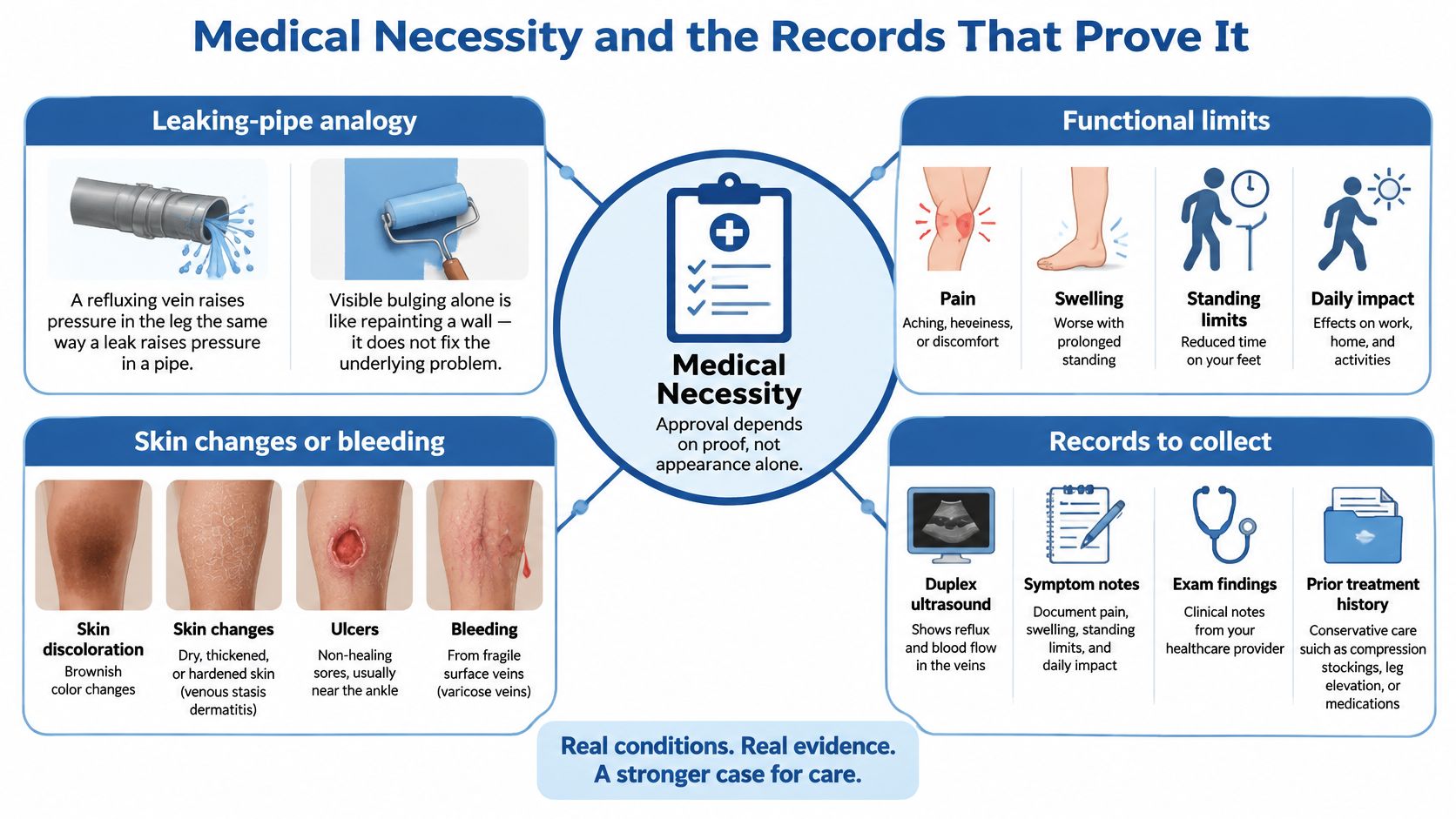
How a Reviewer Reads Your File
First, the clinical exam. The exam records aching, heaviness, swelling, skin changes, phlebitis, bleeding, or ulcers, with a CEAP class where the practice uses one. The Medicare Local Coverage Determination describes policies that require documented symptoms or functional effects, a clinical examination, CEAP classification, and duplex ultrasound showing reflux of at least 500 milliseconds in specified veins while ruling out deep venous obstruction.
Second, the symptom history. Duration matters, and so does function. "Legs ache" is weak. "Aching after two hours on the warehouse floor, most workdays for eight months, easing only with elevation" tells the reviewer what the disease costs you at work, while walking, or during sleep.
Third, the conservative-care note. A Medicare Local Coverage Determination on varicose vein treatment states that interventional treatment may be considered medically necessary when symptoms persist after a six-week trial of compression, exercise, leg elevation, weight management, or avoiding prolonged immobility. A minimally invasive procedure may be considered when venous disease causes persistent symptoms or when compression, elevation and activity modification don't provide enough relief, so the note should say what you tried, how long, and what remained.
Fourth, the duplex report. The report names the vein, shows reflux duration, measures diameter, and states that deep venous obstruction was assessed. Including vein mapping of the legs in the file turns a complaint into a measurable finding tied to specific anatomy.
Fifth, the order itself. The order matches one procedure and one anatomy, with diagnosis and procedure codes the payer lists together. Practices that do this well treat the chart as a revenue and care document at once, which is why documentation strategies for specialty practice revenue focus on connecting each code to a recorded finding rather than coding from memory.
Where Strong Cases Quietly Fail
A technically suitable minimally invasive option can still be denied when the ultrasound abnormality is never tied to symptoms or functional impairment. The duplex shows reflux, but nobody wrote that you can't finish a shift or that the skin above your ankle has darkened and itches. The reviewer sees a number, not a medical need.
Rules also vary by insurer, Medicare contractor, procedure, anatomy, and policy year. Build your packet against the current policy that applies to your plan, not against a summary you read online.
Compare two charts. One says "unsightly veins, patient wants treatment." The other records failed compression over six weeks, reflux duration in a named vein, and daily activity limited by pain and swelling. The legs could look identical. Only one file gives a reviewer a reason to say yes.
How Each Procedure Clears a Payer Rule
Coverage criteria depend on the procedure and the vein being treated. A payer may cover one approach for a particular vein while requiring different documentation for another.
| Procedure | Extra threshold | Frequent denial trigger |
|---|---|---|
| Endovenous laser ablation | Symptomatic great or small saphenous reflux and vein diameter up to 20 mm | Tortuosity, thrombus, or significant arterial disease |
| Radiofrequency ablation | Symptomatic saphenous reflux with a catheter path | Cosmetic intent or missing reflux duration |
| Cyanoacrylate closure | Reflux and symptoms when the payer lists the modality | Authorization written for a different procedure |
| Liquid or foam sclerotherapy | Some commercial policies require a vein at least 2.5 mm plus significant symptoms | Spider veins or asymptomatic small veins |
| Ligation or stripping | Selected symptomatic cases when less invasive options do not fit | Same cosmetic limits and arterial or deep-vein contraindications |
Ablation Has Technical Limits, Not Just Symptoms
For endovenous laser or radiofrequency ablation, a representative Medicare local coverage determination includes technical criteria for treating the great or small saphenous vein with reflux. For laser treatment, the maximum vein diameter is 20 mm. Thrombosis or excessive tortuosity that prevents catheter passage, as well as significant peripheral arterial disease, can also affect eligibility. The catheter must be able to pass safely, and the leg must have adequate arterial blood flow.
For a laser procedure, the clinical decision and the payment decision are related but distinct. Reviewing factors that affect laser vein removal cost alongside duplex measurements can help clarify the difference between an approved treatment and a cosmetic price quote.
Sclerotherapy and Adhesive Closure Face Different Bars
Commercial policies set procedure-specific rules. The NICE guideline on varicose veins diagnosis and management describes the clinical approach to varicose vein treatment. Commercial policy examples cited alongside it list radiofrequency ablation, endovenous laser ablation, cyanoacrylate closure, and selected surgical procedures as medically necessary, while some require liquid or foam sclerotherapy to meet extra criteria. Those may include a recent ultrasound showing the treated vein is at least 2.5 mm in diameter, along with significant symptoms or complications.
That threshold helps explain why an injection treatment may be covered for a larger symptomatic vein but considered cosmetic when used on tiny spider veins for appearance. Coverage depends on vein size, symptoms, and documented treatment purpose.
Practical rule: The authorization should name the exact modality planned. Approval for ablation does not establish coverage for adhesive closure or foam.
Anatomy Is Not Interchangeable
Policy coverage can differ for veins beyond the main saphenous veins. A systematic review indexed in PubMed found that in 2024, 155 of 226 reviewed insurance policies (68.6%) allowed coverage for anterior saphenous vein ablation. Another 62 policies (27.4%) did not specify coverage, and 9 (4.0%) explicitly excluded it. A neighboring vein may therefore be treated differently in a policy, even when its symptoms feel the same.
The NICE guideline on varicose veins diagnosis and management provides clinical guidance, not a U.S. payment mandate. It recommends endothermal ablation when suitable, ultrasound-guided foam sclerotherapy when ablation is unsuitable, and surgery when neither option fits. Permanent compression hosiery is mainly for cases where intervention is unsuitable.
The prior authorization should match the planned treatment to the anatomy and findings: modality, vein, diameter, reflux, symptoms, conservative care, and codes. A mismatch can give the payer a reason to stop the request.
How to Confirm Benefits Before You Schedule
Confirming benefits is a phone and paperwork task you can finish before anyone holds a procedure date. Work through these steps in order, and write down each answer as you get it.
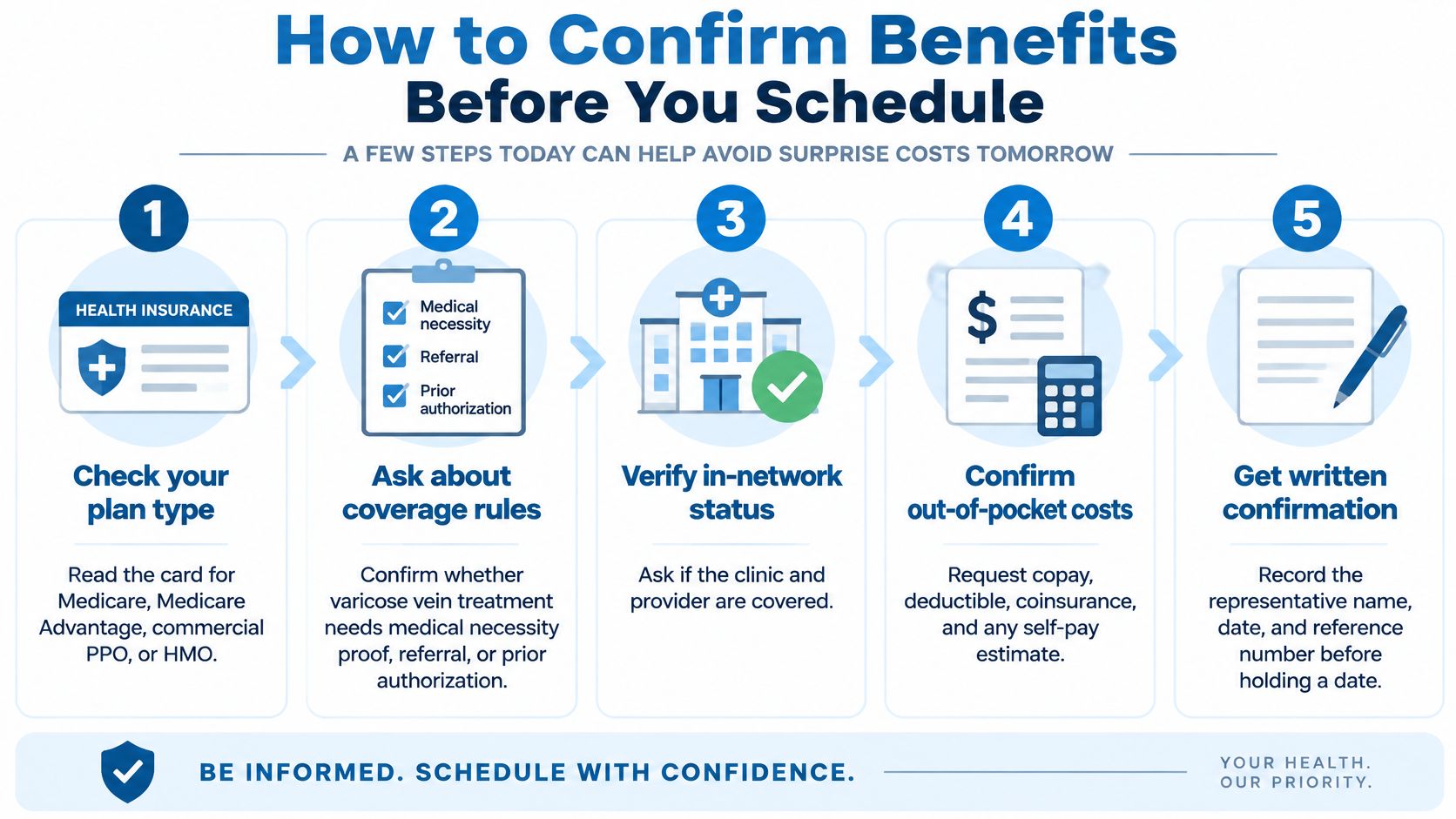
- Read the plan type on your card. Note whether it's Medicare, Medicare Advantage, or a commercial PPO or HMO, because the policy manual and contractor change with the plan type.
- Ask about the exact procedure and vein. Don't ask if vein treatment in general is covered. Ask if radiofrequency ablation of your great saphenous vein, by name and code, is a covered benefit.
- Ask about prior authorization. Confirm whether it's required, which form the plan uses, who submits it, and how many days review typically takes.
- Confirm your share and network status. Get the deductible and coinsurance, and verify that both the office and any facility involved are in network.
- Send one complete packet. Include the duplex report, symptom timeline, six-week conservative-care note, photos of skin changes or ulcers if relevant, and the diagnosis and procedure codes together.
- Save the authorization details. Record the authorization number, approved code, expiration date, and any limit on units or number of veins.
- Recheck when anything changes. A new plan year, a switch from ablation to sclerotherapy, or an added second vein can each require a fresh approval.
Edge Cases That Catch People
An authorization for the great saphenous vein doesn't automatically include the anterior accessory vein. If your duplex shows reflux in both, each vein should appear in the request, or the second one may be treated as unauthorized work.
Coding combinations matter too. A cosmetic code billed beside a medical code can trigger a full denial of the claim, even when part of the visit was clearly medical. Ask the office how cosmetic and medical services on the same leg will be separated before the appointment, not after the claim goes out.
Network status can outweigh the allowed amount. Out-of-network coinsurance on a facility charge can leave you owing far more than the procedure's in-network patient share, so confirm every location named in the authorization. If you want help sorting plan questions from financing questions, our insurance and financing guidance lays out what to bring to that conversation.
Don't treat a scheduler's verbal "usually covered" as approval. Usually covered describes other patients with other charts. Your approval is a number, a code, and an expiration date in writing.
Before you hang up, have these four answers on paper:
- Approved code: The exact procedure code the plan authorized
- Expiration date: The last day the authorization stays valid
- Patient share: Your estimated deductible and coinsurance amount
- Diameter changes: What happens if the vein measures differently on treatment day than it did in the report
What to Do After a Coverage Denial
Start with the denial letter itself, because its stated reason determines the fix. A denial is not a final judgment on every part of a claim; it identifies what the payer says is missing or does not meet its rules.

| Denial reason | Fix | Record to add |
|---|---|---|
| Not medically necessary | Show functional impact and complications | Symptom timeline, skin or ulcer findings, duplex reflux duration |
| Missing conservative-care time | Document the trial and the symptoms that remained | Dated stocking, elevation, and activity log |
| Cosmetic | Argue only from functional disease | Functional limits, phlebitis, bleeding, or ulcer history |
| Wrong anatomy or code | Quote the vein and policy threshold, or correct the code | Vein name, diameter, planned procedure code |
Match the Fix to the Bucket
Use the table to identify the missing proof, then make the appeal easy to review. For example, a physician's peer-to-peer summary for a medical-necessity denial could connect the duplex finding to daily limits: “The documented reflux corresponds with persistent leg heaviness that limits standing, despite conservative care.” The summary should reflect the actual chart.
For a cosmetic denial, an appeal can point to functional symptoms or complications only when the record supports them. If the chart describes appearance alone, restating the same facts is unlikely to address the payer's reason.
The Appeal Path and What Treatment May Cost
Begin with internal reconsideration and attach the records that address the stated denial reason, clearly labeled for the reviewer. If that review does not resolve the dispute, check the letter for the deadline and process for requesting external review. Ask your physician whether treatment can safely wait while the appeal is underway, since an open ulcer and stable aching may call for different timing.
A peer-to-peer call works best when the physician can summarize the key chart evidence on one page: reflux duration, CEAP findings, and conservative therapy tried. Connecting those findings to the symptoms makes the clinical reasoning easier to follow.
When the bill or explanation of benefits arrives, check how the allowed amount and patient responsibility compare with the authorization. Resources on helping employees understand their healthcare costs explain common terms found on an explanation of benefits.
For cost context, published averages are illustrations, not a quote for your care. Medical News Today reported that in 2025, Medicare's average total cost for endovenous ablation was $1,814 in an ambulatory surgical center, with an estimated patient responsibility of $362 under Medicare's 20% coinsurance. Deductibles and additional charges can change the amount you owe, and commercial plan costs may differ.
Schedule an Evaluation With the Right Chart
If leg pain, swelling, bleeding, skin changes, or a slow-healing wound is affecting you, schedule a medical evaluation. If you're seeking treatment only for the appearance of spider veins, ask about cosmetic services and costs instead.
At Vein & Wound Institute, the first visit includes a clinical examination and duplex ultrasound to evaluate venous disease. Recommendations are personalized to your condition and goals. When a chronic wound is involved, the practice can assess vein and wound care together.
Cosmetic services have a different purpose. Vein and Wound Institute offers VeinGogh treatments for facial, breast, and hand veins. These services address appearance rather than a medical condition.
What to Bring to the First Visit
- Insurance card: So the office can identify your plan.
- Prior duplex reports: Bring any ultrasound results from another office.
- Symptom diary: Note when pain or swelling affects your daily activities.
- Skin photos: Include pictures of color changes, rash, or wounds near the ankle.
- Medication and medical history: Bring a current list and relevant records about your health.
Ask about insurance and financing before scheduling treatment. Request a duplex evaluation and benefit check before setting a date for ablation, sealant, foam sclerotherapy, or phlebectomy. That gives you a chance to understand what your plan requires and whether further records are needed.
If leg pain, swelling, skin changes, or a slow-healing wound are part of your picture, an exam and duplex study can help evaluate the problem. Vein and Wound Institute can also help you understand what your plan may require before treatment is scheduled. Visit Vein and Wound Institute to request an evaluation.