Surface-laser treatment for spider veins runs about $300 to $400 per session, with a reported U.S. average near $312 for the treatment alone, according to Healthline's spider-vein removal cost overview citing American Society of Plastic Surgeons data.
That per-session figure is a starting point, not a total. A cosmetic plan often involves multiple visits, and each added session multiplies the bill. Two quotes can also describe different procedures: surface laser treats the visible vessel through the skin, while endovenous laser ablation seals a larger underlying vein from inside it. A cheaper session on the wrong procedure, or one that requires more visits to reach the agreed result, can end up costing more overall.
Before comparing prices, identify the procedure, the billing unit, and the number of sessions each quote assumes.
Table of Contents
- Spider Vein Laser Cost per Session
- Total Cost by Number of Sessions and Why the Cheapest Session Can Cost More
- Why Surface and Endovenous Laser Quotes Differ
- Factors That Move Your Total Price
- Insurance and Financing for Cosmetic Laser Treatment
- Get an Itemized Quote Before You Book
Spider Vein Laser Cost per Session
A quoted surface-laser price describes a treatment visit. Evaluation, imaging, and aftercare sit outside that figure, so the session fee functions as the first line of a budget while the full total only appears once the related charges are added.
The cost framework accompanying the American Society of Plastic Surgeons' spider-vein treatment pricing places typical surface-laser sessions around $300 to $400, reports an average of approximately $312, puts sclerotherapy at about $500 per treatment, and excludes anesthesia, operating-room facilities, and related expenses from those averages.
Spider vein treatment prices by procedure
| Treatment | Typical price | What the figure covers | What it may leave out |
|---|---|---|---|
| Surface spider vein laser, per session | $300 to $400, average about $312 | One session, treatment only | Consultation, imaging, facility, anesthesia, garments, follow-up |
| Sclerotherapy, per treatment | About $500, ASPS average | Injection-based treatment of smaller veins | Anesthesia and operating-room facilities |
| Endovenous laser ablation, per leg | Priced as a procedure on a larger underlying vein | Catheter-based treatment inside the vein | Evaluation, ultrasound, aftercare, and facility inclusions vary by quote |
Each figure measures a different unit of care. A physician-fee average for a single visit, a treatment-category average for injections, and a per-leg price for a catheter procedure cover different scopes of work, so lining them up from lowest to highest produces a misleading ranking.
The three procedures also treat different targets. Surface laser directs energy through the skin toward small visible veins. Sclerotherapy closes selected veins using an injected sclerosant. Endovenous laser ablation delivers energy inside a larger abnormal vein to seal it from within, a scope of work closer to varicose vein treatment than to a cosmetic touch-up. Weighing its price against a surface session means weighing two different purchases.
Check the Billing Unit Before Comparing Prices
Look for these words on every estimate:
- Per session: Confirm which veins or treatment areas the appointment includes.
- Per area: Have the clinic identify the boundaries of that area. A calf and a thigh shouldn't be assumed to count as the same treatment unit.
- Per leg: Establish whether the quote concerns a surface treatment or a procedure on an underlying vein.
A lower session fee can cover a smaller area or a shorter course of follow-up, which is how the cheapest session ends up costing more overall. Until you know the boundaries and inclusions behind each figure, the apparent price difference reveals little about which estimate offers better value. Write down the quoted price, its billing unit, and what it covers before comparing clinics.
Total Cost by Number of Sessions and Why the Cheapest Session Can Cost More
Session count can matter more than a modest difference in the appointment fee. A laser-vein therapy overview citing an ASPS national physician-fee benchmark reports $312 in 2020 and notes that laser treatment commonly requires two or more sessions, which puts approximately $624 in physician fees at the low end of a realistic budget before ancillary charges.
The worksheet below applies the typical per-session range and that reference average to a full treatment course. These are arithmetic estimates, not clinic quotes, and they assume the same charge at every appointment.
Estimated laser treatment totals by number of sessions
| Sessions | Estimated treatment-only total | At $312 average per session | What it means |
|---|---|---|---|
| 1 session | $300 to $400 | $312 | Lowest total, one visit |
| 2 sessions | $600 to $800 | $624 | Common minimum for many patients |
| 3 sessions | $900 to $1,200 | $936 | Plan for a multi-visit course |
| 4 sessions | $1,200 to $1,600 | $1,248 | Plan for a multi-visit course |
| 5 sessions | $1,500 to $2,000 | $1,560 | Upper range, budget for extra visits |
| 6 sessions | $1,800 to $2,400 | $1,872 | Top of the planning range |
The table shows multiplication, not prediction. A clinic's expected session count belongs beside its fee when you compare estimates, because even a small per-visit gap grows with every appointment in the plan.
Compare Cost Against the Intended Result
A peer-reviewed clinical report published in 2015 estimated amortized treatment costs of approximately $250 to $400 per laser session, compared with $80 to $100 for sclerotherapy, and found that roughly half to 60% of patients cleared after one laser pass, against roughly half to 70% after one sclerotherapy pass. Those are historical treatment-cost estimates rather than current retail quotes, and no single clearance figure predicts how your veins will respond.
A treatment pass may also differ from a separately billed visit, which is one more reason the per-session price only makes sense next to the expected response.
Price and response should be evaluated together. A lower-priced treatment loses its advantage when it is poorly matched to the target veins or your cosmetic goal.
Compare the expected cost of reaching the same result, not the cost of buying the same number of appointments.
A discounted session that requires a longer course can cost more overall than a higher-priced session that reaches the agreed goal in fewer appointments. The reverse can also hold. Without an expected treatment plan, either price can mislead.
Build a Budget That Allows for Uncertainty
Use this sequence when reviewing an estimate:
- Request an expected course. Have the clinician explain the likely number of sessions and what improvement would count as a successful result.
- Calculate the planned treatment cost. Multiply the session fee by the expected course, then add separately billed services.
- Price the contingency. Confirm the charge for additional treatment and whether package pricing has limits or expiration terms.
Reviewing laser treatment for spider veins before-and-after results can help you describe your goal to the clinician. Images work as a discussion aid; they cannot promise that your response or expense will match another patient's.
Compare providers on the expected result, session count, and plan for persistent or recurrent veins. A low fee without those details is an incomplete estimate.
Why Surface and Endovenous Laser Quotes Differ
Two quotes that both say "laser vein treatment" can describe different procedures. One targets a visible vein at the skin's surface; the other closes a larger abnormal vein underneath. That difference decides whether you're pricing a cosmetic session or a procedure aimed at underlying venous disease, and the two figures are rarely comparable line for line.
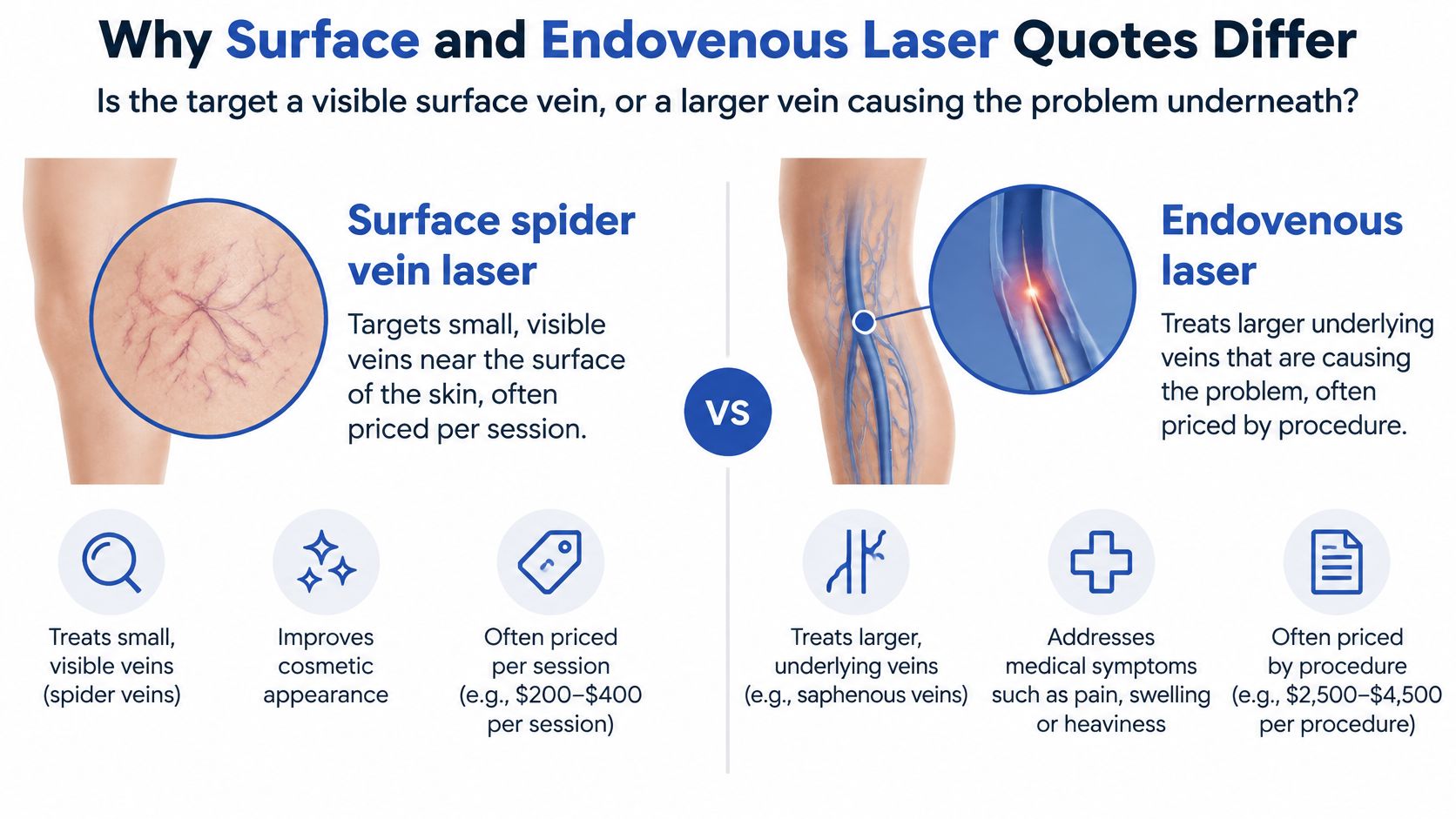
Clinical guidance separates aesthetic spider vein treatment from other venous care, which is why a single search returns prices for substantially different procedures. The bigger trap is the denominator. Surface laser is quoted per session, while endovenous ablation is typically quoted per treated leg. Comparing a per-session figure against a per-leg figure misstates the gap in either direction.
Spider vein procedures compared by target and price basis
| Procedure | What it treats | How the price is quoted | Insurance status |
|---|---|---|---|
| Surface spider vein laser | Small visible veins | $300 to $400 per session | Generally cosmetic, coverage may be limited |
| Endovenous laser ablation | Larger underlying abnormal vein | $1,661 per leg, national average | Requires plan-specific review of documented diagnosis |
| Sclerotherapy | Visible surface veins | $353 national average; $500 ASPS category average | Generally cosmetic, coverage may be limited |
The endovenous figure and the first sclerotherapy figure are national averages reported in the NCBI Bookshelf review of spider veins. The two sclerotherapy figures use different denominators: one is a national clinical average, the other a specialty-society category average.
The Treatment Target Changes the Procedure
Endovenous laser ablation delivers controlled heat inside the abnormal vein through a small catheter or access point. The vessel seals and blood reroutes through healthier veins, which is why the procedure is priced as treatment of a diseased vessel rather than a cosmetic session. Our practice performs it in an office setting, avoiding the larger incisions and general anesthesia of traditional vein stripping.
We also offer radiofrequency ablation, VenaSeal, Varithena, ClariVein, ultrasound-guided foam sclerotherapy, and ambulatory phlebectomy. For a superficial cosmetic option, our comparison of VeinGogh and laser treatment for veins separates the categories.
Before accepting a quote, establish three things: whether it prices surface laser or endovenous ablation, whether the figure is stated per session or per leg, and whether clinically indicated ultrasound could change the recommendation or the coverage review.
Factors That Move Your Total Price
The cost of spider vein laser treatment reflects several inputs, not a universal fee for visible veins. An estimate should describe your treatment area and goal clearly enough that another clinician could understand what's being priced.

Identify the Main Cost Drivers
- Treatment type: External surface laser, injections, and endovenous ablation require different treatment plans. Don't request a generic laser quote before establishing the target.
- Number, size, and distribution of veins: A localized spot and clusters spread across several areas aren't equivalent treatment scopes. Mark the areas you want addressed so the estimate matches your priorities.
- Sessions needed: The clinician's proposed course should reflect the intended improvement, rather than assuming every visible vein will respond after the first appointment.
- Provider expertise and clinic setting: Compare the qualifications and services behind the fee, including who evaluates you and who performs treatment.
- Geographic market: Compare local written estimates with equivalent inclusions. A national average is a planning reference, not proof that a Southern California quote is too high or too low.
- Diagnostic evaluation: Symptoms, examination findings, and concern about underlying disease can lead to a different evaluation pathway from a purely cosmetic visit.
A Small Target Still Needs a Complete Estimate
WebMD's laser-surgery cost overview reports that laser treatment of a single small spider vein can cost up to $150, with two treatments potentially required. That narrowly defined example shouldn't be substituted for pricing a broader area.
Its practical lesson is about scope. Even a small target can involve repeat treatment, while a larger-area quote may include multiple visible veins within the appointment. Comparing those offers solely by their headline prices would answer the wrong question.
At our practice, recommendations are personalized to the patient's condition and goals. We consider vein size and location, symptoms, ultrasound findings, and overall vascular health when choosing a procedure, rather than assigning everyone the same treatment.
Budgeting priority: Identify the factors most likely to change your own plan before requesting prices.
Bring a description of the areas you want treated and explain whether your priority is appearance, symptom relief, or both. That gives the clinical team a more useful starting point than asking only for the lowest laser fee.
Insurance and Financing for Cosmetic Laser Treatment
Treatment performed solely to improve the appearance of spider veins is generally self-pay. Coverage can be handled differently when evaluation identifies a medically significant venous condition, but visible spider veins alone don't establish medical necessity.
Pain, swelling, skin changes, or a wound should be included in the clinical discussion. Our evaluation addresses the source of the problem, not just the veins visible at the skin's surface. An insurer may assess diagnostic evaluation, treatment of reflux, and cosmetic surface treatment separately.
Verify Benefits for the Actual Procedure
Use this checklist with the insurer and billing team:
- Diagnosis and service: Is the proposed service covered for your documented condition, or excluded as cosmetic?
- Diagnostic testing: Is a duplex ultrasound clinically indicated, and what are the plan's coverage and network requirements?
- Authorization: Does the proposed procedure require prior approval?
- Network status: Are the clinician and any separately billing facility in network?
- Patient responsibility: What deductible, copayment, or coinsurance applies to an approved service?
For context on a different cosmetic laser category, NYC Laser Hair Removal's New York laser treatment insurance requirements discusses hair-removal coverage. It isn't a guide to California vein benefits, so don't use it to establish eligibility for your procedure.
Compare Financing by Total Repayment
Our insurance and financing information provides a starting point for discussing payment questions. Confirm available arrangements directly rather than assuming a particular payment plan is offered or that approval is guaranteed.
If you finance care, compare total repayment, including interest and fees, rather than just the monthly payment. Also confirm whether financing covers the expected treatment course or only the initial appointment.
Get the coverage determination in writing before treatment. Approval for underlying venous care shouldn't be interpreted as approval for every cosmetic service associated with it.
Get an Itemized Quote Before You Book
A per-session price is only the starting point. Ask two providers to quote against the same visible veins, the same symptoms and the same goal: fewer sessions, better cosmetic clearance, or treatment of an underlying reflux problem. Without identical inputs, a lower fee may describe a smaller appointment.
Request the estimate in writing and make it name the procedure category: surface laser for fine vessels at the skin, sclerotherapy for reticular or spider veins, or endovenous ablation when ultrasound shows reflux feeding them. Then compare the quoted per-session fee with the stated session count, not with the advertisement. Multiply that fee by the expected course and ask what one added session would cost, because the cheapest session can become the larger bill if the plan assumes more visits or treats only the surface while reflux remains.
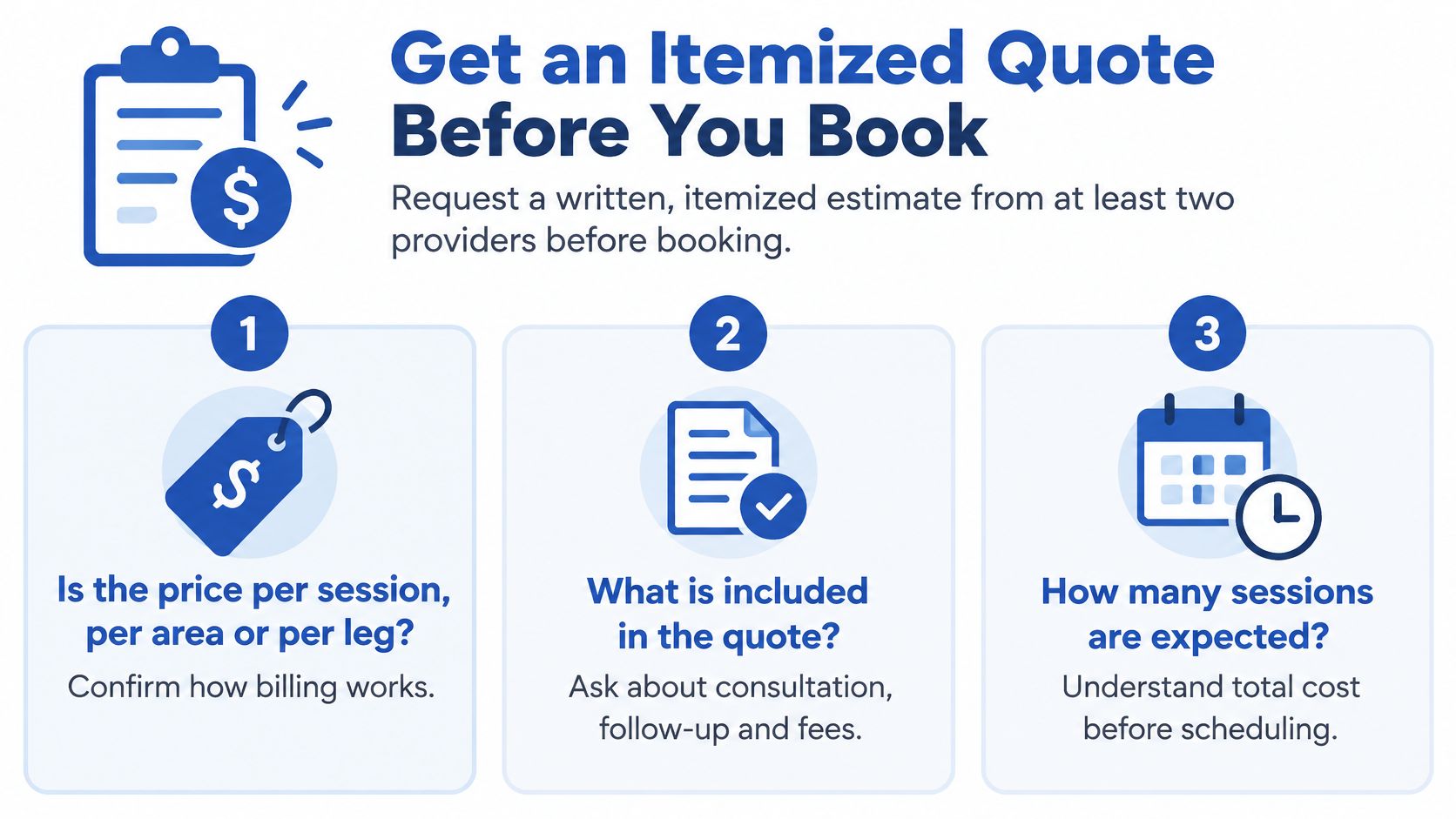
Keep the math visible. If one estimate prices cosmetic clearance and another prices evaluation of the source vessel, you are comparing different products. Write down the expected out-of-pocket total before scheduling, including the planned course and the portion remaining after any confirmed coverage, and leave extra treatment as its own line rather than burying it inside a single number. A useful quote shows the procedure, scope, exclusions and session assumption clearly enough that another clinic could price the same job.
Vein and Wound Institute offers personalized vein evaluation, onsite diagnostics, and minimally invasive treatments such as endovenous laser ablation and ultrasound-guided sclerotherapy. Visit Vein and Wound Institute to discuss whether your visible veins require cosmetic care or evaluation for an underlying condition, and request a treatment-specific cost discussion before booking.