
Medicare patients may pay about $93 in a non-hospital facility or $694 in a hospital outpatient setting for the same ambulatory phlebectomy code, while self-pay estimates commonly reach $2,000 to $4,000. The biggest driver is often where the procedure is performed, not the number of visible veins removed.
That difference can feel impossible until you separate the professional fee, the facility fee, and the insurer's allowed amount. An allowed amount is the price an insurer recognizes for covered care, not automatically the amount you'll receive as a bill. Your deductible, coinsurance, network status, treatment extent, diagnostic testing, and follow-up care can all change what you owe.
Table of Contents
- Why Ambulatory Phlebectomy Costs Vary So Dramatically
- How Procedural Codes Determine Your Price
- Office-Based Care Versus Hospital Outpatient Costs
- Breaking Down the Hidden Components of Your Bill
- Navigating Insurance Coverage and Medical Necessity
- The True Cost of Treating Only the Visible Veins
- Calculating Your Total Episode of Care
Why Ambulatory Phlebectomy Costs Vary So Dramatically
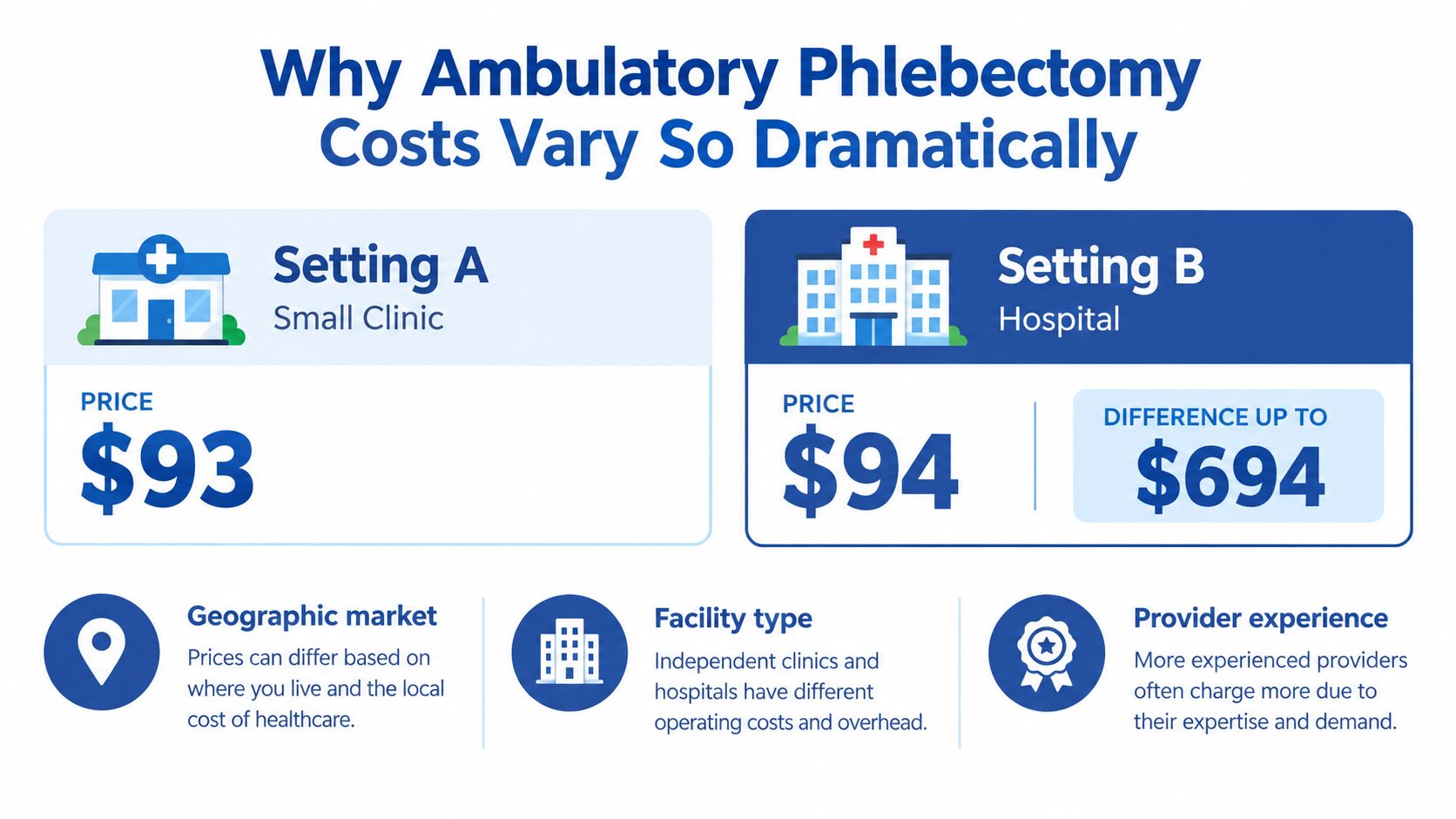
For CPT 37765, Medicare's 2026 national-average payment data shows a striking 7.4-fold difference between settings. In a non-hospital facility, the approved amount is $467, including a $245 physician fee and a $222 facility fee. Original Medicare lists $374 as its payment, leaving average patient responsibility of $93, before other coverage, deductibles, or separately billed services. The Medicare procedure-price data for code 37765 provides these national averages.
In a hospital outpatient setting, the same code has an approved amount of $3,470. The physician fee remains $245, while the facility fee rises to $3,225. Medicare lists $2,776 as its share, leaving average patient responsibility of $694. The procedure code describes the work performed, but the setting can multiply the facility portion of the payment.
These figures are allowed amounts, not universal bills. An allowed amount works like the price an insurer accepts for covered care. Your actual responsibility depends on your plan, deductible, coinsurance, network status, and whether testing or follow-up services are billed separately.
Practical rule: Ask whether every quote covers an office, non-hospital facility, or hospital outpatient department.
A low advertised price may cover only the surgeon's fee. Another estimate may include facility resources, ultrasound, compression, and follow-up. A hospital statement can list professional and facility charges separately, creating financial shock if you compare it with a cash estimate that combines them.
Before treatment, review this overview of ambulatory phlebectomy and ask the practice to identify the setting, included services, and expected total out-of-pocket amount for the entire episode of care. That total matters more than the starting price, especially when visible tributary veins may require evaluation and treatment of underlying reflux.
How Procedural Codes Determine Your Price
Insurers and medical billing departments use CPT codes to describe what was performed. For ambulatory phlebectomy, the number of stab incisions and the extremity treated help determine which code applies. That coding language can feel technical, but it often explains why a larger treatment area produces a different estimate.
Incision count changes the coding category
CPT 37765 applies to removal of varicose veins through 10 to 20 stab incisions on one extremity. CPT 37766 applies when the procedure involves more than 20 incisions. The codes generally shouldn't be reported together for the same leg. The relevant coding distinctions are outlined in this health plan policy on phlebectomy coding.
The code isn't a simple price tag. It describes the scope of work that the clinician documents. A patient with a limited cluster of tributary veins may need fewer access points, while a larger vein burden can require more time, local anesthetic, supplies, compression planning, and facility resources.
| Billing detail | Why it can affect the estimate |
|---|---|
| Number of incisions | A broader removal pattern may fall under a different procedural code |
| One or both legs | Treating both extremities can change the overall treatment plan and charges |
| Treatment extent | More veins can require additional operating time and supplies |
| Facility classification | Office and hospital facility fees may differ substantially |
| Associated services | Ultrasound, consultation, anesthesia, and follow-up may be billed separately |
Ask how the code relates to your treatment plan
A code should match the clinician's documentation. It shouldn't be selected just to produce a preferred price. Ask the billing office which code or codes they expect to submit, whether the estimate covers one or both legs, and whether any services fall outside the procedural charge.
The number of incisions also doesn't tell the whole clinical story. A visible vein may be connected to a deeper source of reflux, and removing the surface segment without evaluating the venous system can leave important questions unanswered. Your estimate should therefore be tied to an examination and, when indicated, duplex ultrasound findings, not just a photograph of the veins.
Office-Based Care Versus Hospital Outpatient Costs
The same coded procedure can produce very different allowed amounts depending on where it is performed. The professional component pays for the clinician's work. The facility component pays for the room, staff, equipment, supplies, and operating costs of the treatment location.
As noted earlier, the code-specific comparison shows a roughly 7.4-fold difference between office-based and hospital outpatient pricing for the same phlebectomy code. The physician's work can be similar, while the facility portion changes sharply. An allowed amount is the insurer's negotiated or approved figure, not necessarily the bill you will receive. Your actual responsibility depends on coverage, deductible, coinsurance, and network status.
The setting can matter more than the surgeon's fee
An office procedure may use local anesthetic and a compact outpatient setup. A hospital outpatient department may attach a much larger facility charge to the same coded service. That difference does not make one setting appropriate for every patient. It makes the location a billing question as well as a clinical question.
Ask these questions before scheduling:
- Where will care occur? Confirm the exact location and whether it is a physician office, ambulatory facility, or hospital outpatient department.
- Who bills separately? Ask whether the clinician, facility, anesthesia team, imaging provider, or laboratory will submit separate claims.
- What is included? Confirm whether the estimate covers the procedure, local anesthetic, supplies, compression garments, follow-up, and planned imaging.
- What is my expected responsibility? Request an estimate using your deductible, coinsurance, and network status, rather than relying on the billed charge.
A useful analogy is a restaurant bill. The surgeon's fee is one item, while the facility charge is the room and service fee. A lower professional fee does not guarantee a lower total.
Patients comparing locations can review this explanation of vein center versus hospital care when preparing questions. Billing protections also depend on the setting and service. For context, read about the No Surprises Act in physician offices, then ask how the practice handles estimates, network participation, and unexpected charges.
Breaking Down the Hidden Components of Your Bill
The procedure code is only one line in a potential treatment bill. A quote that sounds complete may cover the removal itself but exclude diagnostic imaging, compression, follow-up, or treatment of an underlying reflux problem. That's how a seemingly reasonable estimate can become a financial surprise.
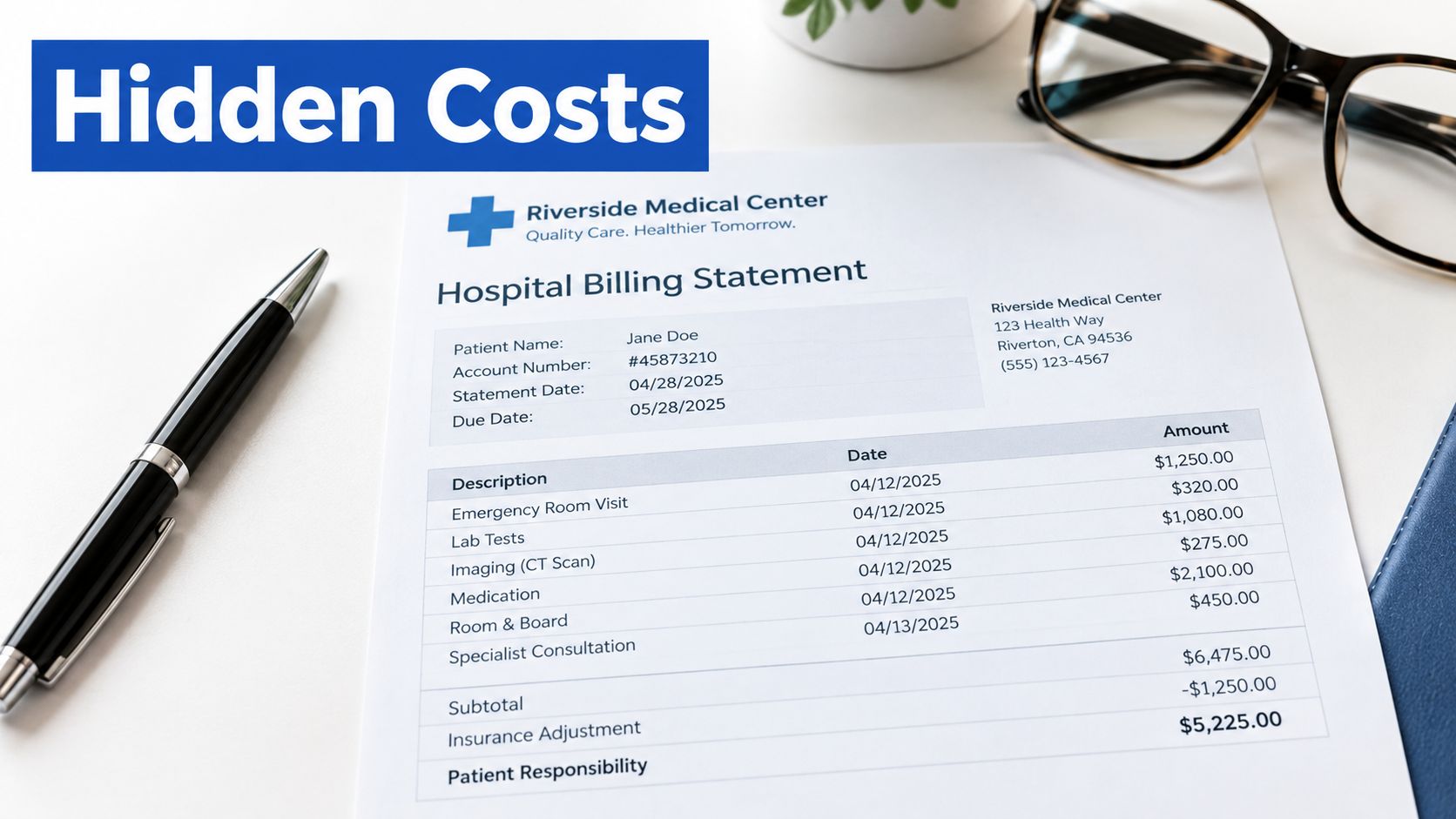
Build the bill line by line
A complete estimate should identify whether each item is included, excluded, or billed only if needed.
- Evaluation: The initial consultation may be separate from the procedure. Ask whether the clinical examination and treatment planning are included.
- Duplex ultrasound: Imaging may be necessary to evaluate reflux or map the veins. Confirm whether the ultrasound is performed and billed separately.
- Procedure: This may include the physician's work, supplies, local anesthetic, and the removal itself, or it may cover only some of those elements.
- Facility services: A facility can charge for the space, staff, equipment, and supplies used during treatment.
- Anesthesia: Local anesthetic may be part of an office package, while anesthesia services in another setting may appear as a separate charge.
- Compression garments: A stocking or wrap may be recommended after treatment, but it isn't necessarily part of the procedural price.
- Pathology: If tissue is sent for examination, a pathology charge may apply.
- Follow-up: Post-procedure checks, wound assessment, and treatment of bruising or other concerns may be separate.
The important distinction is between allowed amount and patient bill. The allowed amount is the insurer's recognized price for a covered service under a particular plan and setting. Your responsibility may depend on how much of your deductible remains, whether coinsurance applies, and whether the provider is in network. A cash quote, by contrast, may be a negotiated self-pay package and may not resemble an insurance claim.
Ask for a bundled estimate that names every expected service, rather than accepting a single number described only as the “procedure cost.”
If the practice expects additional treatment for axial reflux, ask whether that care is part of the same plan or a separate episode. The safest comparison is not physician fee against physician fee. It's total expected episode against total expected episode.
Navigating Insurance Coverage and Medical Necessity
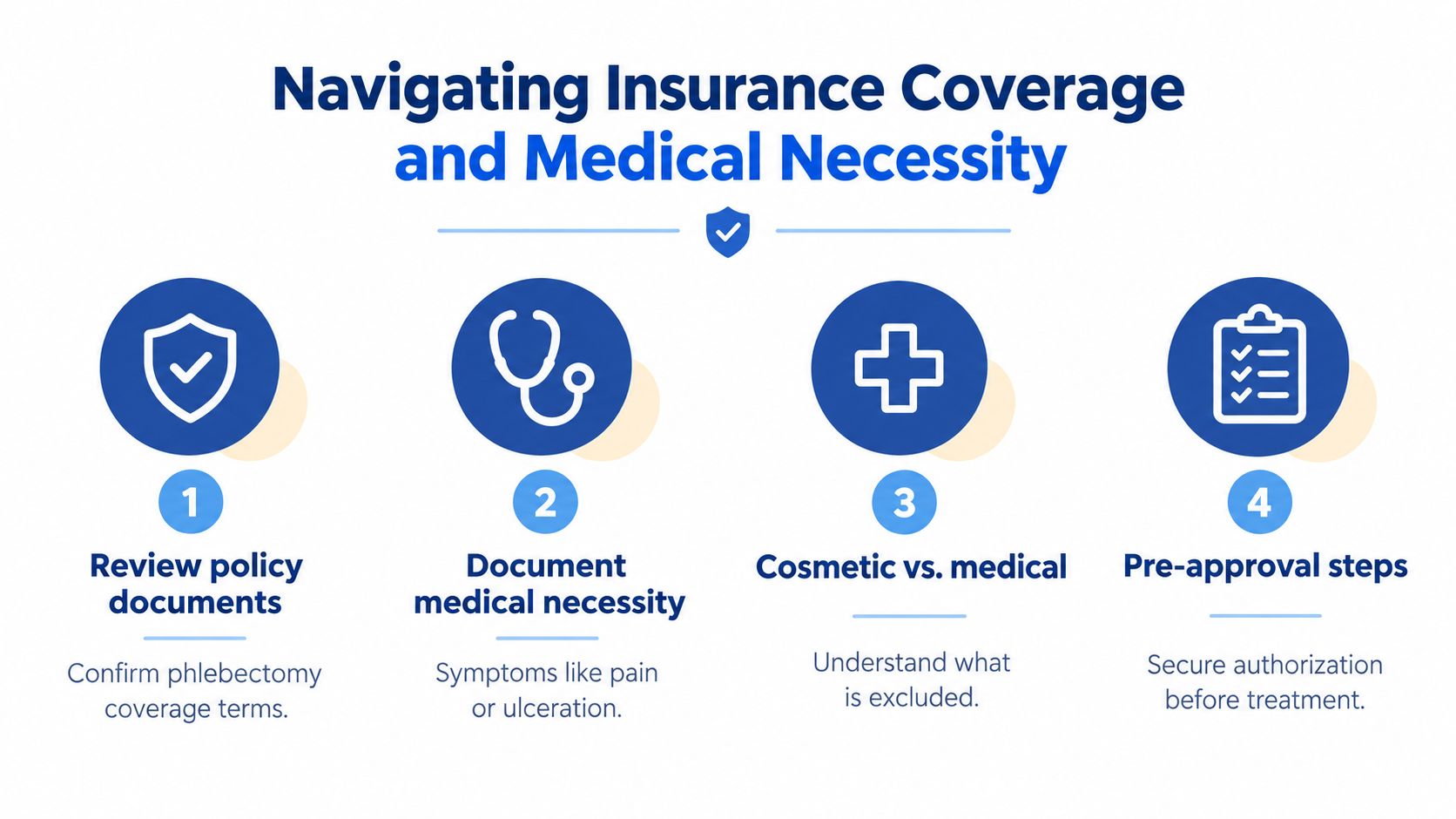
Insurance coverage usually turns on medical necessity, not the appearance of a vein or the procedure's name. A payer may distinguish between treatment for symptomatic venous disease and removal performed only for cosmetic reasons. Coverage rules can also vary by payer and local policy.
Document the clinical reason
CMS guidance states that connecting a procedure code to a diagnosis code isn't enough by itself. The diagnosis, documented suspicion, and supporting records must satisfy the applicable coverage determination. CMS billing guidance on linking diagnoses and procedures explains why the clinical record matters.
Your documentation may include:
- Symptoms: Pain, swelling, heaviness, or functional limitation.
- Skin findings: Skin changes, inflammation, or other signs of chronic venous disease.
- Ulcer history: A current or previous venous ulcer can affect the clinical rationale.
- Conservative care: Records of compression use or other treatment recommended by the payer.
- Examination findings: The clinician's description of the veins and related symptoms.
- Duplex results: Evidence of reflux or other venous pathology when required.
- Treatment relationship: An explanation of how tributary removal fits with treatment of the underlying venous problem.
A denied claim can shift responsibility to you, potentially leaving you with the full negotiated charge or self-pay amount. That's why preauthorization isn't a formality. It's a financial checkpoint.
Verify before scheduling
Call the insurer and the practice separately. Ask the insurer whether phlebectomy is covered for your diagnosis, whether prior authorization is required, what conservative-treatment records are needed, and how deductible and coinsurance apply. Ask the practice to confirm the planned codes, facility classification, network status, and whether associated ultrasound or reflux treatment will be billed independently.
Patients who need help organizing payment questions can review the insurance and financing information available through the practice. Still, the final responsibility for understanding your benefits belongs to you and your insurer. Get authorization details in writing whenever possible, and remember that authorization doesn't always guarantee the exact final payment.
The True Cost of Treating Only the Visible Veins
A lower upfront price isn't always the lower total cost. Ambulatory phlebectomy removes visible superficial veins, called tributaries, but those veins may be affected by reflux in a larger underlying vein. If the source of abnormal flow remains untreated, the initial improvement may not resolve the broader problem.
That doesn't mean every patient needs multiple procedures. It means the treatment plan should begin with an evaluation of the whole venous system. A clinician may recommend tributary removal alone, treatment of underlying reflux, staged care, or observation, depending on the examination and imaging.
Why the cheapest quote can be incomplete
Self-pay estimates for ambulatory phlebectomy commonly reach $2,000 to $4,000, while Medicare-allowed amounts for the defined one-leg, 10-to-20-incision procedure vary from roughly $467 to $3,470 depending on the setting. Cost information on varicose vein treatment highlights why these figures shouldn't be placed in the same comparison column without identifying the billing basis.
One figure may represent a cash package. Another may represent an insurer's allowed amount. A third may reflect only a facility fee or only the physician's service. Geography, treatment extent, unilateral versus bilateral care, imaging, consultation charges, and the handling of underlying reflux all affect the comparison.
Evaluate the plan, not just the visible result
Ask whether the recommended procedure addresses the veins causing symptoms and whether duplex findings support the plan. If a clinician recommends removing tributaries while leaving suspected axial reflux unaddressed, ask why that approach is appropriate for your anatomy and goals.
The financially responsible question isn't “What's the cheapest phlebectomy?” It's “What care plan is least likely to leave me paying twice for an incomplete solution?”
Recurrence, repeat procedures, and wound complications can add cost and inconvenience. Those outcomes aren't inevitable, but they're part of the reason a thorough assessment matters. The right comparison includes both the immediate charge and the possibility that untreated disease could require additional care later.
Calculating Your Total Episode of Care
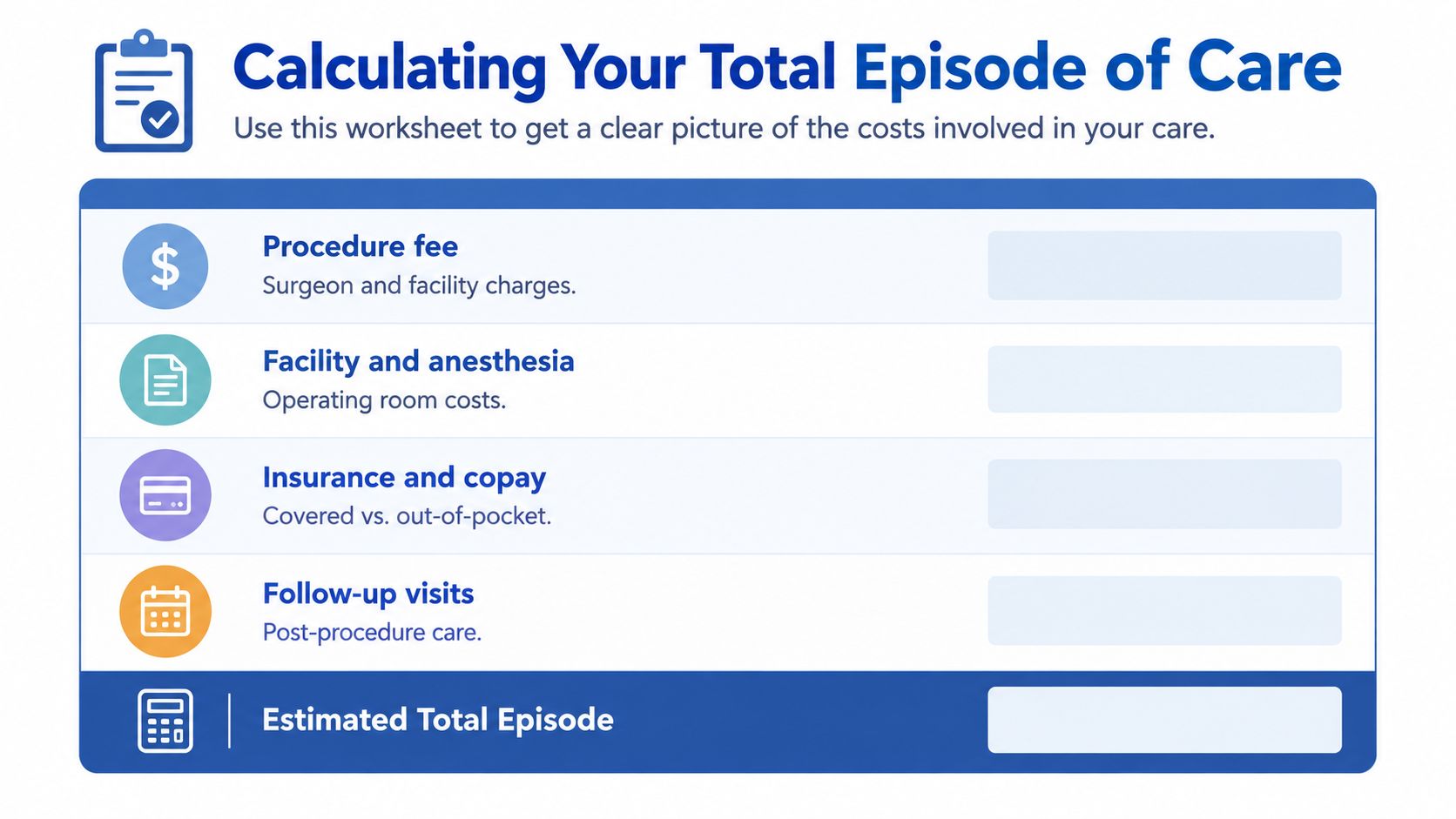
A Total Episode worksheet turns a confusing price range into a practical estimate. Instead of asking only for the ambulatory phlebectomy cost, list each service from evaluation through follow-up and mark whether insurance, a facility package, or self-pay pricing applies.
Use four cost questions
- Evaluation and diagnosis: Is the consultation included? Is duplex ultrasound needed, and who bills for it?
- Procedure and facility: What are the physician and facility fees? Is the estimate based on an office or hospital outpatient setting?
- Coverage and responsibility: What amount is allowed, what remains on the deductible, and what coinsurance applies?
- Recovery and follow-up: Are compression garments, return visits, wound checks, or additional treatment included?
Request a written estimate that distinguishes insurance billing from self-pay pricing. For insurance, ask for the planned codes, authorization status, network confirmation, and an estimate of your responsibility. For self-pay, ask whether the quoted price is bundled and what events would create additional charges.
Southern California patients can compare office-based care and hospital-based care using the same worksheet. Don't compare a physician-only quote with a hospital total. Match the same scope, the same number of extremities, the same diagnostic services, and the same follow-up expectations.
A careful estimate won't eliminate every billing uncertainty, but it can prevent the most common shock: discovering that the number discussed at consultation covered only one part of the care. Bring your insurance documents, ask for itemized answers, and delay scheduling until you understand the expected total.
Vein and Wound Institute evaluates venous disease with clinical examination and duplex ultrasound, offers ambulatory phlebectomy and other minimally invasive vein treatments, and coordinates care for chronic venous insufficiency and venous wounds. Visit Vein and Wound Institute to request an evaluation and discuss a treatment plan with clear insurance or self-pay cost questions.