You've just come home after a varicose vein procedure. Your leg feels tighter than expected, there's a strip of bruising along the treated vein, and you're wondering whether walking is helpful or whether you should stay on the sofa. That uncertainty is common. Varicose vein procedure recovery is usually measured in days for basic function, but healing sensations, bruising, swelling, and follow-up continue on a different timeline.
The most useful comparison isn't with the fastest recovery story you've read online. It's with the procedure you had and the demands of your daily life. A person working at a desk has different limits from someone standing all day, driving for work, lifting, caring for another person, or walking between job sites. The practical aim is to move early, protect healing tissue, recognize warning signs, and return to work without treating discomfort as proof that something has gone wrong.
Table of Contents
- What to Expect in the First 48 Hours After Varicose Vein Procedure Recovery
- How Recovery Time Varies by Procedure Type and Your Daily Routine
- Compression Therapy After Varicose Vein Procedure Recovery
- Activity Restrictions and Safe Movement After Vein Treatment
- Warning Signs, Complications, and When to Contact Your Vein Specialist
- Long-Term Recovery, Follow-Up, and Preventing Recurrence
What to Expect in the First 48 Hours After Varicose Vein Procedure Recovery
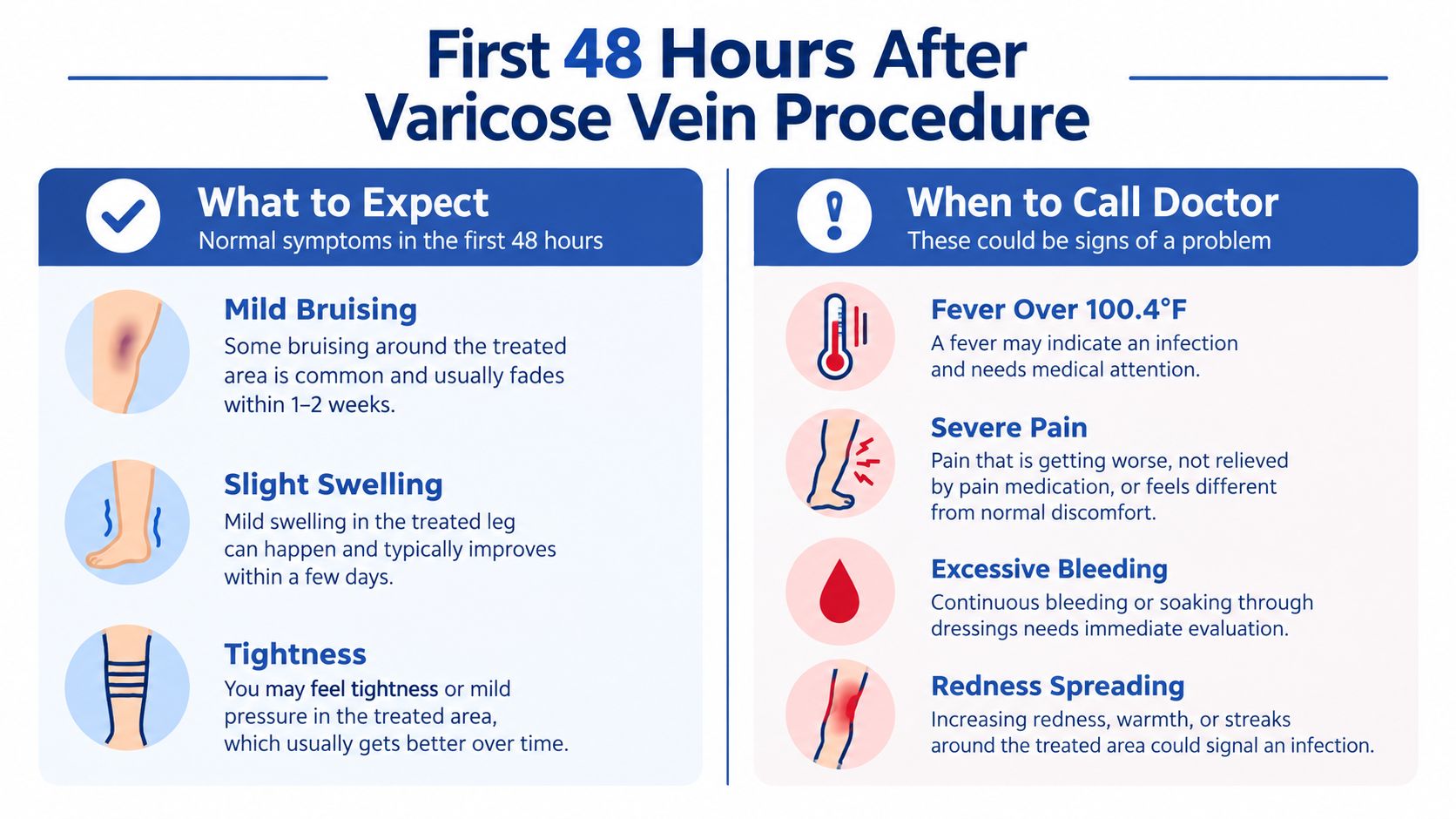
By the time you get home, the procedure itself is over, but the leg often feels more noticeable than it did in the clinic. As the local anaesthetic wears off, a treated vein can feel tight, bruised, tender, or oddly firm. That is a common early pattern after minimally invasive treatment. The details still depend on what you had done, how many veins were treated, and whether your day-to-day routine involves mostly sitting, standing, lifting, or caring for someone else.
For the first 48 hours, the goal is simple. Keep blood moving, protect the treated area, and avoid turning a normal sore leg into an overworked one.
Walking usually starts the same day. Short walks around the house are usually better than staying still for long stretches, and they are more realistic than trying to prove you are "back to normal" by the evening. If your work normally keeps you on your feet all day, this is the point where many patients misjudge recovery. Being able to walk to the kitchen is not the same as being ready for a full shift standing, driving between visits, or carrying equipment.
Rest helps too, but rest means pacing, not bed rest. Put the leg up when throbbing or swelling builds, then get up again for another brief walk. Skip heavy lifting, hard exercise, and long periods of standing while the area is still settling. That trade-off matters more in the first two days than pushing for an early milestone.
Compression should feel snug and supportive. It should not pinch, bunch, or create a tight rolled band at the top or behind the knee. Check that the fabric lies flat. Keep dressings and tiny puncture sites clean and dry exactly as advised by your clinic, and leave adhesive strips alone unless you were told to remove them. In this window, mild bruising, slight swelling, local tenderness, and a pulling or cord-like feeling can all be part of normal healing. The leg can look worse before it looks better.
A simple rhythm for the first two days
- Move regularly: Take brief walks instead of staying seated for long blocks of time.
- Rest deliberately: Raise the leg when swelling, heaviness, or throbbing increases.
- Check the leg calmly: Watch for changes in pain, swelling, drainage, skin colour, or sensation without examining it every hour.
- Stick to the plan: Use only the pain relief, stockings, and dressings your clinician advised.
If practical support will be limited at home, especially after treatment on both legs or if your normal routine includes childcare, shopping, or stairs, it helps to plan ahead. Guidance on arranging home care post-operation can help with transport, washing, meals, and basic support during the first few days.
| Symptom | Typical after recovery | When to call the clinic |
|---|---|---|
| Bruising | Mild discoloration along treatment or puncture sites | Rapidly expanding bruising or bleeding that won't settle |
| Tightness | A pulling or cord-like feeling along the treated vein | Severe or escalating pain despite the advised plan |
| Swelling | Slight, localized swelling that improves with movement and rest | Marked or rapidly increasing swelling, especially in one leg |
| Tenderness | Mild soreness when walking or touching the area | Pain that steadily worsens instead of easing |
| Breathing or neurological symptoms | Not expected | Shortness of breath, chest symptoms, faintness, or new neurological changes require urgent evaluation |
A NICE evidence review found that patients commonly returned to usual activities in about 3 to 5 days after mechanochemical or radiofrequency ablation. In practice, that is useful for setting expectations, not for judging yourself against the fastest recovery story online. Many patients can function early, but bruising, tenderness, and swelling often outlast that first return to routine.
How Recovery Time Varies by Procedure Type and Your Daily Routine
A same-day walk and a full workday aren't the same achievement. Endovenous laser ablation and radiofrequency ablation usually allow early movement, while mechanochemical ablation and foam sclerotherapy can also support a prompt return to routine activity. Ambulatory phlebectomy adds small skin entry points and may leave more local bruising, particularly where visible tributaries were removed. Surgical stripping generally creates a larger recovery burden than these minimally invasive approaches.
The evidence doesn't support promising every patient a universal return to work in one or two days. One randomized comparison reported median return to normal activity of 1 day after radiofrequency ablation and foam sclerotherapy, 2 days after endovenous laser ablation, and 4 days after surgical stripping. Median time off work was 2.9, 2.9, 3.6, and 4.3 days, respectively, for those procedures British Journal of Surgery study. Earlier randomized evidence found a wider difference between endovenous laser treatment and surgery, with median return to normal activity of 2 versus 7 days and return to work of 4 versus 17 days, which shows why procedure-specific counseling matters.
| Procedure | Normal activity | Time off work |
|---|---|---|
| Radiofrequency ablation | Median 1 day | Median 2.9 days |
| Foam sclerotherapy | Median 1 day | Median 2.9 days |
| Endovenous laser ablation | Median 2 days | Median 3.6 days |
| Surgical stripping | Median 4 days | Median 4.3 days |
Match the plan to the job
For desk work, the main challenge is avoiding uninterrupted sitting. Build in short walks, change position, and don't treat the ability to answer emails as proof that the leg is ready for every normal demand.
A standing job can be harder than a sedentary one even when the procedure itself was uncomplicated. Prolonged standing may increase throbbing or swelling, so ask whether you can alternate sitting and walking during the first part of your return. Driving requires more than feeling comfortable. You need reliable control of the pedals, no sedating medication, and the ability to react without hesitation.
Lifting, caregiving, and walking-intensive work require an individualized progression. A person who carries equipment or supports patients may need more time than someone who walks gently around an office. Don't compare vein recovery with an unrelated injury timeline. For broader context on how recovery plans change with the injury and the person's demands, The Patients Guide on fracture recovery offers a useful example of why one timetable rarely fits everyone.
Patients with edema, obesity, diabetes, active wounds, chronic venous insufficiency, or limited mobility may not resemble participants in a trial. If a visible vein remains after the main reflux treatment, that doesn't automatically mean the procedure failed. At reassessment, residual tributaries may be considered for staged treatment, including ambulatory phlebectomy, when clinically appropriate.
Compression Therapy After Varicose Vein Procedure Recovery
Compression is helpful for some patients, but it isn't a universal instruction with one scientifically settled schedule. A contemporary review supports providing graduated stockings immediately after procedural treatment to reduce early pain, edema, and phlebitis, while NICE states that the benefit after intervention remains unclear and recommends that compression, when used, not exceed 7 days NICE varicose-vein guidance. Those recommendations explain why your own clinician may give advice that differs from a friend's or an online checklist.
Make the stocking work for you
Put the stocking on as directed, usually before swelling builds. Turn it partly inside out, position the heel carefully, then smooth the fabric upward rather than pulling hard at the top. A stocking that's loose, folded, or damaged won't distribute pressure properly and may irritate the skin.
Protect puncture sites from friction and inspect the toes and foot. Compression should not cause numbness, blue or pale discoloration, worsening pain, coldness, or skin injury. Difficulty applying the garment can be clinically relevant, particularly if you have limited hand strength, neuropathy, arterial circulation concerns, lymphedema, or an active wound.
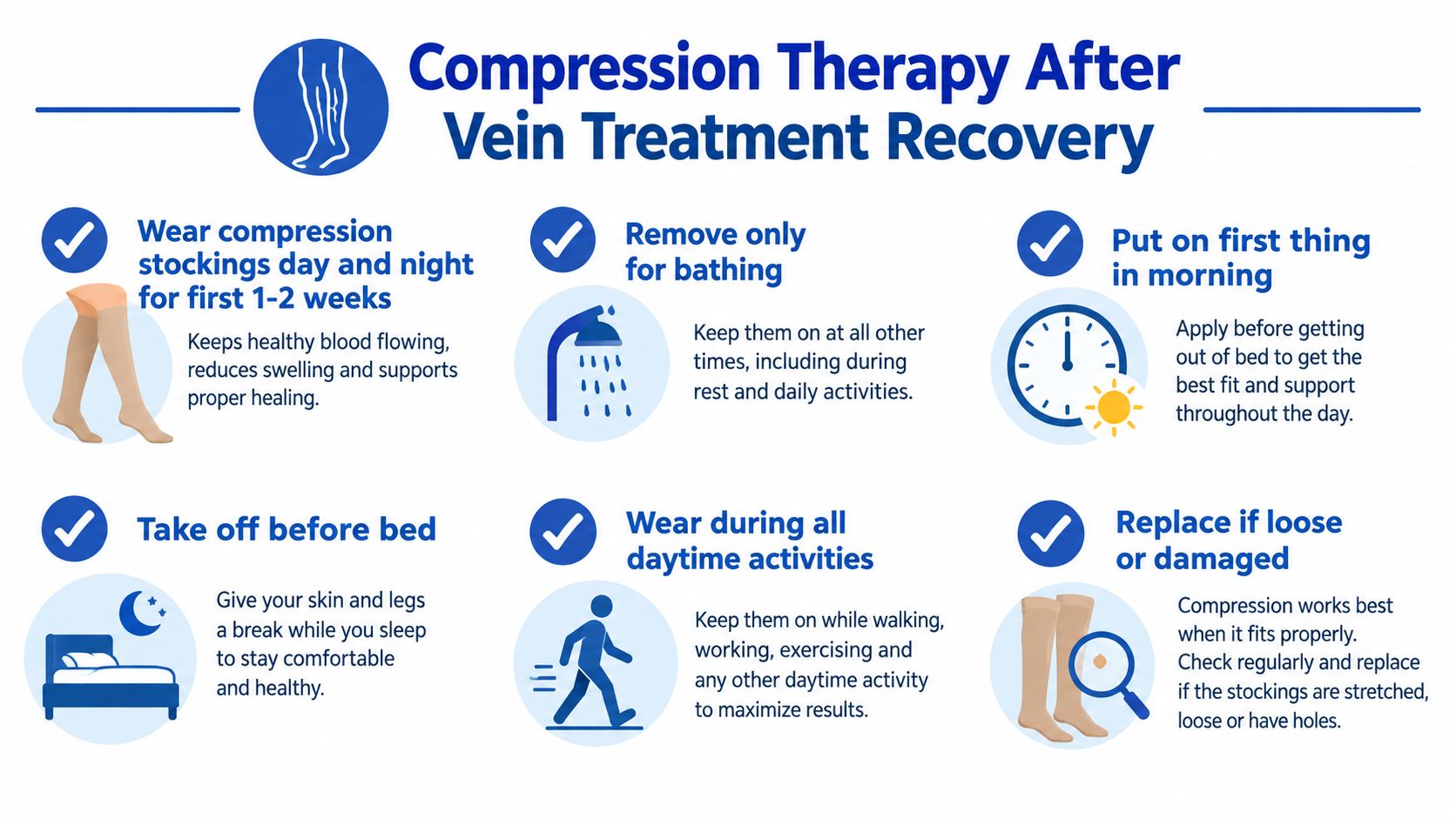
Compression can reduce early discomfort, but it doesn't eliminate venous reflux or guarantee that varicose veins won't recur. Before continuing a difficult or painful garment, ask whether you need a fit review or vascular assessment. Practical advice on compression therapy for varicose veins can help you understand garment selection and safe use, but your treating clinician should set the plan after examining your circulation and treatment sites.
The balanced approach is neither “wear it indefinitely” nor “avoid it completely.” Use the pressure level, duration, and daytime schedule your clinician recommends, and report symptoms that suggest the garment is causing harm rather than support.
Activity Restrictions and Safe Movement After Vein Treatment
You feel decent the morning after treatment, so it is tempting to catch up on errands, housework, or a full shift on your feet. That is where patients often overdo it. Recovery usually goes better when activity matches both the procedure you had and the kind of work you need to return to.
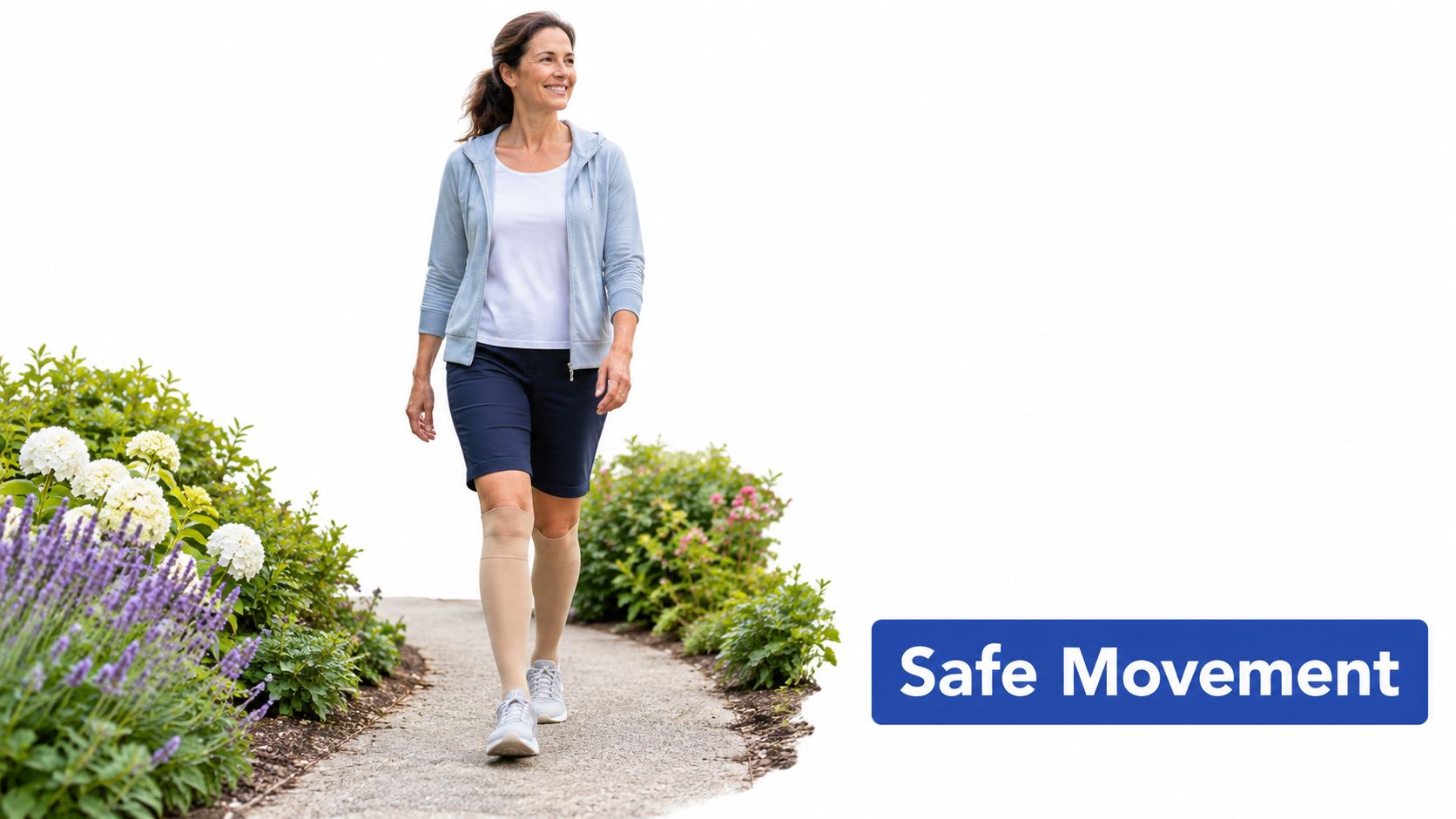
Walking is still the best place to start. Keep the first walks short, flat, and comfortable. Repeat them through the day instead of testing the leg with one long outing. If the leg settles afterward, build up gradually. If you get more tightness, throbbing, or swelling later in the day, scale back the next session and try again.
A desk worker can often resume light routine sooner than someone who lifts, climbs, squats, or stands for hours. Office work is easier if you can get up regularly. Retail, warehouse, childcare, hospitality, and clinical work usually place more load on a healing leg, even when the incisions are small. Procedure type matters too. After less invasive vein treatment, people often move comfortably quite early, but tenderness, bruising, and pulling sensations can still limit pace and stamina for a while.
Use a simple progression:
- Early movement: Walk around the home and change position often.
- Routine walking: Add short outdoor walks if soreness stays manageable.
- Light daily activity: Resume errands or desk work when you can move regularly without a symptom flare.
- Higher-load activity: Return to running, heavy lifting, intense leg exercise, and long periods of standing after your clinician says the leg is ready.
Avoid staying still for long stretches at work or during travel. If you have to sit, flex the ankle, stand up at intervals, and walk when you can. Driving is reasonable only when you are fully alert and can brake safely without hesitation.
A technically successful procedure does not mean the leg feels normal right away. Vein closure can be successful while bruising, tenderness, cord-like tightness, and fatigue with activity are still present for a time. Follow symptoms, not online recovery stories.
Warning Signs, Complications, and When to Contact Your Vein Specialist
Most post-procedure discomfort is mild and local, but a worsening pattern deserves attention. Call your clinic for pain that escalates, swelling that becomes marked, spreading redness, drainage, fever, persistent numbness, or a skin change that concerns you. Heavy bleeding from a puncture site also warrants prompt advice.
Seek urgent evaluation for shortness of breath, chest symptoms, faintness, sudden neurological changes, or significant one-sided leg swelling and pain. Don't wait for a scheduled appointment when symptoms suggest a clot or another acute complication.
Practical rule: Improving function with stable or easing symptoms is reassuring. Declining function with increasing pain, swelling, or systemic symptoms is a reason to call.
Routine early duplex ultrasound isn't recommended for every asymptomatic, average-risk patient after thermal ablation. The Society for Vascular Surgery and American Venous Forum guidance supports a minimum 3-month follow-up to assess symptoms, residual veins, complications, and interval healing, while urgent symptoms should be assessed sooner SVS and AVF guidance.
For a skin concern, don't try to diagnose infection from a photograph alone. Guidance on signs of wound infection and when to seek medical attention may help you recognize concerning changes, but a clinician should assess persistent or spreading findings.
Long-Term Recovery, Follow-Up, and Preventing Recurrence
Recovery isn't complete just because you can work again. At follow-up, your clinician may review symptoms, examine remaining tributaries, and use duplex ultrasound when indicated to assess reflux or closure. Persistent visible veins can sometimes be managed later with ambulatory phlebectomy or ultrasound-guided sclerotherapy rather than being judged as an immediate treatment failure.
Long-term success means your leg functions better, symptoms stay controlled, and you know what to do if swelling, heaviness, aching, or new veins return. Keep walking regularly, avoid long uninterrupted periods of sitting or standing, and use individualized compression when it's indicated. Compression supports symptom management, but it doesn't replace treatment of underlying reflux.
Recurrence remains possible even after a successful procedure. Conventional great-saphenous-vein ligation and stripping historically had a reported 5-year clinical recurrence rate of 20% to 28%, while a Cochrane review found no clear difference in recurrence between radiofrequency ablation and endovenous laser treatment at 3 years, based on 291 participants and low-certainty evidence Cochrane review of varicose-vein procedures. Those findings support monitoring rather than assuming permanent immunity from new reflux or varicosities.
Be cautious with supplements marketed for recovery. If you're considering products such as systemic enzymes, discuss interactions and appropriateness with your clinician rather than adding them automatically. A general systemic enzymes guide can provide background, but it shouldn't replace a medication review or a venous follow-up plan.
Vein and Wound Institute evaluates venous disease with clinical examination and duplex ultrasound, and provides image-guided treatments alongside structured post-procedure follow-up. If you're in Southern California and want a recovery plan matched to your procedure, symptoms, and work demands, visit Vein and Wound Institute to arrange an evaluation.