
The EVLA treatment cost usually lands between $1,000 and $3,131, but the out-of-pocket figure can be much lower or much higher depending on how the procedure is classified. If it's medically necessary and covered, some patients see responsibility as low as $373. If it's treated as cosmetic, the cash price can run $2,000 to $3,500.
That spread is why so many people feel stuck after a vein consultation. You're told you need treatment, but the quote, the insurance estimate, and the internet price range don't seem to describe the same procedure. The difference usually isn't the laser itself, it's the billing category, the place where the procedure happens, and whether your plan pays for reflux treatment or treats it like an elective service.
Table of Contents
- Why EVLA Pricing Feels Confusing
- Understanding EVLA Treatment Cost Breakdown
- How EVLA Compares to Other Vein Treatments
- Factors That Determine Your Personal EVLA Cost
- Insurance Coverage and Financing Options
- The Value Behind EVLA Treatment Cost
Why EVLA Pricing Feels Confusing
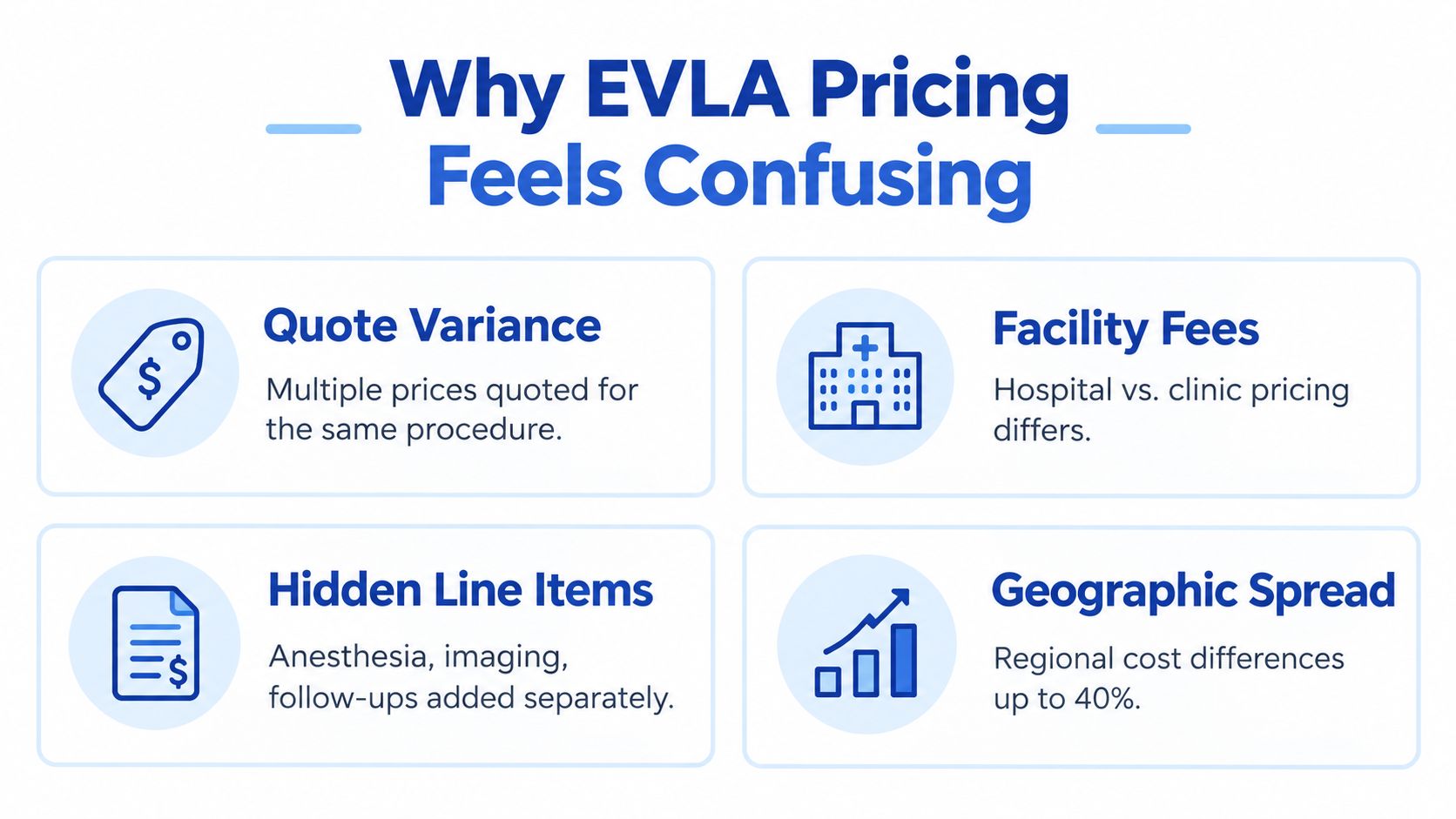
You finally get a diagnosis, then the billing quote lands and it makes little sense. One patient hears a number close to $1,000, another gets a quote near $3,000, and a third sees a completely different insurer estimate for what sounds like the same vein procedure. That confusion is normal, because the label on the bill often matters as much as the treatment itself.
The bill follows the classification
If a vein is causing pain, swelling, skin changes, or reflux on ultrasound, the procedure may be billed as medically necessary. If the same technology is used to treat veins that are mainly a cosmetic concern, the patient usually pays cash. That single distinction changes everything, because insurers don't price care the same way as self-pay clinics.
Practical rule: don't ask only, “What does EVLA cost?” Ask, “How will this be classified on the claim?”
The facility changes the quote
A procedure performed in a hospital outpatient setting is priced differently from one done in an office-based clinic. The difference isn't just overhead, it also reflects how the facility charges are bundled and how payers reimburse the site of service. A patient looking only at the procedure name can miss the largest cost driver of all.
That's why a quote from one setting can't be compared directly with a quote from another. The technology is similar, but the billing path is not.
The estimate rarely includes everything you'll pay
A clean-looking headline price sometimes leaves out imaging, follow-up, or additional vein work. In practice, vein care often involves a diagnosis visit, duplex ultrasound, the ablation itself, and sometimes adjunctive treatment later. A quote that looks simple on paper can become more expensive once those items are added.
If you're reviewing a consult note, the most useful question is this, what's included, what's separate, and what would trigger a second charge? That question usually tells you more than the headline number.
Understanding EVLA Treatment Cost Breakdown
The current market gives you a broad baseline, not a single standard price. A consumer price guide reported a U.S. national average of $3,131 for endovenous ablation, while listing EVLA itself at about $1,000 to $3,000 per treatment (GoodRx cost guide). That range is wide, but it matches what patients see in real billing conversations.
What the numbers actually mean
Insurance changes the picture fast. The same guide reported a 2026 Medicare-based patient-pay amount of $373 for outpatient procedure code 36475, which shows how much coverage and site of service can affect the final bill (GoodRx cost guide). Those numbers aren't interchangeable. One reflects self-pay market pricing, the other reflects a payer framework with different rules.
Older Medicare data show the same pattern. In January 2005, endovenous ablation of an incompetent vein averaged about $2,100 in the office setting versus roughly $370 in the hospital setting, with second-and-subsequent vein treatment averaging about $440 in office and $180 in hospital (GoodRx cost guide). The therapy didn't change, but the setting did.
Bottom line: the same EVLA treatment can look expensive, moderate, or surprisingly affordable depending on who pays and where it's billed.
A realistic benchmark for 2026
Recent U.S. price guides cluster EVLA around $1,900 to $2,200, which suggests a fragmented but fairly stable market rather than one universal cash rate (Auctus Group Consulting coverage guide). In practice, that means patients should treat any single quote as a local price, not a national rule.
For a fuller walkthrough of the treatment pathway itself, the most useful companion is the whole treatment process explained. Knowing the sequence helps you see where charges are likely to appear.
How EVLA Compares to Other Vein Treatments
Price comparisons only make sense when you compare the full treatment path, not just the device or the day of the procedure. A peer-reviewed cost-analysis found the expected 8-week total treatment cost for stand-alone EVLA was $1,827, compared with $2,106 for radiofrequency ablation, $2,165 for polidocanol injectable foam, and $2,374 for surgery (PMC economic analysis). That makes EVLA one of the more cost-efficient options in the short term.
Why the total matters more than the line item
The laser itself is only part of the story. Office-based, minimally invasive treatment tends to shift spending away from operating room time and recovery burden, which is why the total cost can come out lower than surgery even if the procedure feels technical and high-value. The economics are driven by lower downstream utilization, not by hardware alone.
A separate health-economic study found that compared with surgery at 6 months, EVLA reduced mean health-service costs by £160, and by £392 when theatre overhead was included. That's a useful reminder that the “cheaper” option isn't always the cheapest on the day of treatment, it's often the one that avoids more expensive setting costs.
The value case changes when recovery is included
Over 5 years, EVLA was estimated to cost about £3,640 per quality-adjusted life-year gained versus ultrasound-guided foam sclerotherapy, while also generating a cost saving of £206 to £439 and a QALY gain of 0.078 versus surgery. Those figures don't tell every patient what to choose, but they do show why a minimally invasive approach can look favorable once time, recovery, and recurrence are part of the equation.
If you're comparing procedures, which treatment for varicose veins is best for you should be the question, not just which one has the lowest sticker price.
Factors That Determine Your Personal EVLA Cost
The most important driver is whether your procedure is treated as medically necessary or cosmetic. Independent coverage guidance says medically necessary endovenous ablation bills to insurance at roughly $1,417 to $1,567 per leg in one cited example, while the same ablation done cosmetically can run about $2,000 to $3,500 cash (coverage guidance). That gap is why two patients with the same technology can leave with very different bills.
The classification question comes first
If your ultrasound shows reflux and your symptoms are documented, the claim may move into the medical bucket. If the veins are being treated for appearance alone, insurance usually won't help. That's why the same office may give you one estimate before the ultrasound and another after it.
Other cost drivers still matter
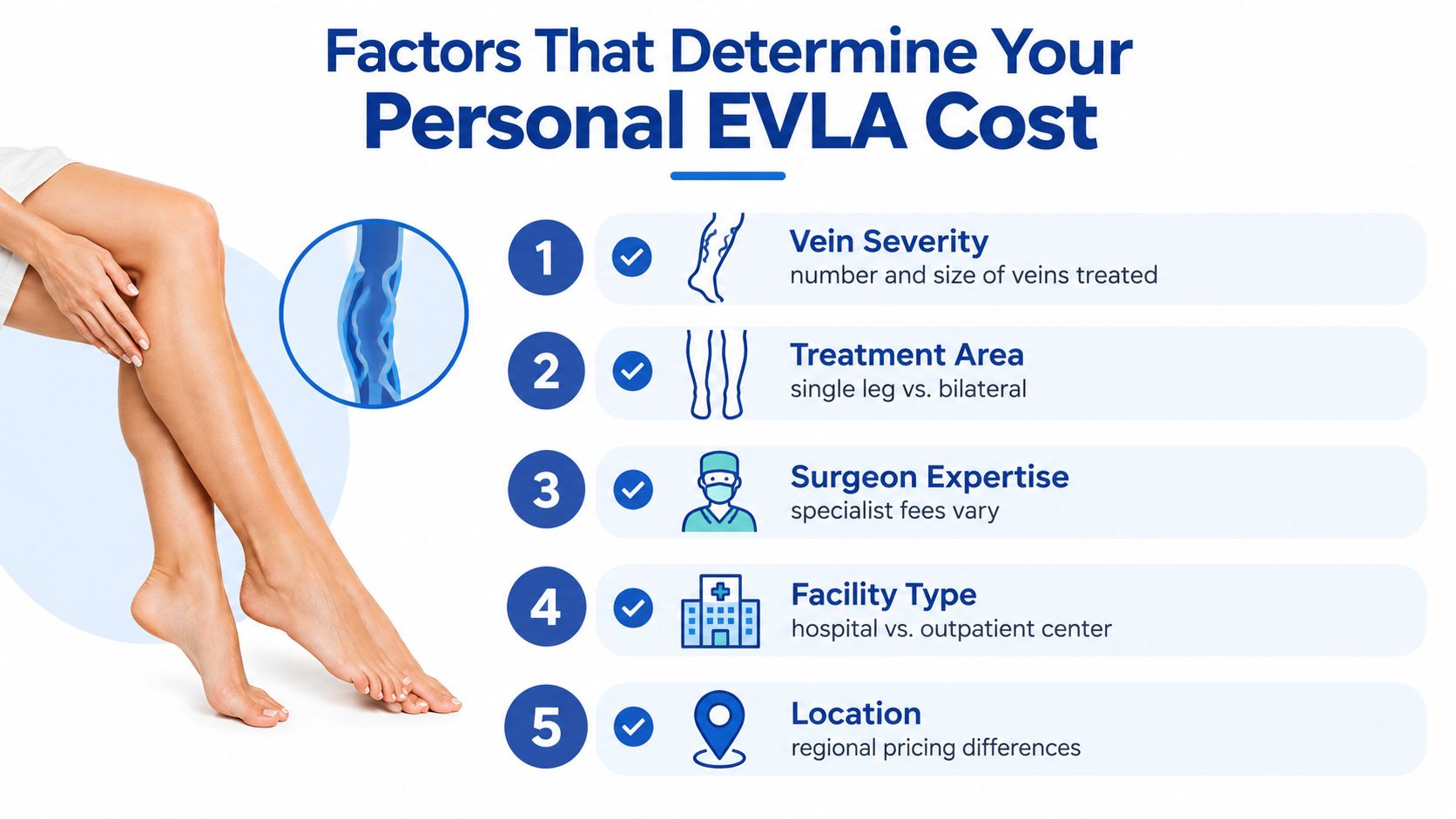
Even after classification, the final number can shift based on the treating physician's experience, the clinic's location, whether duplex ultrasound is included, and whether you need extra work such as ambulatory phlebectomy or foam sclerotherapy in the same treatment course. A patient with one refluxing vein and a simple plan won't pay the same as someone who needs staged treatment across both legs.
Practical rule: ask whether the quote includes imaging, procedure time, follow-up, and any likely add-on vein treatment before you accept it.
A checklist for the consult room
- Vein severity: Ask how many veins are being treated and whether the reflux is isolated or widespread.
- Treatment area: Confirm whether the quote is for one leg or both, because that changes planning.
- Facility type: Ask if the procedure is billed as office-based care or facility-based care.
- Extra procedures: Find out whether phlebectomy or sclerotherapy would be separate charges.
- Documentation: Ask what the clinic needs to support medical necessity if you're hoping for coverage.
The key is to leave the consult with a written estimate that matches your diagnosis, not a generic “from” price. If your provider can't explain the billing logic, the quote isn't ready yet.
Insurance Coverage and Financing Options
Insurance coverage usually depends on documentation, not just symptoms. If your chart shows leg heaviness, swelling, pain, skin changes, or ulcers, and duplex ultrasound confirms reflux or obstruction, the procedure is more likely to be treated as medically necessary. If the concern is cosmetic, coverage usually doesn't apply.

How billing gets approved
Most plans want the diagnosis established before they approve the procedure. In practical terms, that means the clinic needs ultrasound evidence and a documented symptom history, not just visible veins. Prior authorization rules vary by plan, so the safest move is to verify benefits before scheduling.
Patients often compare this process with other elective medical services. A useful parallel is your guide to LASIK coverage and discounts, because both services can shift between insurance-covered care and self-pay care depending on how the insurer classifies the procedure.
What to do if you're paying out of pocket
If insurance won't cover your treatment, ask for a line-item estimate and ask whether the clinic offers bundled pricing. That matters because a cosmetic cash quote can look lower at first and then grow once follow-up visits or adjunctive vein work are added. Patients who ask for the full treatment plan up front usually get a cleaner number.
You can also ask whether your benefits, HSA, or other pre-tax medical funds apply to any part of the visit. The key is transparency before the first charge posts, not after.
For more planning detail, see insurance and financing guidance. It's the right place to compare coverage language with real billing expectations before you commit.
The Value Behind EVLA Treatment Cost
A low quote doesn't always mean good value, and a high quote doesn't always mean overpricing. In vein care, value comes from treating the reflux source, reducing symptoms, and avoiding repeated short-term fixes. That's why EVLA often makes financial sense even when the initial price isn't the lowest number on the page.
The economics support the clinical logic
In the health-economic study cited earlier, EVLA reduced mean health-service costs by £160 versus surgery at 6 months, and by £392 when theatre overhead was included. Over 5 years, it also produced a QALY gain of 0.078 versus surgery while generating a cost saving of £206 to £439. Those findings support a simple clinical point, treating symptomatic reflux early can be financially smarter than waiting until symptoms or skin changes push care into a more expensive lane.
The real savings come from what patients avoid
When EVLA closes the faulty trunk vein, patients often avoid the cycle of short-lived surface treatment without addressing the source problem. That doesn't mean every patient needs the same intervention, but it does mean the right procedure can lower repeat visits, reduce downtime, and simplify follow-up. Those are real costs, even if they don't always show up on the first invoice.
A good EVLA quote should help you understand not just what you pay today, but what you're likely to spend if the vein disease is left to progress.
What to remember before you decide
If your treatment is medically necessary, the price may be far lower than the cosmetic cash market suggests. If it's cosmetic, ask what the quote includes and whether the clinic can separate necessary treatment from optional appearance-based work. Either way, the best decision comes from comparing the full care plan, not the laser fee alone.
At Vein and Wound Institute, we evaluate venous disease with onsite diagnostics, explain whether EVLA is medically necessary or cosmetic, and help patients understand the billing path before treatment starts. If you're trying to make sense of your own EVLA treatment cost, visit Vein and Wound Institute to review your options and get a clearer picture of what care may cost.